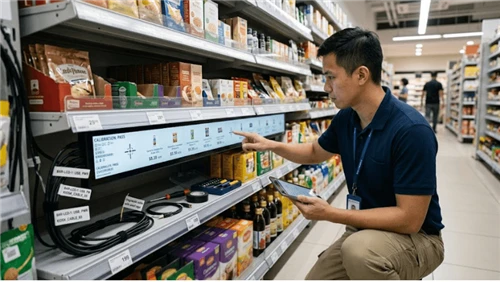
Kiosk Screen Size and Mounting Height: Design for Reach, Sightlines, and Accessibility is not a question that can be answered by one brochure value. For kiosk designers, architects, accessibility teams, product managers, and procurement teams, the real decision is how to select screen size and physical placement so users can see, reach, understand, and complete the task in the real site. A reliable project therefore starts with the operating task, records the installed conditions, and converts every important claim into evidence that can be reviewed before rollout.
This guide uses a user-envelope method that connects screen dimensions, orientation, tilt, touch targets, reach, sightlines, mobility devices, standing users, privacy, glare, and local accessibility review. It does not assume that a particular product, architecture, certification, return, or performance level applies to every project. Published specifications should be tied to the exact model and configuration, while legal, safety, accessibility, payment, and cybersecurity obligations should be reviewed by qualified parties for the relevant market.

The recommended output is a decision package: scope, requirements, drawings or data maps, test method, expected result, captured evidence, defect ownership, recovery procedure, and the conditions that require retesting. That package gives procurement, engineering, content, operations, and suppliers a common basis for approval instead of relying on subjective impressions.
Define the design job
For kiosk screen mounting height, this stage should produce a reviewable output rather than an informal agreement. The team should connect the requirement to the intended user, operating condition, owner, and acceptance evidence.
Define the user population and task
This requirement should be decided before hardware is ordered. Define the user population and task. This matters because a kiosk can look operational while a scanner, printer, payment device, touch zone, or backend dependency has already failed. The project should identify who will use the kiosk, what they carry, how long the task takes, whether assistance is available, and which users may be excluded, and retain the most relevant parts of user-flow tests, peripheral logs, remote alerts, thermal records, accessibility reviews, transaction traces, and signed acceptance results as evidence. For a project team, this changes the decision: test the requirement under standing adults, seated users, wheelchair users, children where intended, and users with limited reach or vision, name the owner who accepts or escalates exceptions, and state whether the conclusion applies only to the tested configuration. Supplier documentation can define a starting boundary, but local validation is still required.
Teams that need the broader product context can review the self-service terminal solution before locking this requirement.
Set measurable acceptance criteria for the user population and task
This is a system question rather than a single-component feature. Set measurable acceptance criteria for the user population and task. This matters because a kiosk can look operational while a scanner, printer, payment device, touch zone, or backend dependency has already failed. The project should capture personas, task maps, accessibility review, and observed user needs and compare it with an approved baseline, and retain the most relevant parts of user-flow tests, peripheral logs, remote alerts, thermal records, accessibility reviews, transaction traces, and signed acceptance results as evidence. In a pilot, the difference becomes obvious: test the requirement under a representative pilot, worst-case content, and normal operating hours, name the owner who accepts or escalates exceptions, and state whether the conclusion applies only to the tested configuration. Supplier documentation can define a starting boundary, but local validation is still required.
Assign ownership and an exception path for the user population and task
The specification only becomes useful when it is tied to a real operating condition. Assign ownership and an exception path for the user population and task. This matters because a kiosk can look operational while a scanner, printer, payment device, touch zone, or backend dependency has already failed. The project should record who reviews failures, who authorizes changes, and how the result is retested, and retain the most relevant parts of user-flow tests, peripheral logs, remote alerts, thermal records, accessibility reviews, transaction traces, and signed acceptance results as evidence. Operations should translate the requirement into a repeatable check: test the requirement under handover, store changes, software releases, and supplier substitutions, name the owner who accepts or escalates exceptions, and state whether the conclusion applies only to the tested configuration. Supplier documentation can define a starting boundary, but local validation is still required.
This checkpoint should be read alongside the site's guidance on kiosk display product range, because adjacent decisions can change the result.
Translate the job into measurable requirements
For kiosk screen mounting height, this stage should produce a reviewable output rather than an informal agreement. The team should connect the requirement to the intended user, operating condition, owner, and acceptance evidence.
Define screen size from information and touch needs
A strong design separates the intended outcome from the method used to achieve it. Define screen size from information and touch needs. This matters because a kiosk can look operational while a scanner, printer, payment device, touch zone, or backend dependency has already failed. The project should choose diagonal, aspect ratio, resolution, and orientation based on content density, target size, keyboard use, media, and viewing distance, and retain the most relevant parts of user-flow tests, peripheral logs, remote alerts, thermal records, accessibility reviews, transaction traces, and signed acceptance results as evidence. For a project team, this changes the decision: test the requirement under simple check-in, long forms, product browsing, maps, payment, and document review, name the owner who accepts or escalates exceptions, and state whether the conclusion applies only to the tested configuration. Supplier documentation can define a starting boundary, but local validation is still required.
For related implementation context, use the Android smart service touchscreen display resource as a starting point and verify the local configuration.
Set measurable acceptance criteria for screen size from information and touch needs
The most common mistake is to approve the visible result without testing the process behind it. Set measurable acceptance criteria for screen size from information and touch needs. This matters because a kiosk can look operational while a scanner, printer, payment device, touch zone, or backend dependency has already failed. The project should capture wireframes, native-resolution prototypes, and task-completion tests and compare it with an approved baseline, and retain the most relevant parts of user-flow tests, peripheral logs, remote alerts, thermal records, accessibility reviews, transaction traces, and signed acceptance results as evidence. In a pilot, the difference becomes obvious: test the requirement under a representative pilot, worst-case content, and normal operating hours, name the owner who accepts or escalates exceptions, and state whether the conclusion applies only to the tested configuration. Supplier documentation can define a starting boundary, but local validation is still required.
Assign ownership and an exception path for screen size from information and touch needs
The buyer should define both the supported condition and the condition that triggers redesign. Assign ownership and an exception path for screen size from information and touch needs. This matters because a kiosk can look operational while a scanner, printer, payment device, touch zone, or backend dependency has already failed. The project should record who reviews failures, who authorizes changes, and how the result is retested, and retain the most relevant parts of user-flow tests, peripheral logs, remote alerts, thermal records, accessibility reviews, transaction traces, and signed acceptance results as evidence. Operations should translate the requirement into a repeatable check: test the requirement under handover, store changes, software releases, and supplier substitutions, name the owner who accepts or escalates exceptions, and state whether the conclusion applies only to the tested configuration. Supplier documentation can define a starting boundary, but local validation is still required.
The next linked decision is covered in self-service ticketing interactive kiosk; keep the boundaries separate so one article does not substitute for a project test.
Kiosk Screen Mounting Height Decision Table
The table below turns the topic into a compact review structure. Add project-specific limits, test tools, owners, and approval signatures before using it as an acceptance record.
| Design variable | Question | Validation |
|---|---|---|
| Screen size | Can users read and touch without crowding? | Full-scale task prototype |
| Mounting height | Are key controls reachable? | Standing and seated reach test |
| Tilt and angle | Is content visible without glare? | Installed multi-user viewing test |
| Clear floor space | Can users approach and operate? | Site measurement |
| Alternative path | Can excluded users complete the service? | Fallback demonstration |
Build the content or physical design
For kiosk screen mounting height, this stage should produce a reviewable output rather than an informal agreement. The team should connect the requirement to the intended user, operating condition, owner, and acceptance evidence.
Define mounting height, tilt, and reach envelope
This requirement should be decided before hardware is ordered. Define mounting height, tilt, and reach envelope. This matters because a kiosk can look operational while a scanner, printer, payment device, touch zone, or backend dependency has already failed. The project should position interactive controls and critical information within the intended user envelope while accounting for enclosure depth and approach clearance, and retain the most relevant parts of user-flow tests, peripheral logs, remote alerts, thermal records, accessibility reviews, transaction traces, and signed acceptance results as evidence. For a project team, this changes the decision: test the requirement under standing and seated use, mobility devices, bags, queues, and fixed floor or wall mounting, name the owner who accepts or escalates exceptions, and state whether the conclusion applies only to the tested configuration. Supplier documentation can define a starting boundary, but local validation is still required.
Teams that need the broader product context can review the car wash payment kiosk display before locking this requirement.
Set measurable acceptance criteria for mounting height, tilt, and reach envelope
This is a system question rather than a single-component feature. Set measurable acceptance criteria for mounting height, tilt, and reach envelope. This matters because a kiosk can look operational while a scanner, printer, payment device, touch zone, or backend dependency has already failed. The project should capture dimensioned drawings, full-scale mockups, and reach trials and compare it with an approved baseline, and retain the most relevant parts of user-flow tests, peripheral logs, remote alerts, thermal records, accessibility reviews, transaction traces, and signed acceptance results as evidence. In a pilot, the difference becomes obvious: test the requirement under a representative pilot, worst-case content, and normal operating hours, name the owner who accepts or escalates exceptions, and state whether the conclusion applies only to the tested configuration. Supplier documentation can define a starting boundary, but local validation is still required.
Assign ownership and an exception path for mounting height, tilt, and reach envelope
The specification only becomes useful when it is tied to a real operating condition. Assign ownership and an exception path for mounting height, tilt, and reach envelope. This matters because a kiosk can look operational while a scanner, printer, payment device, touch zone, or backend dependency has already failed. The project should record who reviews failures, who authorizes changes, and how the result is retested, and retain the most relevant parts of user-flow tests, peripheral logs, remote alerts, thermal records, accessibility reviews, transaction traces, and signed acceptance results as evidence. Operations should translate the requirement into a repeatable check: test the requirement under handover, store changes, software releases, and supplier substitutions, name the owner who accepts or escalates exceptions, and state whether the conclusion applies only to the tested configuration. Supplier documentation can define a starting boundary, but local validation is still required.
This checkpoint should be read alongside the site's guidance on self-service reception kiosk, because adjacent decisions can change the result.
Prototype under realistic conditions
For kiosk screen mounting height, this stage should produce a reviewable output rather than an informal agreement. The team should connect the requirement to the intended user, operating condition, owner, and acceptance evidence.
Define sightlines, privacy, and glare
A strong design separates the intended outcome from the method used to achieve it. Define sightlines, privacy, and glare. This matters because a kiosk can look operational while a scanner, printer, payment device, touch zone, or backend dependency has already failed. The project should control screen angle, reflections, shoulder viewing, camera placement, and visibility of prompts or sensitive data, and retain the most relevant parts of user-flow tests, peripheral logs, remote alerts, thermal records, accessibility reviews, transaction traces, and signed acceptance results as evidence. For a project team, this changes the decision: test the requirement under bright lobbies, windows, crowded queues, and payment or identity workflows, name the owner who accepts or escalates exceptions, and state whether the conclusion applies only to the tested configuration. Supplier documentation can define a starting boundary, but local validation is still required.
For related implementation context, use the digital kiosk manufacturing guide resource as a starting point and verify the local configuration.

Set measurable acceptance criteria for sightlines, privacy, and glare
The most common mistake is to approve the visible result without testing the process behind it. Set measurable acceptance criteria for sightlines, privacy, and glare. This matters because a kiosk can look operational while a scanner, printer, payment device, touch zone, or backend dependency has already failed. The project should capture site photographs, reflection tests, privacy observation, and camera framing tests and compare it with an approved baseline, and retain the most relevant parts of user-flow tests, peripheral logs, remote alerts, thermal records, accessibility reviews, transaction traces, and signed acceptance results as evidence. In a pilot, the difference becomes obvious: test the requirement under a representative pilot, worst-case content, and normal operating hours, name the owner who accepts or escalates exceptions, and state whether the conclusion applies only to the tested configuration. Supplier documentation can define a starting boundary, but local validation is still required.
Assign ownership and an exception path for sightlines, privacy, and glare
The buyer should define both the supported condition and the condition that triggers redesign. Assign ownership and an exception path for sightlines, privacy, and glare. This matters because a kiosk can look operational while a scanner, printer, payment device, touch zone, or backend dependency has already failed. The project should record who reviews failures, who authorizes changes, and how the result is retested, and retain the most relevant parts of user-flow tests, peripheral logs, remote alerts, thermal records, accessibility reviews, transaction traces, and signed acceptance results as evidence. Operations should translate the requirement into a repeatable check: test the requirement under handover, store changes, software releases, and supplier substitutions, name the owner who accepts or escalates exceptions, and state whether the conclusion applies only to the tested configuration. Supplier documentation can define a starting boundary, but local validation is still required.
The next linked decision is covered in custom supermarket touchscreen kiosk; keep the boundaries separate so one article does not substitute for a project test.
Validate readability and usability
For kiosk screen mounting height, this stage should produce a reviewable output rather than an informal agreement. The team should connect the requirement to the intended user, operating condition, owner, and acceptance evidence.
Define interface adaptation and alternatives
This requirement should be decided before hardware is ordered. Define interface adaptation and alternatives. This matters because a kiosk can look operational while a scanner, printer, payment device, touch zone, or backend dependency has already failed. The project should support large targets, clear focus, adjustable or simplified flows, audio or tactile alternatives where required, and staff-assisted fallback, and retain the most relevant parts of user-flow tests, peripheral logs, remote alerts, thermal records, accessibility reviews, transaction traces, and signed acceptance results as evidence. For a project team, this changes the decision: test the requirement under limited dexterity, low vision, hearing needs, language differences, and temporary impairment, name the owner who accepts or escalates exceptions, and state whether the conclusion applies only to the tested configuration. Supplier documentation can define a starting boundary, but local validation is still required.
Teams that need the broader product context can review the outdoor touchscreen kiosk before locking this requirement.
Set measurable acceptance criteria for interface adaptation and alternatives
This is a system question rather than a single-component feature. Set measurable acceptance criteria for interface adaptation and alternatives. This matters because a kiosk can look operational while a scanner, printer, payment device, touch zone, or backend dependency has already failed. The project should capture accessibility test results, alternative-flow demonstrations, and issue logs and compare it with an approved baseline, and retain the most relevant parts of user-flow tests, peripheral logs, remote alerts, thermal records, accessibility reviews, transaction traces, and signed acceptance results as evidence. In a pilot, the difference becomes obvious: test the requirement under a representative pilot, worst-case content, and normal operating hours, name the owner who accepts or escalates exceptions, and state whether the conclusion applies only to the tested configuration. Supplier documentation can define a starting boundary, but local validation is still required.
Assign ownership and an exception path for interface adaptation and alternatives
The specification only becomes useful when it is tied to a real operating condition. Assign ownership and an exception path for interface adaptation and alternatives. This matters because a kiosk can look operational while a scanner, printer, payment device, touch zone, or backend dependency has already failed. The project should record who reviews failures, who authorizes changes, and how the result is retested, and retain the most relevant parts of user-flow tests, peripheral logs, remote alerts, thermal records, accessibility reviews, transaction traces, and signed acceptance results as evidence. Operations should translate the requirement into a repeatable check: test the requirement under handover, store changes, software releases, and supplier substitutions, name the owner who accepts or escalates exceptions, and state whether the conclusion applies only to the tested configuration. Supplier documentation can define a starting boundary, but local validation is still required.
This checkpoint should be read alongside the site's guidance on touch screen kiosk supplier selection, because adjacent decisions can change the result.
Control lifecycle changes
For kiosk screen mounting height, this stage should produce a reviewable output rather than an informal agreement. The team should connect the requirement to the intended user, operating condition, owner, and acceptance evidence.
Define compliance ownership and installed validation
A strong design separates the intended outcome from the method used to achieve it. Define compliance ownership and installed validation. This matters because a kiosk can look operational while a scanner, printer, payment device, touch zone, or backend dependency has already failed. The project should identify applicable laws, codes, contracts, and organizational requirements with qualified reviewers, then verify the production unit at the site, and retain the most relevant parts of user-flow tests, peripheral logs, remote alerts, thermal records, accessibility reviews, transaction traces, and signed acceptance results as evidence. For a project team, this changes the decision: test the requirement under jurisdiction, industry, public accommodation, and project-specific obligations, name the owner who accepts or escalates exceptions, and state whether the conclusion applies only to the tested configuration. Supplier documentation can define a starting boundary, but local validation is still required.
For related implementation context, use the touchscreen monitor kiosk applications resource as a starting point and verify the local configuration.
Set measurable acceptance criteria for compliance ownership and installed validation
The most common mistake is to approve the visible result without testing the process behind it. Set measurable acceptance criteria for compliance ownership and installed validation. This matters because a kiosk can look operational while a scanner, printer, payment device, touch zone, or backend dependency has already failed. The project should capture review records, measured installation, user tests, and signed acceptance and compare it with an approved baseline, and retain the most relevant parts of user-flow tests, peripheral logs, remote alerts, thermal records, accessibility reviews, transaction traces, and signed acceptance results as evidence. In a pilot, the difference becomes obvious: test the requirement under a representative pilot, worst-case content, and normal operating hours, name the owner who accepts or escalates exceptions, and state whether the conclusion applies only to the tested configuration. Supplier documentation can define a starting boundary, but local validation is still required.
Assign ownership and an exception path for compliance ownership and installed validation
The buyer should define both the supported condition and the condition that triggers redesign. Assign ownership and an exception path for compliance ownership and installed validation. This matters because a kiosk can look operational while a scanner, printer, payment device, touch zone, or backend dependency has already failed. The project should record who reviews failures, who authorizes changes, and how the result is retested, and retain the most relevant parts of user-flow tests, peripheral logs, remote alerts, thermal records, accessibility reviews, transaction traces, and signed acceptance results as evidence. Operations should translate the requirement into a repeatable check: test the requirement under handover, store changes, software releases, and supplier substitutions, name the owner who accepts or escalates exceptions, and state whether the conclusion applies only to the tested configuration. Supplier documentation can define a starting boundary, but local validation is still required.
The next linked decision is covered in restaurant self-service kiosk guide; keep the boundaries separate so one article does not substitute for a project test.
Implementation Checklist
Use this checklist as a planning aid, then adapt it to the exact product, site, jurisdiction, and service model.
- Define intended users and excluded-risk cases
- Prototype the actual task at full scale
- Keep critical controls inside the tested reach envelope
- Test standing and seated sightlines
- Check glare at the final site
- Protect privacy in queue conditions
- Provide an assisted fallback
- Obtain qualified accessibility review before acceptance
Common Project Mistakes
- Selecting a solution from a headline specification before defining how to select screen size and physical placement so users can see, reach, understand, and complete the task in the real site.
- Testing an open bench sample while ignoring the final fixture, enclosure, content, network, and service environment.
- Accepting a supplier statement without recording the exact model, configuration, assumption, method, and evidence boundary.
- Treating a successful normal-flow demonstration as proof of failure detection, fallback, recovery, and reconciliation.
- Leaving ownership ambiguous across buyer, integrator, software team, store operations, facilities, and service provider.
- Approving rollout without version control, defect closure, training, spares, monitoring, and a retest trigger for future changes.
Questions to Ask Suppliers and Integrators
- Which exact display, touch stack, compute unit, enclosure, peripheral, software, and device-management versions are offered?
- Who owns each interface, certification obligation, backend dependency, security control, and field-support boundary?
- Can the supplier demonstrate complete and interrupted user transactions on a production-representative unit?
- How are component health, user-impact failures, remote actions, consumables, and service events monitored?
- What is the approved replacement, configuration restore, calibration, test, and inventory process?
- Which FAT/SAT gates, defect rules, warranty terms, spare parts, training, and end-of-life notices are contractual?
Standards and Official Guidance
Official sources can help define a control framework, but they do not certify the offered system or replace a project-specific assessment.
FAQ
Q: Is there one correct mounting height for every kiosk?
A: No. The correct placement depends on jurisdiction, users, enclosure depth, tilt, screen size, touch zones, approach space, and the specific task. Use qualified accessibility review and full-scale testing.
Q: Does a larger screen automatically improve accessibility?
A: Not always. Larger screens can improve readability but may spread controls beyond reach, increase glare, or create excessive visual scanning. Layout and mounting must be tested together.
Q: Why should kiosk height be tested with a mockup?
A: A dimension on a drawing does not reveal enclosure depth, wrist angle, glare, wheelchair approach, bags, queues, camera framing, or the way real screens divide touch zones.
Q: What is an assisted fallback?
A: It is a defined alternative that lets a user complete the service through staff, another channel, or an accessible device when the kiosk path cannot be used.
Q: Who should approve kiosk accessibility?
A: Use qualified legal, accessibility, architectural, and project reviewers as appropriate. Product marketing claims should not replace a jurisdiction-specific compliance assessment.
Conclusion
A defensible kiosk screen mounting height decision connects the intended result to the complete installed system, a named operating owner, and evidence from realistic conditions. Start by defining how to select screen size and physical placement so users can see, reach, understand, and complete the task in the real site; then document the configuration, run normal and failure tests, close defects, and retain the evidence used for approval. The strongest procurement outcome is not the longest specification. It is a controlled requirement set that suppliers can answer, project teams can test, and operations can sustain after handover.