This guide explains what retail advertising actually covers, how it differs from retail media and retail marketing, which channels deliver results and why, and how to tell whether your campaigns are working. No definitions for their own sake - just the framework you need to make better decisions.
What Is Retail Advertising?
Retail advertising is all the paid and promotional activity a brand or retailer uses to drive product awareness and purchase across physical and digital environments. It's broader than most people assume - it covers everything from a promotional end cap in a grocery store to a sponsored product listing on Amazon to a personalized email triggered by a customer's purchase history.
What makes it distinct from general brand advertising is proximity to the sale. Retail advertising operates in environments where shoppers are already in a buying mindset - and that context is what makes it consistently outperform broad awareness advertising in conversion terms. Understanding what a retail environment actually means today - including its digital dimensions - is the starting point for any effective strategy.
Retail Advertising vs. Retail Marketing vs. Retail Media
These three terms get used interchangeably, and the confusion has real consequences for strategy and budget allocation.
- Retail marketing is the full strategic picture: product, pricing, store layout, promotions, and customer experience.
- Retail advertising is the communications layer within that strategy - the paid and promotional messages designed to drive awareness and purchase.
- Retail media is a specific format within retail advertising: ads placed inside a retailer's own ecosystem (website, app, in-store screens) using that retailer's first-party shopper data.
Brands that treat "retail advertising" and "retail media" as the same thing tend to over-invest in on-site sponsored listings while neglecting in-store execution, email, and off-site channels that often perform better for awareness and loyalty objectives.
Why the Timing Matters Now
Retail advertising is growing faster than almost every other ad category. According to eMarketer's 2025 Retail Media Forecast Update, retail media ad spending is projected to grow at a compound annual rate of 17.2% through 2028. WARC's 2025 global ad spend data puts total retail media investment at approximately $177 billion for the year.
Two structural forces are behind this. First, third-party cookies are effectively gone. Retailers hold exactly the data that fills the targeting gap: direct, consented, purchase-based customer information. Second, retail media networks - Amazon Advertising, Walmart Connect, Kroger Precision Marketing, Target Roundel - have built advertising infrastructure that makes that data accessible and measurable at scale. Brands that know how to work within this ecosystem have a genuine competitive advantage. Those that don't are increasingly operating blind.
The Main Retail Advertising Channels
In-Store Advertising
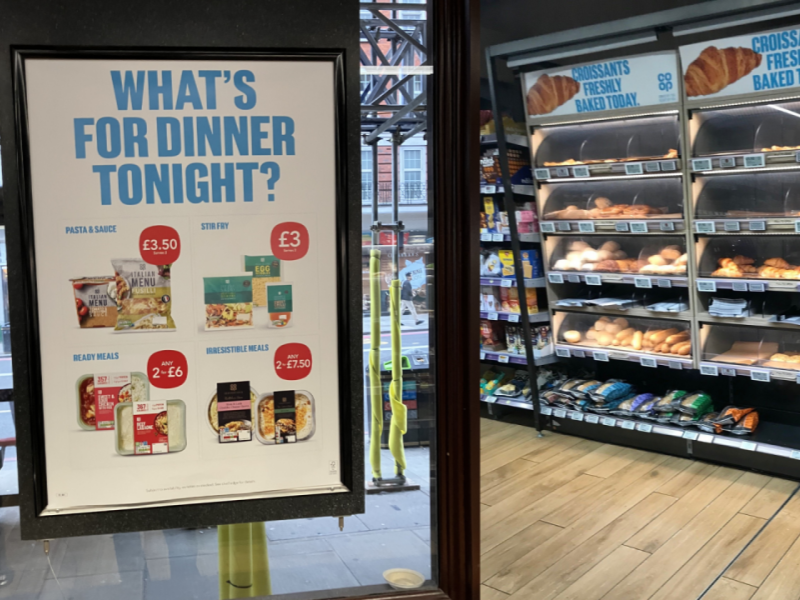
Physical retail still accounts for the majority of purchases in most categories, and in-store advertising reaches shoppers at the decision moment - not before they've considered buying, but while they're doing it.
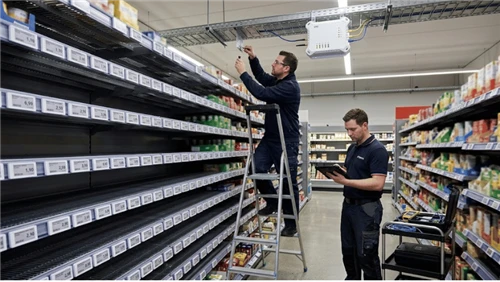
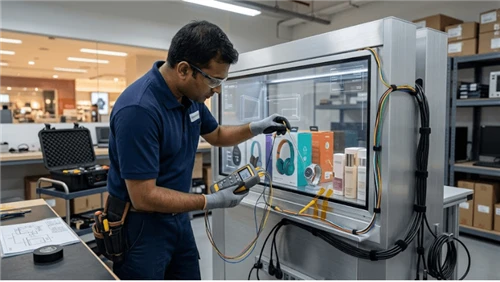
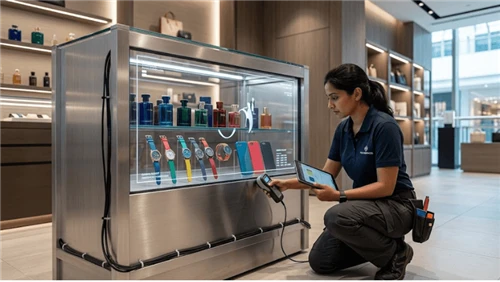
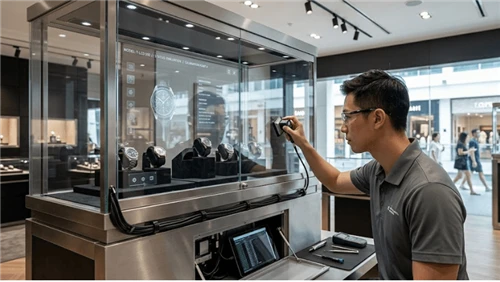
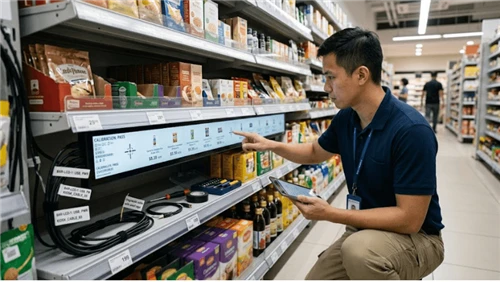
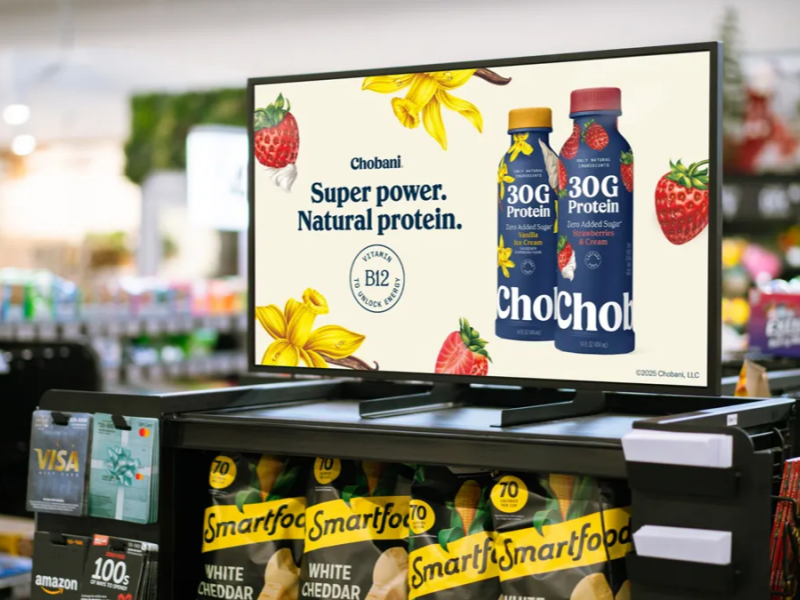
Formats range from end cap displays and point-of-sale signage to increasingly sophisticated digital options. Electronic shelf labels have moved beyond price display - today's electronic shelf label technology supports real-time promotional content, countdown timers, and QR-linked product pages, turning a price tag into an active advertising surface. Digital endcap displays and transparent display cases create product presentations that drive dwell time and impulse purchase.
The case for in-store investment is straightforward: a shopper who encounters a promotion at the shelf is significantly more likely to act on it than one who saw the same promotion in a digital ad earlier in the day. Digital campaigns and in-store execution compound each other's returns - they don't compete.
On-Site Retail Media
Sponsored products and display ads on retailer websites intercept shoppers with purchase intent already established. Someone searching "running shoes" on a retailer's site has already decided to buy; the question is which brand they'll choose. That's why on-site retail media tends to outperform general digital advertising on conversion metrics.
The key advantage is closed-loop attribution: because the retailer controls both the ad placement and the checkout, it can confirm whether someone who saw your ad actually bought. Reported ROAS figures (commonly cited between 3x and 10x) reflect gross returns, however - they don't account for sales that would have happened anyway. Measuring incremental ROAS against a holdout group gives you the honest number.
Off-Site Retail Media and Digital Channels
Off-site retail media uses a retailer's first-party data to reach their customers on external channels - display networks, social media, and connected TV. It's best suited for mid-funnel objectives: reaching category browsers who haven't converted, or reactivating lapsed customers. Attribution is more complex than on-site, and minimum budgets are higher, so it generally makes sense after on-site and in-store strategies are already performing.
Google Shopping ads and paid social (Meta, TikTok, Pinterest) operate alongside retail media rather than within it. Paid search captures in-market intent; social platforms build awareness and reach early-journey buyers. Digital signage solutions and bar-shaped LCD shelf screens bring this same targeting logic into the physical store, delivering dynamic content at the point of sale.
How to Build a Strategy That Actually Works
Start with objective, not channel
Most retail advertising budget is wasted because the channel is chosen before the objective is clear. An awareness campaign and a conversion campaign require fundamentally different channel mixes. Running sponsored product ads for a brand shoppers haven't heard of is expensive and inefficient. Building awareness for a product that's already well-known is unnecessary spend. Define what you're trying to accomplish - awareness, consideration, conversion, or loyalty - before you decide where to spend.
Map the purchase journey, then match channels to it
Shoppers don't follow a linear path. A buyer might discover a product on TikTok, compare options on a retailer's website, and purchase in-store three days later. Knowing which touchpoints carry the most weight for your specific audience determines where budget has the most leverage. Retailer audience insights and purchase data can map this reasonably accurately - guesswork is more expensive than the research.
Create for the context, not just the brand
In-store advertising operates at a completely different scale and speed than social video. A shelf-edge display has under two seconds to communicate. An email to a lapsed customer has room for context. Retail display creative that's built for its specific environment consistently outperforms brand assets adapted from another channel.
Measure what's actually incremental
Set your primary metric before the campaign launches, and design the campaign to generate clean data against it. For conversion campaigns, use sales lift measured against a holdout group - total ROAS includes organic sales that would have occurred without advertising. For awareness campaigns, track new-to-brand rate and share of search within the retail environment. For loyalty campaigns, track repeat purchase rate over 90–180 days. An ESL ROI calculator can help quantify the in-store digital component of a campaign - an element that often goes unmeasured and therefore gets cut.
Six Mistakes That Drain Retail Advertising Budget
1. Treating retail media as the whole strategy. It's one channel. Relying on it exclusively leaves the in-store decision moment - where most final purchases still happen - completely unaddressed.
2. Running conversion campaigns without upper-funnel support. Shoppers who've never heard of a brand don't click sponsored listings. Conversion tactics need awareness investment behind them, or the click-through rates will disappoint regardless of placement quality.
3. Investing in digital while the in-store experience fails. A strong digital campaign that ends with an out-of-stock shelf or invisible in-store promotion doesn't just underperform - it creates a negative brand moment. ESL dynamic pricing keeps in-store promotions synchronized with digital campaigns automatically, removing this gap.
4. Reusing creative across channels. What works on a social feed is wrong for a shelf label. Channel-specific creative isn't optional - it's the difference between an asset being noticed and one that's ignored.
5. Measuring reported ROAS without incrementality testing. Retail media platforms report revenue from exposed shoppers - not the revenue that occurred because of the ad. Holdout testing is the only reliable method for identifying your actual return.
6. Deploying in-store digital without understanding the technology. ESL campaigns require understanding refresh rates, wireless protocols, and content management systems. How electronic shelf labels work in practice determines what's realistic to promise in a campaign brief.
Frequently Asked Questions
What's the difference between retail advertising and retail media?
Retail advertising covers all paid and promotional activity designed to drive retail sales. Retail media is a specific format within it - ads placed inside a retailer's ecosystem using their first-party data. All retail media is retail advertising; most retail advertising isn't retail media.
How much does retail advertising cost?
Costs vary by channel. In-store display programs can start at a few thousand dollars per retailer. On-site retail media is bid-based with no fixed floor, though budgets under $5,000 per month rarely generate enough data to optimize. Off-site retail media typically requires $25,000 or more per campaign. For in-store digital advertising specifically, see this breakdown of electronic shelf label costs.
Is retail advertising only viable for large brands?
No. Small brands often outperform larger competitors by focusing budget on one or two high-relevance channels rather than spreading thin across everything. The channel mix changes with scale; the strategic principles don't.
What role do electronic shelf labels play in retail advertising?
Retail electronic shelf labels have evolved from pricing tools into active advertising surfaces - displaying promotional content, countdown timers, and QR codes linked to product pages, all updated remotely and instantly. For brands running coordinated digital and in-store campaigns, they're increasingly the mechanism that keeps both sides aligned. The case for switching to ESLs covers why this infrastructure investment has become central to modern retail media execution.
The Bottom Line
Retail advertising delivers consistent returns when it's built as a connected system - objective first, channel mix second, context-specific creative third, and measurement designed before the first dollar is spent. The structural conditions for this have never been better: richer first-party data, more accountable platforms, and in-store technology that finally closes the loop between digital campaigns and physical execution.
The gap between brands that see strong results and those that don't usually isn't budget - it's clarity about what they're trying to accomplish before they start spending. If you're evaluating in-store digital options specifically, our retail display solutions page covers the hardware and software available for shelf-level and aisle advertising execution.