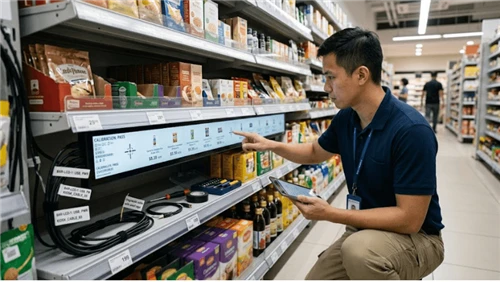
Retail labeling is the system that connects products to customers, shelves to inventory, and stores to the legal frameworks they operate within. When it works, nobody notices. When it doesn't, the consequences show up fast. This guide covers what retail labeling actually involves, where the real business risk lies, and how to decide whether your current approach is working.

What Is Retail Labeling?
Retail labeling is the practice of attaching identifying and informational tags to products, shelves, and packaging throughout a store environment. A label might contain a product name, price, barcode, batch number, allergen declaration, care instructions, or country of origin - depending on the product type and the laws that apply to it.
It's worth being precise about scope. Retail labeling isn't just about price stickers. It encompasses every point where information passes between the store and the customer, or between physical inventory and the systems that track it. A shelf-edge label that guides a shopper to the right product and a compliance label that satisfies a food safety requirement are both part of the same system - and a failure in either one creates a different kind of problem.
Types of Retail Labels: Function and Format
Most labeling breakdowns happen because retailers treat all labels as the same problem. They're not. Labels differ by what job they do and what they're made of, and choosing the wrong format for the function is a common source of avoidable cost.
By Function
- Product labels - attached directly to items, carrying the product name, brand, SKU, usage instructions, and any required certifications. These are the labels customers examine most closely before buying.
- Price labels - display the selling price and any active promotions. In most markets, displaying a clear and accurate price is a legal obligation, not just good practice. Errors here create compliance and customer trust problems simultaneously.
- Shelf labels - mounted at the shelf edge to identify what's stocked at that location. They serve both shoppers navigating the store and staff maintaining planogram compliance.
- Packaging labels - found on outer packaging, often containing supply chain data: batch numbers, handling instructions, country of origin.
- Compliance labels - mandated by regulation for specific product categories. These include nutritional panels, allergen declarations, and hazard symbols. Missing or incorrect compliance labels carry the highest risk of regulatory penalty.
By Material and Technology
- Paper labels - lowest upfront cost, widely used across most retail formats. Require manual replacement when information changes and degrade in moisture-heavy environments.
- Plastic labels - more durable than paper and suitable for refrigerated sections, outdoor displays, or high-traffic areas. Still require manual updates.
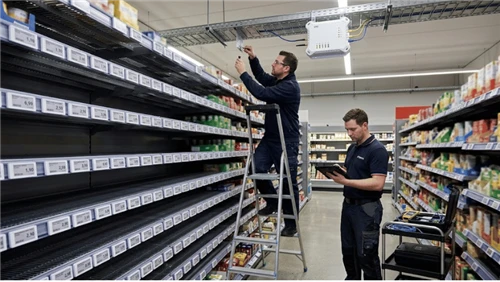
- Electronic shelf labels (ESLs) - digital displays that update wirelessly from a central system. Higher upfront investment, but they eliminate manual reprinting and reduce pricing errors significantly. Widely adopted in grocery, pharmacy, and large-format retail.

Benefits of Retail Labeling
Labeling does four things for a retail business, and each one has a direct commercial consequence if it fails.
Customer experience. Shoppers base purchasing decisions on shelf information. When labels are missing, ambiguous, or inconsistent with the checkout price, trust erodes. Accurate labels - especially those that surface allergen information or product comparisons clearly - also reduce post-purchase returns and complaints.
Operational efficiency. Labels are the link between physical products and the inventory systems that track them. A correctly barcoded or RFID-tagged item can be tracked from receiving dock to sale. Without that, inventory counts become unreliable, reorder triggers misfire, and staff spend time reconciling discrepancies instead of serving customers. In high-velocity environments like grocery or convenience retail, maintaining accurate shelf labels across thousands of SKUs manually is a significant labor burden.
Legal compliance. Depending on your market and product category, there are binding requirements governing what information must appear on a label, in what format, and in what language. Non-compliance isn't just a reputational risk - it can mean regulatory fines, product recalls, or delisting.
Loss prevention. Labels with security features - tamper-evident seals, RFID tags, or serialized barcodes - contribute to shrinkage reduction and support product recalls by enabling item-level traceability.
Retail Labeling Compliance: What the Law Actually Requires
This is the area most general retail guides skip over. The labeling requirements that apply to your store depend on your market and your product category - and the consequences of getting them wrong vary accordingly.
Food Retail (EU)
Under EU Regulation No 1169/2011 (EU FIC), food products sold in the European Union must include all of the following on their label:
- Name of the food
- List of ingredients
- Allergens - highlighted in the ingredients list (typically bold or a contrasting colour, not just listed separately)
- Net quantity
- Date of minimum durability or use-by date
- Storage conditions and/or conditions of use
- Name and address of the food business operator
- Country of origin or place of provenance (for certain categories including fresh meat, honey, olive oil, and unprocessed fruit and vegetables)
- Nutrition declaration
The allergen highlighting requirement is where EU food retailers most commonly fall short. Listing allergens separately is not sufficient - they must be visually distinct within the ingredients list itself.
Food Retail (US)
The FDA's food labeling requirements mandate a Nutrition Facts panel, an ingredient list, an allergen declaration under the Food Allergen Labeling and Consumer Protection Act (FALCPA), and net quantity declarations. Requirements differ slightly between conventional food products and dietary supplements.
Supply Chain and Non-Food Retail
GS1 standards for barcode and data formatting are not a legal requirement in most markets, but they are a practical one: most major retailers require GS1-compliant labels from their suppliers, and many e-commerce platforms enforce them for listing eligibility. For fashion retail, fiber content labeling and care instruction requirements vary by country but are legally mandated in both the EU and US.
Note: The above is a general reference framework, not legal advice. Verify the specific requirements that apply to your product category and target market with the relevant regulatory body or a compliance specialist.
Labeling by Retail Sector: Where Requirements Diverge
The practical labeling priorities differ significantly across retail categories.
Grocery and food retail faces the most complex compliance landscape and the highest velocity of price and promotion changes. The combination makes it the primary driver of electronic shelf label adoption - not because paper labels can't carry the right information, but because keeping them accurate at scale becomes operationally unsustainable.
Fashion and apparel requires care instruction labels (wash, dry, iron symbols), fiber content declarations, size labeling, and country of manufacture. RFID is increasingly used in this sector for inventory accuracy and to enable self-checkout in high-SKU environments.
Health, beauty, and pharmacy requires ingredient declarations using INCI naming (in the EU), expiration dates, batch codes for traceability, and usage warnings. Over-the-counter medicines require a Drug Facts panel. This sector has seen strong adoption of NFC-enabled labels that allow customers to access extended product information via their phone - particularly as ingredient transparency becomes a purchasing factor.

Paper vs. Electronic Shelf Labels: A Practical Comparison
The choice between paper and electronic shelf labels isn't a technology question - it's an operations question. The right answer depends on how often your prices change, how many SKUs you carry, and what your labor costs look like.
| Dimension | Paper Labels | Electronic Shelf Labels |
|---|---|---|
| Upfront cost | Low | High (hardware + software) |
| Ongoing cost | Ongoing print and labor | Low after deployment |
| Price update speed | Manual; hours to days | Seconds to minutes, store-wide |
| Error risk | High (manual entry) | Low (system-driven) |
| Compliance updates | Requires reprinting | Remote update, immediate |
| Durability | Low to medium | High (typically 5–10 years) |
| Best for | Low-velocity, smaller stores | High-velocity, promotional, multi-location |
ESLs also enable capabilities that paper simply can't match - including dynamic pricing, pick-to-light for order fulfillment, and NFC-triggered product information for shoppers. For stores with frequent promotions or high SKU counts, the labor savings on manual updates alone often justify the investment. If you're evaluating the numbers for your operation, an ESL ROI calculator can help model the payback period against your specific store parameters.
A note on ESL communication protocols: different wireless technologies suit different store environments. RF (radio frequency) offers broad coverage across large floor areas; NFC is better for customer-facing interactivity; Bluetooth Low Energy works well for smaller deployments. Understanding which protocol fits your store layout is worth doing before committing to a system.
Paper labels remain appropriate for smaller independent retailers, stores with stable pricing, and product packaging labels that are printed by manufacturers rather than updated in-store.
How to Build a Reliable Retail Labeling System
The most common labeling problems aren't technology failures - they're process failures. A structured approach covers both.
Audit before you invest. Walk the floor and identify where labels are most often missing, damaged, or inconsistent with the checkout price. Where do pricing disputes happen most frequently? Which sections require the most staff time to maintain? The audit tells you where your actual problem is before you decide on a solution.
Map your compliance requirements first. Before choosing label formats or technology, establish what information each label type legally must carry for your product categories and markets. This is especially important if you're expanding into a new category - each move can trigger requirements you haven't dealt with before. Build a requirements document that covers both legal minimums and operational needs.
Match technology to operations, not the other way around. If your prices change twice a year and you carry 200 SKUs, paper labels are probably fine. If you run weekly promotions across 5,000 SKUs at multiple locations, understanding how ESLs work is a worthwhile investment of time. Evaluate total cost of ownership, not just hardware price. For implementation specifics, the installation process for ESLs is more straightforward than many retailers expect.
Integrate with your existing systems. A label system that isn't connected to your POS or ERP will create more work, not less. Price changes, promotions, and product updates should flow automatically from the source of truth to the shelf edge. Disconnected systems are the primary cause of shelf-price discrepancies at checkout.
Build maintenance into your operations calendar. Labels are not a one-time setup. Products move, prices change, promotions expire, and regulations update. A quarterly label audit - checking for damaged, missing, or outdated labels across high-risk sections - catches problems before they reach customers or regulators. Assign clear ownership: someone specific should be responsible for label accuracy in each department.

Common Labeling Mistakes That Cost Retailers
- Treating labeling as set-and-forget. A label that was accurate six months ago may not be today. Retailers that don't build an audit cadence into their operations routinely discover outdated promotional labels still displayed weeks after a campaign has ended.
- Letting shelf price and POS price drift apart. This is both a compliance risk and a trust issue. In many jurisdictions, a customer is legally entitled to the lower price if there's a discrepancy. Systems that sync shelf labels directly to the POS database eliminate this category of error.
- Using the wrong label material for the environment. A standard paper label in a freezer section will degrade within weeks. A retailer expanding into fresh food who doesn't specify moisture-resistant or low-temperature labels for refrigerated aisles will be dealing with the consequences quickly.
- Underestimating the true cost of manual label updates. The real cost isn't the label paper - it's the hours staff spend printing, sorting, and replacing tags for each price change or promotional cycle. This cost is easy to overlook because it's distributed across many small tasks rather than appearing as a single line item.
- Skipping compliance review when entering a new category. A grocery retailer adding a health supplement range, or a fashion retailer adding children's clothing, may face labeling requirements they've never dealt with before. Assuming existing processes apply is one of the more common - and expensive - labeling errors.
Frequently Asked Questions
What is the purpose of labeling in retail?
Retail labeling serves four core functions: informing customers so they can make confident purchasing decisions; enabling store operations by linking physical products to inventory and pricing systems; satisfying legal and regulatory compliance requirements; and supporting loss prevention through product traceability.
Is retail labeling a legal requirement?
In most markets, yes - at least for certain information. Food products, pharmaceuticals, and consumer goods are subject to mandatory disclosure requirements that vary by country and product category. Displaying a clear and accurate selling price is also a legal obligation in many jurisdictions. The specific requirements depend on where you operate and what you sell.
What is the difference between a product label and a shelf label?
A product label is physically attached to or printed on the product itself and travels with it through the supply chain. A shelf label is mounted at the shelf edge in a store and identifies what's stocked at that location and at what price. Shelf labels stay in the store; product labels stay with the product.
When does it make sense to switch from paper to electronic shelf labels?
ESLs deliver the most value where prices change frequently, promotions are complex, labor costs are high, or pricing accuracy is a customer-facing priority. Grocery chains, pharmacies, and large-format general merchandise retailers are the most active adopters. For a breakdown of ESL costs and who benefits most, the economics vary significantly by store size and update frequency.
What communication technology do electronic shelf labels use?
Most ESL systems use radio frequency (RF), Bluetooth Low Energy (BLE), or near-field communication (NFC), depending on the store size and the functionality required. RF is the most common choice for large retail environments due to its range; NFC adds shopper interactivity. Some systems use a combination. The choice affects installation complexity, update speed, and battery life.
Labeling Is Infrastructure
Every retailer has a labeling system. The question is whether it's a deliberate one or an accumulated set of workarounds that nobody has formally reviewed.
The retailers who treat labeling as operational infrastructure - something to be designed, maintained, and periodically audited - tend to have fewer pricing disputes, lower compliance exposure, and lower labor costs per price change. The ones who treat it as admin tend to find out the hard way when a regulatory audit, a checkout dispute, or a product recall reveals how fragile the system actually is.
If you're not sure where your operation currently sits, the audit step is the right place to start: walk the floor, look for the gaps, and work forward from there. For retailers evaluating whether electronic shelf labels make sense as part of that infrastructure, the technology has matured significantly and the implementation process is more accessible than it was even a few years ago.