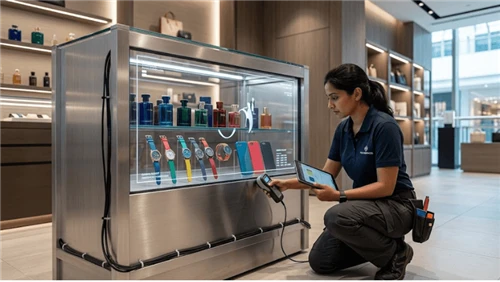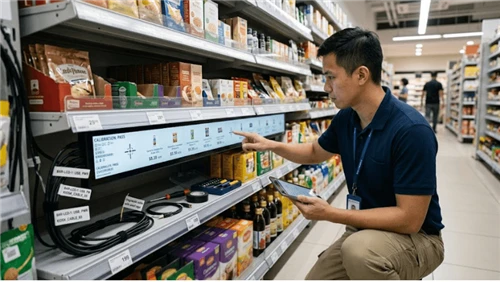
Electronic shelf label cybersecurity is not limited to encrypting the wireless link between a gateway and a shelf tag.
An ESL environment may also contain human accounts, service accounts, APIs, POS and ERP connections, cloud or local management software, gateways, device registrations, remote-support tools, scheduled price jobs, templates, logs, backups, and recovery processes.
A system can use encrypted communication and still create serious operational risk if administrators share accounts, API permissions are too broad, production secrets are poorly controlled, old gateways remain registered, software is no longer supported, or an unexpected price update cannot be traced and reversed.
Quick answer: A secure ESL deployment needs a documented system boundary, named control owners, least-privilege access, protected machine credentials, trusted device onboarding, restricted network paths, authorized price workflows, supported updates, governed logs, tested incident recovery, and supplier evidence that can be verified before rollout.
An electronic shelf label solution is a connected retail system, not just a collection of e-paper displays. The security review must follow the complete path from the approved price source to the management platform, gateway, physical label, and visible shelf result.
What Electronic Shelf Label Cybersecurity Covers
The security boundary normally includes:
- The product or pricing system that creates the approved value
- POS, ERP, PIM, promotion, and store-master platforms
- Integration middleware, message brokers, and API clients
- The ESL management platform and its tenants
- Human, administrative, and service accounts
- Gateways, access points, labels, and mobile binding tools
- Cloud services, local servers, and store networks
- Supplier remote-support channels
- Logs, backups, exports, and recovery records
The underlying relationships among data, management software, gateways, and physical labels are explained in the guide to how electronic shelf labels work.
The Bluetooth SIG's Electronic Shelf Label Profile 1.0.1 specifies how a GATT client can control and update ESLs using Bluetooth technology. It is an interoperability specification, not proof that a complete retail deployment has appropriate identity, access, update, monitoring, and incident-response controls.
NIST IR 8259A provides a general IoT capability baseline that organizations can use as a starting point when evaluating device identification, configuration, logical access, data protection, software update, and cybersecurity-state capabilities. It is general IoT guidance rather than an ESL certification. See the official NIST IR 8259A IoT device cybersecurity baseline.
Start With a Business-Focused ESL Threat Model
A threat model does not need to predict every attacker. It should identify events that could produce an unacceptable business result and the decision that follows.
| Risk Event | Possible Business Impact | Typical Release Decision |
|---|---|---|
| Unauthorized or incorrectly approved price update | Incorrect customer price, compliance exposure, or large-scale rework | Block publication until the authoritative value is restored |
| Compromised privileged or service account | One identity may affect several stores, templates, or integrations | Restrict the identity, preserve evidence, and assess scope |
| Unknown label or gateway registration | Unapproved device gains management or network access | Quarantine the device relationship |
| Permanent supplier remote access | Actions may occur without a current business approval or clear attribution | Require a named, time-limited support process |
| Unsupported platform or gateway software | Known weaknesses may remain without a supported correction path | Apply compensating controls or block wider rollout |
| Missing or inconsistent logs | The team cannot establish who changed what, when, or why | Do not approve production recovery without sufficient evidence |
Not every incorrect display is a cyberattack. The investigation must distinguish malicious activity, account misuse, integration defects, stale events, template problems, and physical binding errors. The operational consequences of an unresolved mismatch are discussed in what happens when price displays are wrong.
Step 1: Inventory Assets, Identities, Data Flows, and Data Classes
Begin with an inventory that covers more than the physical labels.
Record the label models and identifiers, gateways and store locations, management tenants, environments, user roles, administrator accounts, service accounts, API clients, certificates, keys, integrations, remote-support tools, logging destinations, backup systems, software versions, mobile binding devices, and support owners.
Create a data-flow diagram showing how an approved price or product change reaches the shelf. For each connection, document the source, destination, authentication method, credential owner, permitted action, store scope, data transferred, network path, logging location, failure behavior, and revocation method.
The broader electronic shelf labelling workflow can help identify where business data, integrations, gateways, and endpoint confirmation enter the process.
Classify the Data Before Defining Retention
| Data Class | Examples | Primary Concern |
|---|---|---|
| Commercial data | Regular price, promotion, store scope, template content | Integrity, approval, timing, and recovery |
| Product and operational data | SKU, GTIN, shelf position, binding, device status | Accuracy, availability, and traceability |
| Identity data | User, administrator, supplier, and service-account identities | Authentication, authorization, and privacy |
| Secrets and credentials | Passwords, API secrets, certificates, keys, tokens | Confidentiality, controlled use, and revocation |
| Security and audit data | Logins, configuration changes, API calls, alerts, exports | Integrity, access control, time accuracy, and retention |
| Customer-related data | Loyalty or eligibility attributes where the architecture uses them | Privacy, minimization, and legal requirements |
Retention should follow business, contractual, legal, privacy, investigation, and recovery needs. The article should not prescribe one universal period for every ESL platform or retailer.
Step 2: Design Roles, Separation of Duties, and Access Reviews
Role-based access control should separate commercial price authority from technical administration.
| Role | Typical Permissions | Permissions Normally Restricted |
|---|---|---|
| Store associate | View device state, report faults, perform approved binding tasks | Chain-wide pricing, user administration, or security settings |
| Store manager | Approve limited local actions where policy permits | Create privileged accounts or alter integration credentials |
| Pricing team | Create or approve commercial price events | Change gateway, identity, or network configuration |
| Merchandising team | Manage approved content and templates | Change authentication or API authorization |
| ESL operations | Register devices, monitor updates, investigate failures | Approve commercial prices unless separately authorized |
| Integration service | Submit defined data or events for approved stores and fields | Interactive administration or unrelated chain-wide actions |
| Platform administrator | Manage platform configuration and identities | Approve their own high-risk commercial change |
| Supplier support | Time-limited technical access for an approved case | Permanent unrestricted production access |
The model should include named accounts, least privilege, separation of duties, approval boundaries, temporary access, joiner-mover-leaver processes, emergency access, service-account ownership, and recurring access reviews.
Where the platform supports it and organizational policy requires it, privileged human access should use stronger authentication than a reusable password alone. Do not describe this as a universal product feature unless the selected platform supports it.
A shared "ESL Admin" account may simplify setup, but it weakens attribution and makes selective revocation difficult.
Step 3: Protect Human and Machine Credentials
Machine identities deserve the same governance attention as human users. Create a credential register covering administrative credentials, API client secrets, service-account passwords, gateway certificates, onboarding credentials, message-broker credentials, support accounts, encryption keys, update-verification keys, and backup credentials.
For each item, record:
- Owner and business purpose
- Systems, stores, and environments in scope
- Approved storage location
- Creation and last-review dates
- Authorized users or services
- Rotation or review rule
- Revocation and replacement method
- Emergency contact and dependent services
Do not place production secrets in public repositories, shared spreadsheets, ordinary email threads, installation photographs, or unprotected configuration exports.
There is no universal rotation interval for every ESL credential. Review or replacement may be triggered by suspected disclosure, staff or supplier departure, contract termination, gateway loss, environment cloning, store closure, platform migration, or unauthorized access.
Step 4: Secure Labels, Gateways, and Binding Tools Throughout Their Lifecycle
Onboarding is the process through which a device receives an approved identity, store assignment, network relationship, and management authority.
For every label or gateway, verify the expected identity, ownership, destination store, approved model and version, authorized platform or tenant, approved gateway relationship, required credential, successful test update, asset-register entry, and rejection of the previous or unauthorized relationship.
NCCoE's finalized work on trusted IoT device onboarding and lifecycle management provides general guidance on establishing trust before provisioning network credentials and on managing devices throughout their lifecycle.
A replacement label should not inherit trust merely because it occupies the same shelf position. A gateway moved to another store should not retain old credentials, tenant registration, network permissions, certificates, remote-support access, or unnecessary configuration.
Protect Physical and Mobile Administration Paths
The security review should also cover gateway cabinets, store back-office terminals, handheld scanners, smartphones or tablets used for binding, installation accounts, local administrative interfaces, and lost-device response.
The physical process should align with the approved electronic shelf label installation method so that only authorized tools and personnel can register or rebind a label.
Step 5: Restrict Gateway and Network Communication
A gateway should communicate only with services required for its approved function. Document management servers, DNS and time services, update servers, logging destinations, message brokers, cloud endpoints, remote-support paths, and administrative interfaces.
Possible controls include restricted inbound administration, approved outbound destinations, firewall rules, network segmentation, named management stations, time-limited support paths, removal of unused services, and monitoring for unexpected destinations.
NIST IR 8349 describes a methodology for capturing and documenting expected IoT network communication behavior so that organizations can better manage access to and from devices. See the official NIST IR 8349 network-behavior methodology.
The practical network design will depend on whether the system uses Bluetooth, Wi-Fi, Sub-GHz, or another approved architecture. Review the differences in Bluetooth, Wi-Fi, and Sub-GHz ESL communication.
On-premise deployment is not automatically secure, and cloud deployment is not automatically insecure. The relevant questions are who operates the system, who can access it, how it is updated, which connections are permitted, how credentials are managed, and what evidence is available.
Step 6: Secure APIs and Price-Update Workflows
API authentication proves that a request came from an accepted identity. It does not prove that the requested business action was authorized, current, or correct.
An ESL API security audit should review:
- Authentication and client identity
- Permission, store, product, and price-field scope
- Input validation and approved code sets
- Timestamp, sequence, and version handling
- Duplicate, delayed, and expired events
- Batch-size and chain-wide update controls
- Test and production separation
- Approval requirements and exception paths
- Error responses, logging, and credential revocation
High-risk actions may include chain-wide price changes, large deviations, store-group changes, price-visible template changes, new service accounts, product-to-label rebindings, promotion overrides, and disabled validation rules.
The exact approval workflow depends on the retailer, but an integration should not silently bypass the organization's price authority. Readers who need the baseline product context can review what digital price tags are and how they fit into retail price operations.
Step 7: Manage Software, Firmware, Vulnerabilities, Backups, and Support
For every component, record the current version, supported version, approved update source, update owner, supplier support end date, maintenance window, verification method, test environment, backup requirement, rollback method, and failed-update response.
Components may include the management platform, gateway software and operating system, database, message broker, integration service, mobile binding application, label firmware, and administrative tools.
NIST's IoT software-update capability guidance describes secure and configurable update capabilities, including limiting updates to authorized entities and verifying that updates come from valid sources.
Use a Vulnerability Management Process
- Receive supplier advisories and relevant vulnerability information.
- Map the affected version to the actual ESL asset inventory.
- Assess exposure, store scope, business impact, and exploit conditions.
- Decide whether to patch, isolate, restrict, monitor, or replace.
- Test the correction and recovery path before wider deployment.
- Record compensating controls when a patch is not yet available.
- Escalate unsupported components into a replacement or risk-acceptance plan.
Backups should cover the configuration and records required for recovery, not simply produce an archive file. Test whether the backup can restore the approved tenant, roles, gateway configuration, templates, integrations, and price workflow without restoring obsolete credentials or incorrect data.
Device refresh and update tests should account for the operational factors explained in ESL refresh rates and display performance.
Step 8: Govern Logs, Alerts, and Security Event Correlation
Logs should support attribution, operational recovery, and security investigation. Listing available events is not enough; the retailer also needs rules for time, storage, access, retention, and alert ownership.
| Log Source | Priority Events | Governance Requirement |
|---|---|---|
| Identity and administration | Privileged login, failed login, role change, new account, emergency access | Named identity, synchronized time, restricted access, and review owner |
| API and integrations | Authentication failure, large batch, unusual store scope, validation bypass | Client identity, request or batch ID, source record, result, and correlation fields |
| ESL platform | Template publication, binding change, price publication, configuration change | Before-and-after values, operator or service identity, approval reference |
| Gateways and devices | Registration, deregistration, unexpected endpoint, update failure, status loss | Device identity, store, version, gateway, event time, and supported state evidence |
| Remote support | Session start, privilege granted, action performed, session end | Ticket, approver, supplier identity, duration, scope, and session record |
| Audit and export functions | Log deletion, export, retention change, monitoring interruption | Restricted permission, tamper protection, alerting, and independent review |
Define which events require immediate notification, which require scheduled review, and which are retained mainly for investigation. Critical examples may include an unknown gateway, disabled validation, a retired service account becoming active, a large price batch outside an approved window, or logs stopping unexpectedly.
NIST's cybersecurity state-awareness guidance describes capabilities for generating and providing authorized access to device state and event information. Actual label, gateway, and platform capabilities vary.
When an event appears to be a device failure rather than a security event, use the site's guide to electronic shelf labels not updating to separate binding, gateway, network, battery, template, and hardware causes.
Step 9: Define Incident Severity, Response, and Recovery Acceptance
NIST CSF 2.0 organizes cybersecurity outcomes around Govern, Identify, Protect, Detect, Respond, and Recover. It does not prescribe an ESL-specific playbook, but it provides a useful governance structure. See the official NIST Cybersecurity Framework 2.0.
| Severity | Illustrative ESL Condition | Typical Response |
|---|---|---|
| Critical | Active incorrect prices across many stores, uncontrolled privileged access, or loss of recovery capability | Pause publication, appoint incident command, preserve evidence, protect shelf pricing, and escalate immediately |
| High | Compromised service credential, unknown gateway, or unauthorized production configuration | Restrict access, assess scope, review queued events, and prepare controlled recovery |
| Medium | Limited failed control with no confirmed customer impact | Assign owner, increase monitoring, correct within an approved deadline |
| Low | Documentation gap or low-risk configuration issue | Track through normal remediation and review |
Immediate Response
- Appoint the incident owner and business price owner.
- Stop or isolate affected publication jobs when necessary.
- Preserve logs, queues, configuration, and current device state.
- Identify affected stores, products, accounts, integrations, gateways, and labels.
- Confirm the authoritative price and product source.
- Restrict suspected accounts, credentials, devices, or support sessions.
- Prevent delayed or older events from publishing.
- Apply the approved shelf-price continuity or corrective update process.
- Communicate with business, security, technical, supplier, legal, or compliance teams as required.
Do not destroy evidence by immediately deleting the suspicious account, gateway, or event history before the responsible team preserves what it needs.
Recovery Acceptance Criteria
- The approved prices and product content are visible.
- POS, source systems, platform records, and shelf results agree.
- Affected credentials have been replaced or restricted.
- Unauthorized access and device relationships are removed.
- Queues, scheduled jobs, templates, and bindings are reviewed.
- Monitoring and logging are restored.
- The recovery action has a named business and technical approver.
- Open root-cause and corrective actions have owners and deadlines.
Step 10: Verify Supplier Security Evidence
A supplier questionnaire should request evidence, not only "yes" answers.
| Topic | Evidence to Request |
|---|---|
| Architecture | Current system and trust-boundary diagram |
| Identity | User, administrator, service-account, gateway, and device identity model |
| Access control | Role and permission matrix, access review, and emergency-access method |
| Credentials | Secret, key, certificate, rotation, storage, and revocation process |
| Onboarding | Registration, transfer, replacement, and deregistration procedure |
| Gateway security | Required services, ports, destinations, administration, and remote-support design |
| API security | Authentication, authorization, scope, validation, versioning, and logging documentation |
| Updates | Software and firmware update, verification, testing, and rollback policy |
| Vulnerabilities | Reporting channel, advisory process, customer notification, and remediation responsibility |
| Logs | Available events, timestamps, retention, export, and monitoring integration |
| Support lifecycle | Supported versions, end-of-support policy, and migration options |
| Incident response | Supplier roles, escalation contacts, evidence support, and notification process |
| Decommissioning | Account, tenant, credential, gateway, and device offboarding process |
NIST's manufacturer documentation catalog explains how cybersecurity documentation can help customers make informed purchase decisions and operate IoT devices securely throughout their lifecycle. See NIST guidance on manufacturer security documentation.
A statement such as "uses AES encryption" does not answer the complete questionnaire. Security and support evidence should be reviewed alongside the broader criteria for choosing a retail ESL solution and comparing electronic shelf label manufacturers.
Security Control Ownership Matrix
| Control | Responsible | Approver | Required Evidence |
|---|---|---|---|
| Account and role review | Platform owner | Information security | Named-account and access-review report |
| API credential management | Integration owner | Security owner | Credential register and revocation test |
| Gateway onboarding and network rules | ESL and network operations | Network security | Registration and communication matrix |
| Price-event approval and rollback | Pricing and ESL operations | Business price owner | Approved test and recovery evidence |
| Software and vulnerability management | Technical product owner | Change or risk owner | Version inventory and remediation record |
| Log monitoring | Platform or security operations | Security owner | Log matrix, alert test, and review record |
| Incident response | Incident-response team | Incident commander and business owner | Incident record and recovery approval |
| Supplier evidence review | Procurement and technical owner | Risk owner | Completed evidence-based questionnaire |
Actual job titles may differ, but every control should have one accountable owner. A list of departments is not a substitute for assigned responsibility.
Hypothetical ESL Security Incident
The following scenario is hypothetical and does not claim a customer result.
At 09:05, monitoring detects an unusually large price-update batch outside the approved promotion window. The request is authenticated through a valid service account, but the batch has no matching approval reference and targets stores outside the integration's normal scope.
A controlled response would:
- Classify the event and appoint an incident owner.
- Pause affected ESL publication jobs.
- Preserve API, identity, platform, gateway, and pricing-source logs.
- Identify the targeted stores, products, labels, and queued events.
- Confirm the authoritative prices.
- Restrict the service credential and review recent permission changes.
- Cancel or quarantine unapproved queued events.
- Publish approved values through a controlled recovery process.
- Physically verify selected shelf positions.
- Replace the credential and reduce its store and function scope.
- Correlate timestamps and determine whether the cause was exposure, defect, test-environment error, operator action, or unauthorized use.
- Approve recovery and assign corrective actions.
The example illustrates why valid authentication, correct business approval, log correlation, and physical shelf verification are separate controls.
ESL Security Release Gates
Block Rollout
- Privileged accounts are shared and actions cannot be attributed.
- Production credentials have no approved storage or revocation process.
- Unknown gateways or service accounts remain active.
- An integration has unrestricted chain-wide access without a documented need.
- Critical price, identity, and configuration actions are not logged.
- Required software is unsupported and no accepted control exists.
- No controlled price rollback or recovery test exists.
- Supplier remote access cannot be limited or reviewed.
- Test and production environments cannot be separated.
Conditionally Ready
A restricted pilot may proceed when unresolved issues cannot affect approved pilot prices, stores and identities are constrained, compensating controls are documented, owners and deadlines are assigned, and both business and security approvers accept the remaining risk.
Ready
The project is ready when assets and data flows are documented, roles and machine identities have approved scopes, credentials have owners and revocation methods, devices use approved onboarding, network paths are understood, APIs enforce business scope, updates and recovery are tested, logs and alerts are governed, incident roles are assigned, and supplier evidence has been reviewed.
Final ESL Cybersecurity Audit Checklist
| Control Area | Minimum Evidence | Blocking Failure |
|---|---|---|
| System boundary | Asset, identity, environment, and data-flow inventory | Unknown production component or connection |
| Access control | Role matrix, named privileged accounts, and access review | Shared or unattributable privileged access |
| Credentials | Credential register, protected storage, and revocation test | Unowned or exposed production secret |
| Onboarding | Approved label and gateway registration procedure | Unknown or unrecoverable device identity |
| Network | Expected communication matrix and approved administration path | Unrestricted or unexplained gateway communication |
| API workflow | Authentication, business scope, validation, versioning, and logging test | Integration can bypass price authority |
| Updates | Version inventory, supported update path, and rollback evidence | Unsupported critical component without accepted control |
| Vulnerabilities | Advisory intake, asset mapping, remediation, and support lifecycle | No method to assess or respond to supplier advisories |
| Logs | Time-synchronized log matrix, access control, retention, and alert test | Critical actions cannot be reconstructed |
| Incident response | Severity model, roles, communication path, and recovery test | No way to stop or safely restore price publication |
| Supplier evidence | Architecture, permissions, updates, logs, vulnerability, and lifecycle documentation | Critical claims cannot be verified |
| Decommissioning | Account, credential, tenant, gateway, and device revocation process | Retired access or devices remain active |
Common ESL Security Mistakes
| Mistake | Security Impact | Better Control |
|---|---|---|
| Treating encryption as the entire security program | Valid but overprivileged identities can still publish incorrect actions | Combine encryption with identity, authorization, monitoring, and recovery |
| Using one account for everyone | Actions cannot be reliably attributed or selectively revoked | Use named accounts and owned service identities |
| Giving an integration chain-wide access by default | One credential can create a broad event | Limit stores, fields, actions, and batch scope |
| Leaving supplier access permanently enabled | Support actions may occur outside an approved case | Use approved, time-limited, logged access |
| Sharing test and production credentials | Testing can affect live stores or expose production secrets | Separate environments, identities, and endpoints |
| Monitoring only offline labels | Identity, API, configuration, and validation events remain invisible | Monitor both operational and security-relevant events |
| Updating without recovery testing | A failed release may interrupt pricing or logging | Test backup, rollback, and business-price recovery |
| Retiring hardware without revoking digital access | Old gateways, accounts, or certificates may remain trusted | Use a complete digital and physical offboarding process |
These controls add planning, testing, monitoring, and supplier-review effort. They should be included when evaluating the real costs of electronic shelf labels.
FAQ
Q: Are electronic shelf labels connected directly to the public internet?
A: It depends on the architecture. Individual labels commonly communicate through gateways, while gateways and management platforms may connect to local networks, private services, or cloud endpoints. The actual trust boundaries must be documented for the selected system.
Q: Should ESL logs be sent to a SIEM?
A: That depends on risk, platform export capabilities, event volume, and the retailer's monitoring architecture. At minimum, the team should be able to preserve and correlate critical identity, API, platform, gateway, and price-publication events.
Q: How often should ESL access and credentials be reviewed?
A: Use organizational policy, credential type, platform capability, staff changes, supplier access, incidents, migrations, and support lifecycle as triggers. One universal interval does not fit every identity or secret.
Q: What should happen when an ESL gateway is lost or replaced?
A: Record the event, identify the old and new device identities, restrict or revoke the old registration and credentials, review queued events, apply approved network settings, test communication, confirm store scope, and update the asset inventory.
Q: What should a retailer do when an ESL component reaches end of support?
A: Map the affected version to stores and integrations, assess exposure, obtain supplier options, define compensating controls where appropriate, test the replacement path, and establish an approved migration or risk-acceptance deadline.
Q: How often should the ESL security audit be repeated?
A: Repeat relevant controls after major platform, supplier, network, integration, role, credential, firmware, store, or support-lifecycle changes. Incidents and failed recovery tests should also trigger a focused reassessment.
Final Takeaway
Electronic shelf label cybersecurity is a system-governance problem, not a wireless-encryption feature.
The security boundary extends from the authoritative product and price source through human and machine identities, APIs, middleware, management software, gateways, binding tools, and physical labels.
Before rollout, a retailer should be able to show who owns each control, what evidence proves it works, which failures block release, how suspicious events are detected and escalated, and how correct prices are safely restored.
In high-volume environments such as grocery retail, the scope and urgency of these controls increase with store count, promotion frequency, and price-event volume. The article on supermarket electronic price tags provides additional operational context.
Review the available electronic shelf labels and discuss architecture, access control, integration scope, gateway communication, support lifecycle, logging, and recovery evidence with the LEGOYO team before approving a pilot or wider rollout.