This guide is written for pharmacy operators who already understand what ESLs are and want to know whether they make sense for their specific environment: the compliance exposure, the operational math, and where the technology earns its cost.
How ESL Deployments in Pharmacy Differ from General Retail
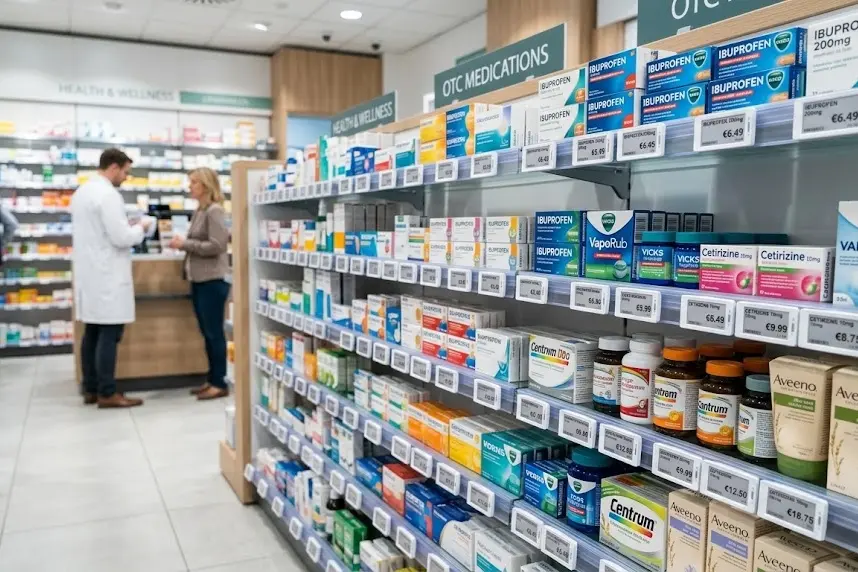
The first clarification most ESL evaluations skip: a pharmacy is two distinct retail environments operating under one roof, and they're not both candidates for ESL deployment.
The Rx/OTC Divide
The dispensing area - where prescriptions are filled and labeled - is governed by state pharmacy board regulations and operates under labeling requirements that have nothing to do with shelf-edge price tags. ESLs are not relevant here, and scoping a pharmacy ESL project to include the Rx area reflects a misunderstanding of both the technology and the regulatory environment. The FDA's framework for OTC vs. prescription drug labeling makes clear these are separate compliance domains.
ESLs belong in the front-end OTC floor: the consumer retail section carrying vitamins, cold remedies, personal care products, first-aid items, and seasonal merchandise. This is where retail ESL deployments apply, and it's where the pricing accuracy, compliance, and labor efficiency arguments actually land.
Why the Stakes Are Higher in Pharmacy
A price mismatch in a pharmacy carries different weight than the same error in a hardware store. Patients purchasing OTC medications are often on fixed incomes, managing chronic conditions, or making price-sensitive decisions about their health. A shelf price that doesn't match what they're charged at the register doesn't just create friction - it damages the trust relationship a pharmacy depends on for long-term retention. The consequences of pricing discrepancies extend beyond individual transactions into compliance exposure and patient experience at scale.
What Pharmacy ESLs Display - And Why It Goes Beyond Price
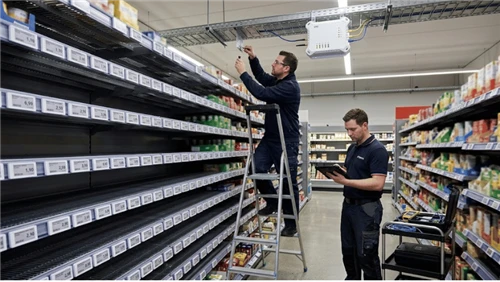
The core function is straightforward: ESLs replace paper tags with wireless e-ink displays that update automatically when prices change in the central management system. When a promotion goes live at the register, the shelf label reflects it simultaneously - no printing, no manual replacement, no lag.
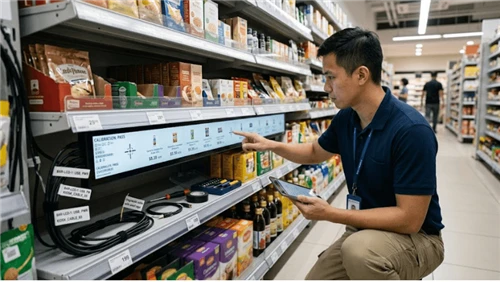
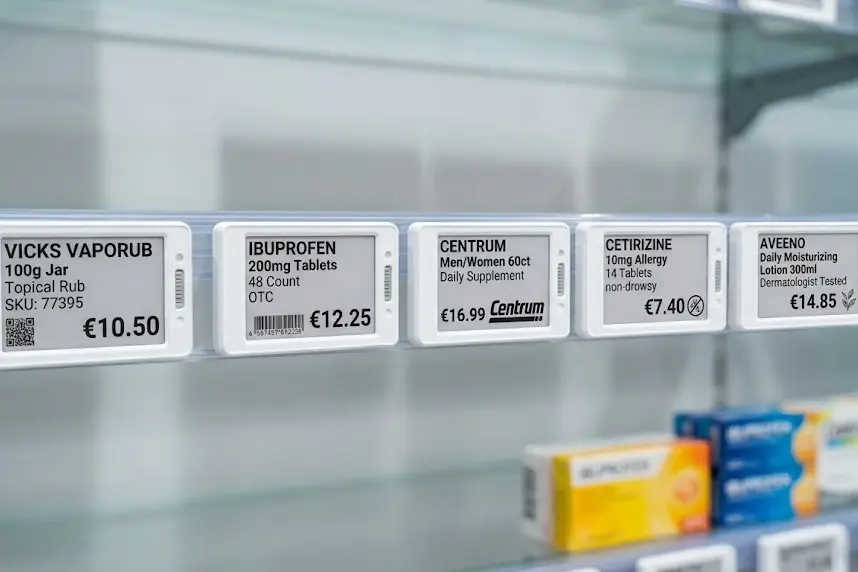
But the more interesting capability for pharmacy operators is what else these labels can display. The multi-field display capability of current ESL systems supports information beyond price, and in a pharmacy environment, that has concrete applications:
- Unit pricing - legally required in several states and a genuine service for patients comparing product sizes. Displaying unit cost per dose or per ounce eliminates a common point of confusion in the vitamin and supplement aisle.
- Promotional mechanics - "Buy 2, Save $3" or "Loyalty Price: $X.XX" displayed directly below the item, rather than on separate signage that may not be positioned clearly. This is particularly useful for pharmacy loyalty programs where the shelf price and the member price are different.
- Category indicators - simple designators like "Daytime Formula" or "Non-Drowsy" that help patients navigate OTC sections without requiring staff assistance. In a busy pharmacy, reducing the number of product-location questions staff field has real operational value.
- Stock status signals - in systems with live inventory integration, labels can indicate when an item is temporarily out of stock, directing patients to alternatives rather than leaving them searching an empty shelf.
None of these require additional hardware. They require clean upstream data and appropriate software configuration - which is why data quality is a prerequisite for ESL deployment, not an afterthought.
Pharmacy Pricing Compliance: What the Regulatory Environment Actually Requires
The word "compliance" appears in nearly every ESL marketing piece, without much explanation of what it means in practice. For pharmacy operators, the relevant framework is state-level consumer protection law, not federal pharmacy regulation.
State Price Accuracy Programs
Most U.S. states have statutes requiring that the price charged at the register match the price displayed on the shelf. Enforcement is typically handled by state weights and measures departments, which conduct periodic audits of retail locations - including pharmacy front ends. According to NIST Handbook 130, which provides the model legislation many states adopt for pricing accuracy, allowable error rates are typically defined, and stores that consistently exceed them face escalating penalties.
The compliance exposure from paper tags isn't hypothetical. A promotion entered in the POS that hasn't been manually updated on the shelf creates a scanner accuracy violation during the period the discrepancy exists. For a pharmacy running weekly ad cycles across hundreds of OTC SKUs, the number of individual opportunities for that discrepancy to occur is large.
The National Retail Federation has noted that ESLs structurally address the scanner accuracy problem by eliminating the manual step where most price discrepancies originate - the gap between when a price changes in the system and when it appears at the shelf edge.
The Audit Trail Advantage
Beyond accuracy, modern ESL management platforms maintain timestamped logs of every label update: what price was displayed, when it changed, and which store locations were updated. When a compliance inspection raises a question about whether a promotion was active on the shelf during a specific period, that log is a verifiable answer. Paper-based systems offer no equivalent - the prior tag is discarded the moment it's replaced. This is one of the documented advantages that becomes particularly meaningful in audit-sensitive retail environments.
Where Pharmacy Operators See Measurable Impact
Three areas consistently account for the operational ROI in pharmacy ESL deployments. How significant each one is depends on the specific store, but they're worth quantifying before talking to vendors.
Labor Recovered from Tag Management
Weekly ad cycles in a pharmacy front end can affect hundreds of SKUs simultaneously. Manual tag management requires printing new labels, locating each item on the floor, and replacing the tag accurately - work that competes directly with customer-facing tasks. In environments where pharmacy staff are already stretched across dispensing, patient consultations, and front-end support, the weekly tag round is a genuine operational burden.
ESLs redirect that time. The promotion updates automatically; staff don't need to execute it at the shelf level. The savings are proportional to how many price changes occur weekly and how many staff-hours those changes currently consume. That number is worth tracking for a month before beginning an ESL evaluation - it becomes the foundation of the financial model. To estimate your ROI, that weekly hour count is the most important variable.
Promotional Timing and Execution Consistency
A promotion that goes live in the POS on Monday morning but doesn't reach the shelf until Tuesday afternoon creates two problems simultaneously: the store is selling at the promoted price without the shelf signaling it, which erodes margin without the customer benefit; and when staff finally update the tags, the promotion has been partially active on an inconsistent basis across different aisles. ESL scheduling eliminates this. Promotions activate and expire at a defined time, consistently, without requiring anyone to physically execute them in the store.
For chain pharmacy operators, this consistency extends across every location in the network simultaneously - which leads to a related capability: dynamic pricing and time-sensitive promotions that would be logistically impossible to execute manually at scale.
Checkout Friction
When shelf prices reliably match POS prices, checkout disputes largely disappear. This is harder to quantify than labor savings but is operationally significant in pharmacy, where checkout interactions often happen at the pharmacy counter - where staff are simultaneously managing other tasks - rather than at a dedicated register with a supervisor nearby. The broader operational impact of eliminating routine pricing disputes is worth considering beyond just the individual transaction cost.
Chain Pharmacy vs. Independent Pharmacy: The ROI Case Differs
One of the meaningful gaps in most ESL coverage is the assumption that all pharmacy operators evaluate the technology the same way. They don't, and being honest about that difference matters.
The Chain Pharmacy Case
For chain pharmacy operators managing dozens to hundreds of locations, ESLs address a specific organizational problem: execution consistency across a distributed network. A weekly promotion that fails to go live on time at 20% of locations isn't a shelf tag problem - it's a revenue and compliance problem at scale. Centralized ESL management solves this by taking the execution out of individual store hands entirely. District managers can verify promotion compliance across the network without field visits, which changes the management overhead of running complex promotional programs. This mirrors the value seen in chain-wide rollouts in grocery, where network-level consistency is the primary driver of adoption.
The Independent Pharmacy Case
For a single-location independent pharmacy, the math is more conservative. The labor savings are real but smaller in absolute terms. The compliance and accuracy benefits apply equally, but there's no network-level consistency problem to solve.
A simplified way to frame the decision: take your current weekly hours spent on OTC tag management, multiply by your fully loaded hourly labor cost, and multiply by 52. That's the annual labor cost ESLs would eliminate or significantly reduce. Compare that against the annualized cost of the ESL system (hardware amortized over useful life, plus software and support). If the labor savings cover the system cost within 24–36 months, the investment pencils out. If the payback period stretches beyond 36 months, the capital may be better deployed elsewhere unless compliance exposure or checkout dispute frequency adds to the urgency.
Independent pharmacies with large OTC floors, active weekly promotion programs, and constrained staff time have a more compelling case. Those with minimal OTC assortments and few weekly price changes probably don't - and no responsible vendor should tell them otherwise.
How to Start an ESL Deployment in a Pharmacy: A Practical Sequence
Pharmacy ESL projects that run into problems typically do so because integration requirements weren't clarified upfront. The following sequence reflects where most of the real work happens.
Step 1: Audit Your Current Label Environment
Before requesting vendor proposals, document the baseline. How many OTC SKUs does the front end carry? How many price changes occur in a typical week? Which system currently controls pricing - a standalone POS, a pharmacy management system with retail modules, a corporate price file pushed from headquarters? This baseline determines deployment scope and reveals integration complexity before it becomes a surprise mid-project.
Step 2: Confirm System Integration Requirements
ESLs deliver their value by pulling pricing data from the same source as the POS. If that connection requires custom API development, that cost belongs in the project budget. Most enterprise ESL vendors offer pre-built connectors for common retail POS platforms; pharmacy operators using pharmacy management systems should verify connector availability early in the evaluation. The installation process is straightforward for the hardware - it's the software integration that determines project timeline and cost. Also worth confirming at this stage: what wireless protocol the system uses, and whether your store layout requires additional infrastructure for full coverage.
Step 3: Pilot in High-Velocity OTC Categories First
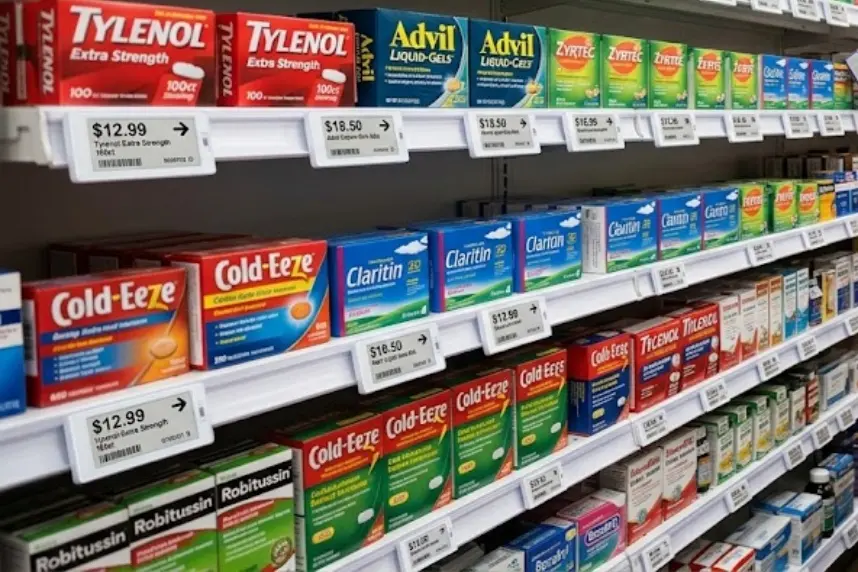
A full-floor deployment from day one introduces unnecessary risk. Starting with two or three high-velocity OTC sections - cold and flu, analgesics, vitamins - allows the team to validate system performance, staff adoption, and data accuracy before expanding to the full assortment. A pilot also generates real performance data for the internal business case before committing further capital.
Three Things to Verify Before Choosing a Vendor
Vendor selection for pharmacy ESLs deserves more scrutiny than most buying guides provide. Three questions cut through most of the evaluation noise:
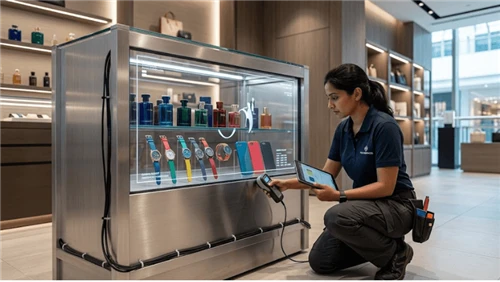
- Does their hardware fit your shelf edge? Pharmacy shelving configurations vary - narrow edges, specialized display fixtures, and refrigerated sections all impose physical constraints. Label dimensions and mounting systems need to be confirmed against actual shelf profiles before purchasing. A vendor who can't provide pharmacy-specific installation references should not be shortlisted.
- What does the management platform log, and how accessible is it? For compliance purposes, you need timestamped records of label updates that are retrievable during an audit. Ask vendors to demonstrate how this works in practice, not just confirm that the feature exists.
- What is the realistic integration timeline with your specific POS or pharmacy management system? Pre-built connectors dramatically reduce this. Custom integrations add months and cost. Get specifics, not generalities, on this before signing anything.
For a broader comparison of what to look for across providers, the ESL manufacturer comparison covers key differentiators worth reviewing before vendor conversations.
Common Misconceptions Worth Addressing
"ESLs will handle our labeling compliance in the dispensing area."
They won't. Prescription labeling compliance is governed by state pharmacy board regulations and applies to drug dispensing labels - a completely separate domain from front-end retail shelf tags. Conflating the two reflects a scoping error that can derail an otherwise sound project.
"ESLs eliminate pricing errors entirely."
Consider what actually happens when a vendor enters the wrong promotional price in the source system: the ESL displays that wrong price accurately and instantly across every label in scope. ESLs eliminate errors that originate in the tag replacement process. They faithfully reproduce whatever the upstream data says - which means data quality upstream is a prerequisite, not something ESLs fix. A useful analogy: switching from paper maps to GPS doesn't help if the address you enter is wrong.
On payback timelines: vendors sometimes present ROI projections based on high-labor-cost markets or large-format stores. The 18–36 month range that appears in most industry discussions reflects a wide spread of actual deployments. For a realistic projection, use your own labor costs, your own weekly price-change volume, and your own system integration complexity - not industry averages. The real deployment costs vary significantly by operator size and geography.
Frequently Asked Questions
- Are electronic shelf labels required for pharmacy pricing compliance?
- No. ESLs are not mandated by any current U.S. regulation. They're a technology choice that helps operators meet existing price accuracy requirements more reliably than manual systems. The compliance benefit is structural - removing the human step where most errors occur - not a regulatory checkbox.
- Can ESLs display information other than price in a pharmacy?
- Yes, depending on the management platform. Current systems support unit pricing, promotional mechanics, category identifiers, loyalty pricing tiers, and stock status indicators. The capability requires clean upstream data and appropriate configuration, but the hardware supports multi-field display across most current product lines.
- What's a realistic ROI timeline for a pharmacy ESL deployment?
- Industry figures typically cite 18–36 months, but the right number for your operation depends on your labor costs, your weekly price-change volume, and your integration complexity. Build your own model using current tag-management hours before accepting vendor projections.
- How long does a pharmacy ESL deployment take?
- A single-location pilot in two or three OTC categories can be operational in a few weeks once integration is confirmed. A full-floor deployment typically runs two to three months. Chain rollouts across multiple locations are multi-quarter programs, with integration work determining the critical path.
- What happens to shelf prices if the ESL system goes offline?
- E-ink displays are bistable - they retain their last-displayed image without power. If the system loses connectivity, labels continue showing the last price pushed to them. Most enterprise platforms include monitoring that alerts operators to individual label failures. A process for identifying and replacing failed labels should be part of any deployment plan.
The Honest Summary
Electronic shelf labels solve a well-defined set of problems in pharmacy retail: pricing accuracy, promotional timing, compliance exposure from manual tag lag, and the labor cost of weekly tag management. The technology is mature, the operational benefits are real, and the business case is defensible - for the right operator.
The pharmacy-specific reality is that the relevant environment is the OTC front end, not the dispensing area; the compliance stakes are higher than in general merchandise retail; and the ROI calculation for an independent pharmacy requires honest numbers, not industry benchmarks. Operators who start with those distinctions make better decisions about whether and how to move forward.
If you're at the evaluation stage, the most useful next step is a four-week audit of your current tag-management labor, followed by a vendor conversation grounded in that specific number. Everything else follows from there. For a deeper look at how ESL solutions can be configured for your pharmacy's specific setup, the details are worth reviewing before your first vendor call.