A customer may see the price of one product on a store shelf, at checkout, in a mobile app, on an e-commerce page, and inside a click-and-collect order. Those numbers do not always have to be identical. A loyalty offer may require membership, a delivery order may include a service charge, and one store may mark down stock that is not available elsewhere.
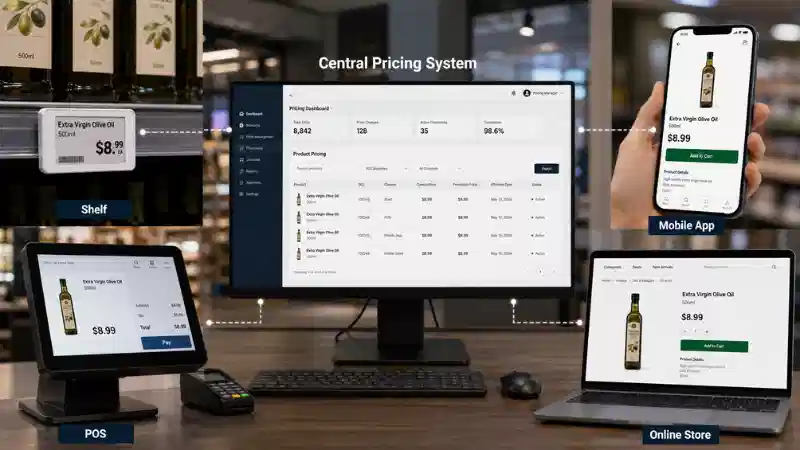
They do, however, need to follow approved and visible rules. Omnichannel price consistency means that every customer-facing price has a defined owner, a valid time and channel scope, a traceable source, and a method for detecting unintended differences.
For retailers using electronic shelf label solutions, this also means treating the physical shelf as one endpoint in a wider retail price synchronization process rather than as a separate pricing system.
Quick Answer
To keep shelf, POS, app, and online prices consistent, define one source of truth for each price type, attach a unique version and time-zone-aware effective period to every pricing event, distribute the event only to eligible channels, confirm the strongest available endpoint status, and reconcile the final displayed or charged price against the approved source. Legitimate channel differences should be documented and explained to the customer. Unexplained differences should enter an exception workflow instead of being hidden inside an overall success rate.
What Omnichannel Price Consistency Actually Means
Price Parity
Price parity means that the numerical price is identical in every channel. A product priced at $9.99 on the shelf is also $9.99 at the POS, in the app, and on the website.
This model is easy to explain, but it is not suitable for every retail operation. Online fulfillment, loyalty programs, local inventory and marketplace-funded promotions can create valid differences.
Price Consistency
Price consistency means that every price, including a different one, follows a documented business rule. A store price of $9.99, a member price of $8.99 and a delivered price of $11.99 can coexist when the eligibility and service conditions are clear.
A difference becomes an error when two channels claim to represent the same offer but show different values, when an expired promotion remains visible, or when the customer learns about a restriction only at checkout. Retailers should also review the price-display rules that apply in each target market. For example, the European Commission's Price Indication Directive guidance covers selling prices, unit prices and price-reduction announcements in the European Union.
The objective is not to force every channel into one number. It is to make every price correct, explainable, synchronized and auditable.
Map Every Customer-Facing Price Channel
Retailers often begin by connecting software. A safer first step is to document every place where a shopper can see or receive a price.
| Channel | Typical Price States | Key Question |
|---|---|---|
| Physical shelf | Regular, promotion, loyalty, clearance and unit price | Does the visible shelf offer match the product and the checkout rule? |
| POS and checkout | Final transaction price, tax, discount and coupon result | Which connected service determines the amount charged? |
| E-commerce website | Standard, online-only, marketplace and subscription price | Does the price depend on delivery, pickup or selected store? |
| Mobile app and loyalty platform | Member offer, activated coupon and personalized reward | Are the eligibility conditions visible before checkout? |
| Click-and-collect | Order-time, picking-time or collection-time price | At which moment is the price locked? |
| Digital signage and price checker | Promotional or informational price | Does it use the same approved event as the shelf and POS? |
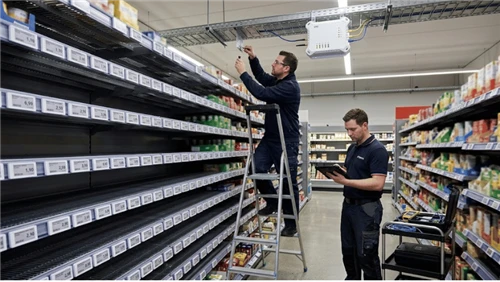
The physical shelf is usually the most complex endpoint because it combines software, store networks, product-to-label binding, display hardware and local procedures. Readers who need the hardware foundation can review how electronic shelf labels work, while this article focuses on the price-governance layer above the hardware.
Define One Source of Truth for Each Price Field
A retailer may store prices in several systems, but each price field should have one approved business owner. The owner is not necessarily the same application for every price type.
| Price Element | Possible System of Record | Decision That Must Be Documented |
|---|---|---|
| Regular selling price | Pricing engine, ERP or POS pricing service | Which system approves the base customer price? |
| Promotion price | Promotion engine or pricing platform | Which campaign wins when offers overlap? |
| Loyalty price | CRM or loyalty platform | What customer action or status activates the offer? |
| Online-only price | E-commerce pricing platform | Is it valid for delivery, pickup or both? |
| Store override | Regional or store pricing workflow | Who may approve it and when does it expire? |
| Unit price | Pricing engine or POS service | Where is it calculated and validated? |
| Clearance price | Markdown or inventory system | Is it limited to one store, batch or stock condition? |
The product identifier must also remain stable across systems. A GTIN is used to identify a trade item that may be priced, ordered or invoiced, as explained by the GS1 definition of a Global Trade Item Number. Retailers may use internal SKU values as well, but the mapping among product, store, offer and physical label must be unambiguous.
"Last update wins" is not a pricing policy. Without ownership, versioning and conflict rules, it is simply an undocumented race between systems.
Choose an Implementation Scope That Fits the Retailer
Not every retailer needs the same architecture. The control principles remain similar, but the technical implementation should match channel count, promotion volume and operational risk.
| Retail Environment | Practical Starting Point | When More Control Is Needed |
|---|---|---|
| Single store | POS-led price ownership, controlled imports and daily exception review | When online ordering, loyalty pricing or frequent promotions are added |
| Small chain | Central ERP or pricing source with store-level distribution and acknowledgement | When local overrides and multiple time zones become difficult to govern |
| Multi-region chain | Central pricing or promotion service, versioned events and formal reconciliation | When partial regional failures or overlapping campaigns create material risk |
| Large omnichannel retailer | Event-driven distribution, channel eligibility rules, observability and automated exception routing | When marketplaces, personalized offers and complex fulfillment methods are involved |
Technology scope should also be included in the business case. The article on real electronic shelf label costs can help separate label hardware from integration, installation, maintenance and operating-process costs.
A Complete Price Event Example
The following is an illustrative example, not a customer case study.
A grocery retailer plans a member promotion for a 500 g yogurt. The regular store price is $9.99 and the member price is $8.99. The offer begins at 08:00 local store time on August 3 and ends at 23:59:59 on August 9. It applies to the shelf, POS and loyalty app, but not to home delivery.
| Field | Illustrative Value |
|---|---|
| Event ID | PRICE-20260803-00081 |
| Product ID | SKU-10425 |
| Price type | Loyalty promotion |
| Regular price | 9.99 |
| Member price | 8.99 |
| Eligible channels | Store shelf, POS and loyalty app |
| Excluded channel | Home delivery |
| Store scope | Selected store cluster |
| Version | 7 |
| Effective time | 2026-08-03T08:00:00+09:00 |
| Expiration time | 2026-08-09T23:59:59+09:00 |
| Customer condition | Loyalty account identified at checkout |
The offset in the timestamps removes ambiguity across regions. RFC 3339 defines an Internet date-time format that includes a UTC indicator or numerical offset; retailers can consult the RFC 3339 timestamp specification when defining event formats.
The pricing service validates the record and publishes version 7. The POS stores both the regular price and the loyalty condition. The app displays the lower price with its membership requirement. The ESL platform selects a promotion template showing the regular and member prices. Home delivery continues to use its separately approved price rule.
If one store gateway accepts the event but several shelf labels remain unconfirmed, those labels enter an exception queue. The retailer does not mark the entire promotion as reconciled until the POS, app and required shelf endpoints meet the defined completion rule.
Build a Controlled Retail Price Synchronization Workflow
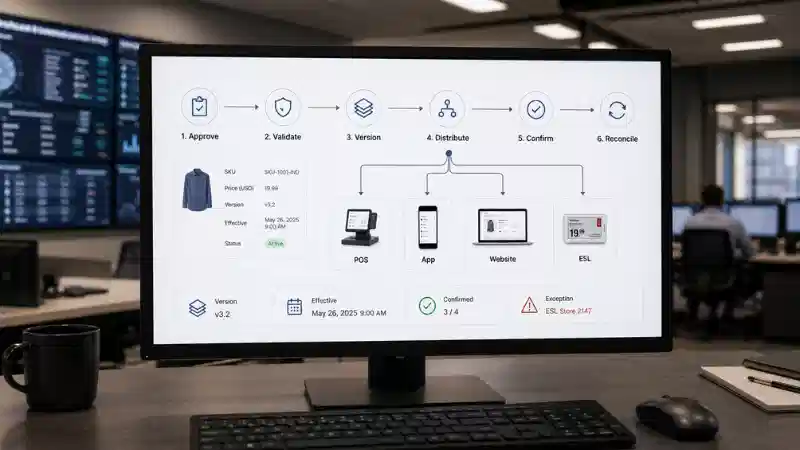
1. Approve the Price and Channel Rule
An authorized system or user creates the regular price, promotion, loyalty offer or local override. The approval record should identify the product, store or channel scope, currency, conditions, effective time, expiration time and approver.
The price strategy itself is separate from its distribution. For example, ESL dynamic pricing may determine when a value should change, while omnichannel price consistency determines how the approved value reaches eligible channels and how the final state is verified.
2. Validate Before Publication
Validation should cover product identity, store scope, price format, unit-price inputs, campaign priority, loyalty conditions, allowed ranges and required customer messages. Invalid records should be rejected or quarantined before they reach a customer-facing channel.
3. Assign a Unique Version and Effective Period
Every event should have an identifier and a version. A delayed version 6 must not replace version 7 simply because it arrives later. Effective and expiration times should include the applicable time-zone rule.
4. Distribute Only to Eligible Endpoints
The event may be sent to POS, e-commerce, app, loyalty, marketplace, ESL management and digital signage platforms. Eligibility should be explicit. A loyalty offer should not reach an unauthenticated online channel, and a local clearance event should not leak into another store.
5. Confirm and Reconcile
Distribution proves that an instruction was submitted. It does not prove that the customer sees or pays the correct price. Each channel should return the strongest available status, and the reconciliation process should compare that state with the approved source event.
Understand What Each Confirmation Level Proves
Status names vary by platform, so retailers should document their exact meaning instead of assuming that "success" has one universal definition.
| Status | What It May Prove | What It Does Not Automatically Prove |
|---|---|---|
| Accepted | The destination platform received and accepted the event | The price was published or displayed |
| Published | The channel application made the new price active | The shopper sees the correct product-price association |
| Transmitted | A store gateway sent an ESL update | The intended label rendered the new content |
| Device confirmed | The device returned the platform's defined acknowledgement | The label is mounted beside the correct product |
| Reconciled | The final recorded state matches the approved event and channel rule | Every physical placement issue has been visually inspected |
Communication technology affects what acknowledgement is available and how quickly failures can be detected. The comparison of Bluetooth, Wi-Fi and Sub-GHz ESL communication provides additional context, but confirmation semantics must still be verified with the selected platform.
Define Legitimate Channel Differences
Loyalty Prices
A member price should display the membership condition clearly. The standard price should remain understandable to a shopper who is not eligible.
Online-Only and App-Only Offers
The offer should state the channel, period, coupon requirement, product limit and fulfillment method. A shelf should not imply that an app-only price is available at checkout unless the retailer intends to honor it there.
Delivery and Service Charges
Where possible, separate the merchandise price from delivery, handling, installation or service fees. This makes a legitimate total-price difference easier to explain.
Regional and Store-Level Prices
A store-specific price remains consistent when the selected location is clear, the POS uses the same store context, the override has an owner and the rule expires or is reviewed.
Marketplace-Funded Promotions
A marketplace may fund an offer that does not apply to the retailer's website or stores. The retailer should document eligible inventory, funding responsibility, return treatment and customer messaging.
Use Electronic Shelf Labels as a Controlled Physical Endpoint
Electronic shelf labels can reduce the manual delay between an approved event and the physical shelf, but they do not remove the need for price ownership, product binding, exception handling and reconciliation.
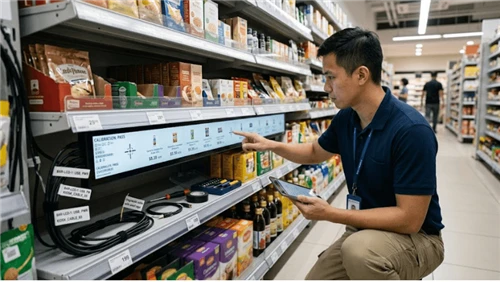
A shelf update may depend on correct binding, store network availability, gateway coverage, label registration, template compatibility, battery condition and successful refresh. A valid price can still appear beside the wrong product when the binding or physical placement is incorrect.
When a label fails to update, the exception record should identify the store, product, label, intended price, last known state, failure reason, retry history, owner and final verification. The troubleshooting guide for electronic shelf labels not updating covers device and network causes that should be investigated without turning this article into a hardware repair guide.
Physical deployment quality also matters. Proper electronic shelf label installation and accurate product-to-label binding are prerequisites for reliable price reconciliation.
Control the Full Promotion Lifecycle
A promotion is not successful merely because it starts correctly. The workflow must cover the pre-promotion price, scheduled activation, active period, approved changes, expiration, replacement price and final reconciliation.
- Scheduled start: The offer must not appear early and must activate in each eligible channel at the intended local time.
- Early termination: The process must identify who can stop the campaign and which price replaces it.
- Overlapping campaigns: Priority may be based on campaign rank, eligibility, local clearance or manual review, but the rule must be explicit.
- Expiration: The offer must disappear from the shelf, POS, website, app and other eligible channels.
- Restoration: The next value may be the original price, a newly approved base price, another promotion or a local markdown. It should be treated as another controlled pricing event.
For grocery and high-promotion environments, the practical guide to supermarket electronic price tags provides additional application context.
Detect and Resolve Cross-Channel Price Exceptions
| Exception | Risk | Recommended Response |
|---|---|---|
| Shelf and POS differ | Checkout dispute | Verify the approved source, apply the retailer's customer policy, correct both endpoints and confirm the final state |
| Website updates but store does not | Unexplained channel difference | Check store routing, event scope, ESL queue, gateway and device state |
| App shows an expired promotion | Invalid customer expectation | Remove the expired event and investigate the expiration workflow |
| Only some stores update | Regional inconsistency | Compare store IDs, time zones, local configuration and channel acknowledgements |
| Older price replaces a newer value | Stale-event failure | Reject the lower version and preserve the latest approved event |
| Loyalty price appears without conditions | Potentially misleading offer | Correct the message and review template and eligibility rules |
| One channel receives no event | Silent data loss | Reconcile source events against destination completion records |
| Promotion ends but shelf remains discounted | Margin, trust and possible compliance risk | Trigger a controlled correction and investigate the reversal failure |
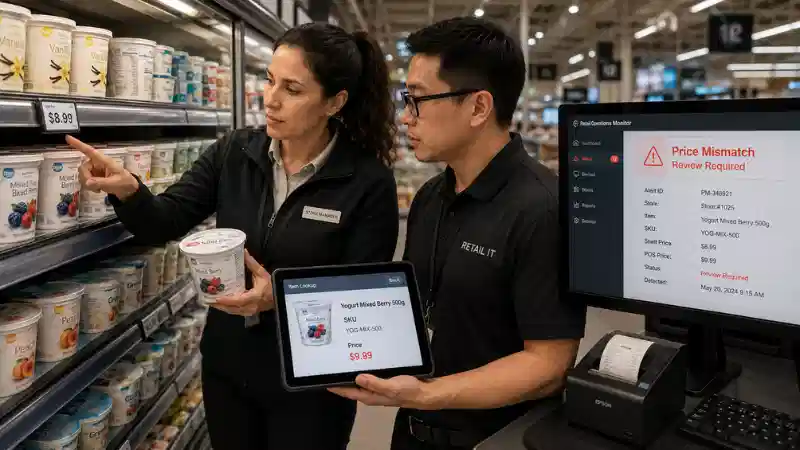
The business impact of a mismatch can extend beyond a single incorrect label. The article on what happens when price displays are wrong explains why customer handling, correction evidence and root-cause review should be part of the incident process.
Each exception should have a severity, owner, response target, escalation path, customer-treatment rule, rollback decision and closure evidence. A mismatch is not resolved merely because a correction was submitted.
Test Omnichannel Price Consistency Before Rollout
| Test | Expected Result | Release Decision |
|---|---|---|
| Normal regular-price update | Every eligible channel shows or charges the approved value | Block rollout if a critical endpoint cannot be confirmed |
| Future promotion | No early activation; correct local time, audience and message | Block if any customer-facing channel activates incorrectly |
| Promotion expiration | All eligible channels restore the approved next price | Block if reversion cannot be detected and confirmed |
| Duplicate event | No duplicate effect or incorrect recalculation | Block if processing is not idempotent for the defined event |
| Delayed older version | The stale event is rejected | Block if older data can overwrite a current price |
| Store network outage | Valid events recover in order; expired events do not publish late | Block if open exceptions disappear or sequence is not preserved |
| Store-specific price | The value remains within the intended store or cluster | Block if the price leaks into another location or channel |
| Online-only or loyalty-only offer | The offer remains restricted and its condition is visible | Block if an ineligible shopper can reasonably expect the lower price |
Testing should include actual shelf and store conditions when ESLs are involved. Retailers comparing the operating consequences of manual and digital updates can review electronic shelf labels versus paper labels.
Monitor the Process After Launch
Continuous operation needs a small set of indicators that reveal whether errors are being prevented, detected and resolved. Exact thresholds should reflect the retailer's volume, risk and local obligations rather than an unsupported universal benchmark.
| Metric | What It Reveals |
|---|---|
| Cross-channel mismatch count | How many products or offers have unexplained differences |
| Unconfirmed price event count | How many updates lack the required completion evidence |
| Stale event rejection count | Whether delayed or out-of-order updates are occurring |
| Promotion restoration failure count | Whether campaigns end cleanly |
| Mean time to resolve | How quickly significant exceptions are closed |
| Repeated exception count | Whether the same product, store or interface continues to fail |
| Manual correction rate | Whether staff intervention remains a hidden dependency |
Audit records should show the event, source, version, destination, status changes and responsible actions. NIST's Guide to Computer Security Log Management provides general guidance on establishing and maintaining log-management processes, although retailers should adapt logging practices to their own architecture and requirements.
ESLs can also support broader process improvements beyond price updates. The article on how ESLs streamline retail operations covers related operational uses, while price governance should remain separately measurable.
Common Mistakes to Avoid
- Treating consistency as mandatory equality: A valid channel difference can exist when the rule and conditions are clear.
- Allowing every channel team to edit the base price: Independent ownership creates conflicts that interfaces cannot solve.
- Using message arrival order as business priority: Version, eligibility and campaign rules should determine the result.
- Confirming transmission instead of final state: An API or gateway success response may not prove the customer-facing outcome.
- Testing activation without expiration: A promotion that starts correctly but fails to end is still a failed campaign.
- Ignoring local time: Server time and store time may differ, especially across regions or daylight-saving transitions.
- Hiding eligibility conditions: A lower displayed price should not surprise an ineligible shopper at checkout.
- Overengineering a small deployment: Controls should match the retailer's scale while preserving ownership, traceability and exception visibility.
Omnichannel Price Consistency Checklist
- Every customer-facing price channel is documented.
- Each price field has an approved source of truth.
- Product and store identifiers are consistent across systems.
- Legitimate channel differences follow written rules.
- Every pricing event has a unique identifier and version.
- Effective and expiration times include an explicit time-zone rule.
- Promotion activation and restoration are both tested.
- Endpoint status meanings are documented.
- ESL product-to-label binding is validated.
- Failed and unconfirmed updates enter a visible exception workflow.
- Source events are reconciled with final channel states.
- Critical mismatches block wider rollout.
- Customer-facing eligibility conditions are visible.
- Audit records identify approval, publication and corrective actions.
- Operations teams monitor recurring failures after launch.
FAQ
Q: Which price should apply to a click-and-collect order?
A: The retailer should define the rule before implementation. Common possibilities include the order-time price, selected-store price or collection-time price. The customer should see the rule before confirming the order, and the same context should be used by the order and checkout systems.
Q: Does a small retailer need a separate pricing engine?
A: Not necessarily. A single store or small chain may use a controlled POS- or ERP-led model. A separate pricing service becomes more useful as the number of channels, stores, promotions, overrides and exception paths increases.
Q: When is an ESL update considered complete?
A: Completion depends on the platform and the business risk. An accepted API request may be enough for a low-risk informational change, while a customer price may require device acknowledgement, source-to-endpoint reconciliation and selected physical checks. Status names and confirmation depth vary by platform.
Q: Should retailers retry or roll back after a partial failure?
A: The decision should depend on event validity, promotion timing, affected channels and customer impact. A safe process identifies which endpoints changed, prevents stale events from taking over and records whether the next action is retry, correction, rollback or temporary suspension.
Q: How often should prices be reconciled?
A: Frequency should follow risk. High-volume promotions and short-lived offers need tighter monitoring than stable regular prices. Retailers should consider update volume, channel criticality, past failure patterns and applicable local requirements rather than adopting an arbitrary universal schedule.
Q: How should a retailer evaluate an ESL supplier for omnichannel pricing?
A: Evaluate product binding, API or import options, version handling, acknowledgement depth, exception reporting, template controls, offline behavior and support for the intended store environment. The guide to choosing a retail ESL solution provides a broader supplier-selection framework.
Final Takeaway
Omnichannel price consistency is not achieved by copying one number into several applications. It depends on clear ownership, explicit channel rules, versioned events, time-aware publication, meaningful endpoint confirmation and visible exception handling.
Electronic shelf labels can close the physical delay between central pricing decisions and store shelves, but they do not replace pricing governance. Retailers first evaluating the technology can review the decision guide to digital price tags, the detailed electronic shelf labelling workflow, and the broader electronic shelf label solution overview before defining a pilot.
A rollout should expand only when the retailer can explain every legitimate price difference, detect every unintended mismatch and prove that the correct replacement price is restored when a channel fails.