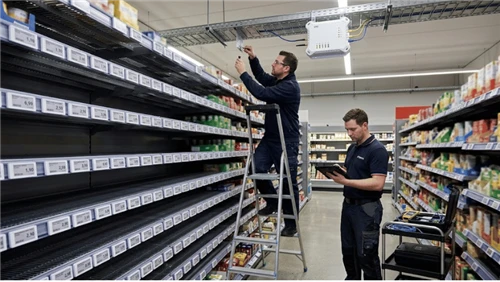
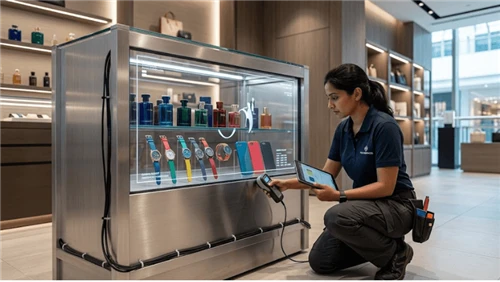
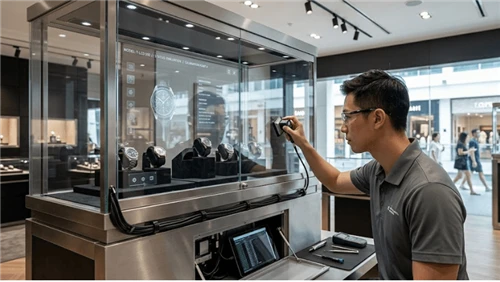
A successful pilot does not guarantee a successful chain-wide electronic shelf label rollout. The pilot tests whether the technology and operating model can work in a controlled environment. A rollout must reproduce that result across stores with different layouts, fixtures, networks, assortments, promotion schedules, staffing levels, and support needs.

Consider a typical failure pattern. A retailer completes a clean pilot in a standard supermarket, then schedules ten production stores in one wave. Two locations use older POS configurations, three have extensive freezer fixtures, and one has not received the correct mounting adapters. Installation starts on time, but price audits, label binding, and support demand quickly diverge from the pilot. The problem is not that the electronic shelf labels do not work. The problem is that the pilot design was expanded before the rollout controls were ready.
Retailers therefore need more than an installation calendar. They need an electronic shelf label rollout plan that defines which stores are ready, how rollout waves are sized, how cutover and rollback work, who owns each decision, how employees are trained, how spare stock is controlled, and what evidence is required before the next wave begins.
Retailers still evaluating the full technology stack should first review the available electronic shelf label solutions and understand how an ESL system works from the pricing platform to the physical shelf.
Quick answer: A dependable multi-store ESL deployment should classify stores into repeatable archetypes, verify readiness before scheduling, size rollout waves according to installation and support capacity, control price cutover, define rollback triggers, train each operational role, maintain appropriate spare stock, run a measurable hypercare period, and use formal entry and exit criteria for every wave.
What Changes After an ESL Pilot Is Approved?
A pilot, a rollout, and steady-state operations answer different questions.
| Project Stage | Main Purpose | Primary Decision |
|---|---|---|
| Pilot | Validate the technology, workflows, integration, and business case | Should the retailer proceed? |
| Rollout | Repeat the approved design across multiple stores without losing control | How quickly and under what conditions should the retailer expand? |
| Steady-State Operations | Monitor, support, maintain, and improve the deployed system | Who owns the system after the project team leaves? |

A good pilot should produce evidence about price accuracy, update reliability, gateway coverage, employee workflows, mounting stability, and operating costs. The rollout converts those findings into repeatable standards. Before scaling, the project team should have:
- An approved store-archetype model;
- A label, template, and mounting matrix;
- A standard gateway and network design;
- Documented product, price, and promotion rules;
- A store-readiness gate;
- A cutover and rollback procedure;
- Role-based training materials;
- A spare-stock and replacement model;
- A hypercare and long-term support model;
- Wave-level performance thresholds.
Do not treat rollout as a larger version of the pilot. A compact convenience store, a standard supermarket, and a large location with refrigerated cases may require different equipment, crew sizes, installation windows, and support arrangements.
Create Store Archetypes Before Scheduling Deployment
Managing every store as a completely unique project creates unnecessary planning work. Treating every store as identical creates operational risk. A practical approach is to group stores into archetypes based on physical, technical, and operational characteristics.

| Archetype Factor | Questions to Answer |
|---|---|
| Store format | Is it a convenience store, standard supermarket, large-format store, pharmacy, or warehouse-style location? |
| Label volume | How many labels are required, and what sizes, colors, and templates are needed? |
| Fixture profile | Which rails, hooks, baskets, glass shelves, freezer doors, endcaps, and promotional fixtures are present? |
| Network design | How many gateways are required, and where are the difficult coverage zones? |
| Pricing activity | How often do regular prices, promotions, markdowns, and emergency corrections change? |
| Installation conditions | Can work occur during trading hours, or is night access required? |
| Employee profile | Which roles, shifts, languages, and permission levels must be supported? |
| Support model | Does the store need on-site hypercare, remote support, or regional spare stock? |
Once an archetype has been validated, the retailer can reuse its bill of materials, mounting rules, gateway design, test script, installation sequence, training package, and support plan. The physical design should be coordinated with the detailed electronic shelf label installation process.
Store archetypes should also reflect the selected display technology. Label size, refresh behavior, viewing conditions, and promotional content may differ between departments. The comparison of LCD and E-Ink shelf labels can help clarify where different formats fit.
Build a Store Readiness Gate
A store should not enter a deployment wave simply because it appears on the calendar. It should first pass a formal readiness review supported by evidence.
| Readiness Item | Evidence | Typical Owner | Blocking? |
|---|---|---|---|
| Product master validated | Duplicate, inactive-SKU, and missing-identifier report | Product-data team | Yes |
| Store assortment confirmed | Approved active-SKU list | Merchandising | Yes |
| POS or ERP interface tested | Regression-test result | Retail IT | Yes |
| Label quantities confirmed | Store bill of materials | Project manager | Yes |
| Mounting hardware approved | Fixture-to-mount matrix | Store operations | Yes |
| Gateway locations approved | Site survey and coverage plan | Network team | Yes |
| Training completed | Attendance and task-assessment records | Store manager | Yes |
| Spare stock delivered | Physical inventory count | Logistics | Usually |
| Go-live support assigned | Support roster and escalation contacts | Support lead | Yes |
| Rollback plan approved | Signed cutover and recovery plan | Program governance | Yes |
Where GTIN is used in the product master, the retailer should align its product-identification rules with the GS1 Global Trade Item Number framework. Product identifiers, store identifiers, and label bindings should be validated before the installation team reaches the store.
Completed Readiness Example
The following example is illustrative and shows how a readiness gate can prevent a schedule-driven go-live.
| Item | Status | Evidence or Issue | Owner | Due Date |
|---|---|---|---|---|
| Product master | Ready | All active SKUs passed validation | Data team | Complete |
| POS integration | Ready | Single and batch price tests passed | Retail IT | Complete |
| Freezer mounts | Blocked | Correct adapters have not arrived | Logistics | Three days late |
| Store training | Conditional | Night-shift employees still require assessment | Store manager | T-2 days |
| Support coverage | Ready | On-site lead and remote escalation confirmed | Support lead | Complete |

This store should not proceed until the blocking mounting issue is resolved. A verbal promise that the parts are "on the way" is not the same as physical readiness.
Use Clear Readiness Statuses
- Ready: All critical requirements are complete and evidenced.
- Ready With Conditions: Minor open items have owners, dates, and no material effect on price or safety.
- Not Ready: A critical requirement remains incomplete.
- Deferred: The store requires redesign, construction work, a system upgrade, or rescheduling.
Choose a Rollout Wave Strategy
A rollout wave is a controlled group of stores deployed during the same project period. The correct grouping method depends on logistics, store similarity, business priority, and risk.
| Wave Strategy | Best Use | Main Advantage | Main Risk |
|---|---|---|---|
| Geographic | Stores concentrated in one city or region | Reduces travel and simplifies regional support | Stores in the same region may use different layouts or systems |
| Store Archetype | Locations with similar fixtures, label volumes, and network designs | Makes installation standards easier to repeat | Stores may be geographically dispersed |
| Risk-Based | Early production waves | Prioritizes prepared, lower-risk locations | May delay complex stores that need early learning |
| Business-Priority | Promotional, regulatory, or high-labor locations | Targets the strongest business value first | Commercial urgency may exceed technical readiness |
| Hybrid | Most chain-wide programs | Balances geography, archetype, risk, and business priority | Requires disciplined selection rules |
For most retailers, a hybrid model is the most practical. A wave might include prepared stores in one region, but only locations belonging to approved archetypes and using compatible POS versions.

Calculate Wave Capacity Before Committing Dates
The wave size should be constrained by both installation capacity and post-go-live support capacity. A project can install more stores than it can stabilize.
Installation Capacity Formula
Daily Label Capacity = Crew Count × Productive Hours per Crew × Labels Installed per Crew-Hour × Utilization Factor
Estimated Installation Days = Total Labels in the Wave ÷ Daily Label Capacity
The utilization factor accounts for breaks, store access, fixture changes, travel inside the store, device exceptions, recounting, and price audits. The formula is a planning model, not an industry benchmark.
Illustrative Capacity Example
| Input | Example |
|---|---|
| Stores in proposed wave | 6 |
| Average labels per store | 4,000 |
| Installation crews | 4 |
| Productive hours per crew per day | 7 |
| Labels installed per crew-hour | 85 |
| Utilization factor | 0.75 |
The estimated daily capacity is 1,785 labels. A 24,000-label wave would therefore require approximately 13.5 crew-days before additional time for gateway work, acceptance testing, travel, and rework.
Support Capacity Must Also Limit the Wave
If the help desk and hypercare team can actively support only four new stores at a time, the proposed six-store wave is too large even if installation crews can complete it. The final wave size should be the lower of:
- The installation-based capacity;
- The logistics-based capacity;
- The supplier-support capacity;
- The hypercare capacity;
- The number of stores that have passed readiness.
Cost assumptions should be tested against the complete business case rather than hardware alone. The ESL ROI calculation framework and the analysis of the real cost of electronic shelf labels can help structure those assumptions.

Define Entry and Exit Criteria for Every Wave
Entry criteria determine whether a wave can start. Exit criteria determine whether the next wave can proceed. This is a governance decision, not merely a scheduling decision. The Project Management Institute's discussion of project governance provides a broader reference for decision rights, oversight, and accountability.
Illustrative Entry Criteria
- Every store has passed the readiness gate;
- Hardware, gateways, mounts, tools, and spares are available;
- POS, ERP, middleware, and ESL interfaces have passed regression testing;
- Store product and price data have been validated;
- Installation plans have been approved;
- Required employee training has been completed;
- Support rosters and escalation contacts are active;
- Cutover, price-freeze, and rollback decisions have been approved;
- No unresolved critical defect remains from the previous wave.
Illustrative Exit Criteria
- No unresolved critical price or security incident;
- Price audits meet the approved acceptance threshold;
- Update performance meets the agreed service level;
- Failed updates are visible and controlled;
- Product-to-label binding accuracy meets the target;
- Gateway and network performance are stable;
- Store employees can complete routine tasks;
- Support demand has fallen to the steady-state threshold;
- Installation rework has been corrected;
- The next wave has incorporated required changes.
A wave is not complete when the installation crews leave. It is complete when the stores are stable and the governance team has enough evidence to make the next decision.
Create a Detailed Store Cutover Plan
Cutover is the controlled transition from the existing shelf-label process to the new ESL operating model. It should define the systems, stores, departments, time window, decision owners, price rules, paper-label treatment, testing sequence, and rollback triggers.
Illustrative Cutover Timeline
| Time | Required Actions |
|---|---|
| T-14 Days | Confirm assortment and label quantities; complete the site survey; approve gateways and mounts; review promotions; verify delivery of hardware and spares. |
| T-7 Days | Run final synchronization tests; complete employee training; validate accounts; confirm installation zones; review rollback and escalation procedures. |
| T-1 Day | Verify the latest prices and promotions; confirm monitoring; count spares; review open readiness items; hold the final go or no-go meeting. |
| Go-Live Day | Install and bind by zone; audit each completed area; test one update and one controlled batch; record failures; obtain store acceptance. |
| T+1 to T+14 | Review failed updates, price audits, gateway status, support tickets, staff workarounds, promotion reversals, rework, and hypercare exit evidence. |

The cutover plan should also coordinate the wireless portion of the deployment. Gateway quantity, coverage, interference, and recovery behavior depend on the chosen communication architecture. See the comparison of Bluetooth, Wi-Fi, and Sub-GHz ESL communication.
Decide Whether a Price Freeze Is Necessary
A price freeze is a temporary restriction on price or promotion changes during cutover. It may simplify the transition, but it is not appropriate for every retailer.
| A Freeze May Help When | A Freeze May Be Inappropriate When |
|---|---|
| Paper labels and ESLs will operate together briefly | Prices change continuously |
| Large numbers of products are being bound for the first time | Regulatory or competitive requirements prevent a freeze |
| The team needs a stable audit baseline | The rollout spans several trading days |
| No major promotion is scheduled | The platform is designed to process live updates during installation |
If a freeze is used, document its start and end time, allowed emergency changes, treatment of blocked transactions, release sequence, version controls, and final synchronization audit. Retailers that use frequent automated changes should also coordinate the cutover with their ESL dynamic pricing process.
Manage Paper Labels During the Transition
The rollout plan should define when existing paper labels are removed and what emergency backup remains available. Common approaches include zone-by-zone replacement after each price audit, temporary paper backup in the store office, or paper labels only for fixtures that are not yet approved for ESLs.
The key rule is simple: a shelf should not present two conflicting active prices. The business consequences of inconsistent shelf pricing are discussed in what happens when price displays are wrong.
When calculating labor and transition benefits, compare the complete digital process with the existing paper workflow. The analysis of electronic shelf labels versus paper labels provides a useful baseline.

Define Rollback and Business-Continuity Procedures
A rollback plan explains how the retailer will contain or reverse a failed cutover. It should be tested before go-live rather than written after an incident.
The NIST contingency-planning guidance provides a broader framework for evaluating system recovery requirements, priorities, and operational resilience.
Possible Rollback Triggers
- Widespread incorrect shelf prices;
- POS and ESL prices fail to synchronize;
- Large-scale product-to-label binding errors;
- A promotion cannot start or end correctly;
- Gateway coverage is unstable;
- Transactions disappear without alerts;
- Store employees cannot perform essential tasks;
- A security or access-control failure occurs;
- The system is unavailable without a reliable recovery path.
Define Rollback Scope
| Scope | Example | Typical Authority |
|---|---|---|
| One label | Incorrect binding or damaged device | Store support |
| One department | Mounting, template, or coverage issue in one zone | Store manager and IT |
| One store | Store-wide integration or price failure | Program lead and pricing owner |
| One wave | Repeated design failure across similar stores | Governance board |

The final verification should prove which prices, templates, and bindings were restored, who authorized the action, which corrective transactions were issued, and whether paper backup was reintroduced.
Use a Defect Severity Matrix
Not every issue should block the next wave. A documented severity model prevents teams from treating cosmetic problems and customer-facing price failures as equivalent.
| Severity | Example | Required Response | Wave Effect |
|---|---|---|---|
| Critical | Incorrect customer-facing prices, silent transaction loss, security breach, or no recovery path | Immediate containment, executive escalation, and root-cause correction | Stop or pause |
| High | Repeated binding failures, unstable gateway zone, or failed promotion reversal | Correct before expansion and retest | Usually pause |
| Medium | Training confusion, excessive support steps, or localized mounting rework | Assign owner and include correction in the next wave | Conditional continuation |
| Low | Documentation wording, cosmetic template alignment, or non-blocking inventory issue | Track in the improvement backlog | Continue |
Create a Rollout RACI
Rollout responsibilities should not remain with an undefined "project team." A RACI identifies who is responsible, accountable, consulted, and informed.
R = Responsible, A = Accountable, C = Consulted, I = Informed
| Activity | Retail IT | Store Operations | Supplier | Installer | Pricing / Merchandising | Help Desk | Governance |
|---|---|---|---|---|---|---|---|
| Store readiness approval | C | R | C | C | C | I | A |
| POS and ESL integration test | A/R | I | C | I | C | I | I |
| Gateway and network readiness | A/R | C | C | C | I | I | I |
| Label installation and binding | C | C | C | A/R | I | I | I |
| Price and promotion validation | C | R | C | I | A | I | I |
| Go-live decision | C | C | C | I | C | I | A/R |
| Incident triage | C | C | C | I | I | A/R | I |
| Rollback authorization | R | C | C | I | R | I | A |
The supplier's responsibilities, support hours, replacement process, software-update policy, and escalation commitments should also be reflected in the contract. The comparison of electronic shelf label manufacturers can support early supplier evaluation.
Plan Spare Labels and Replacement Stock
Insufficient spare stock can leave damaged or missing labels unresolved. Excessive stock can create unused inventory when models, templates, or mounting standards change.
Initial Spare Requirement = Installed Labels × Planning Spare Rate + Forecast New-SKU Demand + Known Replacement Backlog + Safety Stock
This is a planning formula, not a universal benchmark. The spare rate should reflect label size, store format, damage exposure, refrigeration, supplier lead time, service target, expected assortment changes, inter-store transfer capability, and the risk of model obsolescence.
Spare Inventory May Include
- Labels by model, size, and color;
- Gateways and power supplies;
- Rails, hooks, clips, and adapters;
- Freezer and refrigerated mounts;
- Binding or scanning devices;
- Replacement batteries where applicable;
- Installation and diagnostic tools.
A retailer may keep emergency stock in each store, regional reserves for common replacements, and central stock for lower-frequency models. The design should balance replacement speed with inventory control.

Train Different Roles for Different Tasks
One generic training session is not enough. Store associates, managers, IT teams, pricing teams, help desks, and installers have different responsibilities.
| Role | Required Competence |
|---|---|
| Store associate | Inspect, bind, move, and replace a label |
| Department manager | Verify prices, promotions, and local exceptions |
| Store manager | Approve local actions and escalate critical issues |
| Retail IT | Monitor interfaces, gateways, queues, access, and recovery |
| Pricing and merchandising | Control product data, templates, promotions, and corrections |
| Help desk | Classify incidents, collect evidence, and route cases correctly |
| Regional operations | Review store readiness and wave performance |
| Installer | Follow mounting, binding, testing, and documentation standards |
Training should be measured through task completion rather than attendance alone. Employees should demonstrate that they can recognize a failed update, correct a basic binding issue, replace a device, verify a promotion, and escalate an incident with the required transaction, label, product, store, and time information.
Run a Go-Live Command Center
For early waves or complex stores, a temporary go-live command center creates one decision and communication channel.
Recommended Participants
- Program or rollout lead;
- Retail IT and integration owner;
- Store-operations representative;
- Pricing or merchandising owner;
- Supplier technical lead;
- Installation lead;
- Help-desk lead;
- Regional manager.
What the Command Center Monitors
- Stores started, completed, blocked, and rolled back;
- Labels installed and bound;
- Price-audit pass rate;
- Offline labels and gateway status;
- Failed and delayed updates;
- Open critical and high defects;
- Promotion activation and reversion;
- Support tickets and response times;
- Spare-stock consumption;
- Go, pause, or rollback decisions.
During go-live, the team may meet at fixed checkpoints, such as before installation, after each department, after the first batch update, and before store sign-off. Every material decision should record the time, evidence, decision owner, and follow-up action.
Create a Measurable Hypercare Plan
Hypercare is a temporary period of enhanced monitoring and support after a store goes live. Its purpose is to detect early operational problems before employees create permanent manual workarounds.
The site's guide to common ESL update failures can help define incident categories for the hypercare queue.
Hypercare Dashboard
| Measure | Why It Matters |
|---|---|
| Offline labels | Identifies device, coverage, and power issues |
| Failed or delayed updates | Shows whether price transactions are reaching the shelf |
| Price-audit pass rate | Protects the customer-facing result |
| Incorrect bindings | Reveals installation and employee-process errors |
| Queue depth and oldest pending update | Detects capacity and recovery problems |
| Promotion reversion failures | Identifies expired promotional prices that remain active |
| Support tickets per store | Measures operational difficulty |
| Installation rework | Shows mounting and quality problems |
| Spare consumption | Tests replacement and inventory assumptions |

Log retention and investigation practices should support incident reconstruction. The NIST Guide to Computer Security Log Management provides broader guidance on developing and maintaining enterprise log-management processes.
Illustrative Hypercare Exit Criteria
- Zero unresolved critical incidents;
- Price audits meet the approved threshold for a defined stable period;
- No silent update loss is detected;
- Failed updates are visible, owned, and within the response target;
- Support-ticket volume is at or below the steady-state threshold;
- Store employees complete routine tasks without project-team assistance;
- Temporary paper or manual workarounds have been removed;
- Ownership has transferred to the permanent support model.
Hypercare should end when the evidence supports transition, not simply because fourteen days have passed.
Protect Access, Monitoring, and Recovery
Rollout introduces new user accounts, mobile binding tools, gateways, APIs, support access, and administrative permissions. Security must be part of readiness and cutover rather than a post-launch task.
The NIST Cybersecurity Framework 2.0 offers a broad structure for governing, identifying, protecting, detecting, responding to, and recovering from cybersecurity risk.
At minimum, verify:
- Role-based access and least privilege;
- Multi-factor authentication where supported;
- API credential storage and rotation;
- Removal of temporary installer accounts;
- Logging of price, template, binding, and rollback actions;
- Approval controls for bulk changes;
- Supplier remote-access rules;
- Backup, recovery, and escalation procedures.
Measure Rollout Performance by Store and Wave
| KPI | What It Measures |
|---|---|
| Labels installed per crew-hour | Installation productivity |
| First-time binding accuracy | Quality of product-to-label setup |
| Installation rework rate | Mounting and process quality |
| Price-audit pass rate | Customer-facing accuracy |
| First-attempt update success | Network and device reliability |
| Median and P95 update time | Typical and long-tail completion performance |
| Time to stable operations | How quickly a store leaves hypercare |
| Support tickets per store | Operational difficulty and support demand |
| Training task-completion rate | Employee readiness |
| Spare consumption | Damage and inventory assumptions |
| Open critical incidents | Whether the next wave can proceed |
| Cost per installed label | Deployment cost efficiency |
Display refresh performance should be separated from backend processing, queue delay, and gateway transmission. See the explanation of ESL refresh rates and display performance.
Report results by store archetype, region, installation crew, fixture type, label model, gateway zone, and rollout wave. A chain-wide average can hide one weak store type or one crew with a high rework rate.
Make a Formal Wave Decision
| Decision | When to Use It |
|---|---|
| Continue | Exit criteria are met, no critical issue remains, and the next stores are ready |
| Continue With Corrections | The design is valid, but training, mounting, support, or documentation changes are required |
| Pause | A significant price, integration, network, security, or support problem requires correction and retesting |
| Redesign the Archetype | The approved standard repeatedly fails for a particular store type |
| Rollback | The customer-facing or operational risk cannot be controlled during the current go-live |

A high total score should never override an unresolved critical pricing, security, or recovery failure.
Illustrative Composite Rollout Scenario
The following example is a composite planning scenario, not a named customer claim.
A retailer proposes a second production wave containing eight supermarkets. All eight have passed basic data validation, but three include extensive freezer departments. The project plan assumes the same mounting and productivity rates used in the first wave.
During the first freezer-store installation, the team finds that the approved adapter becomes loose during replenishment. Installation slows, rework increases, and the crew consumes most of the regional spare mounts. At the same time, the support team is handling unresolved binding questions from two stores that recently left go-live.
The correct decision is not to continue because the first store eventually opened. The governance team should:
- Pause the remaining freezer-store installations;
- Continue only with stores using the validated standard fixture design;
- Test a revised freezer mount under normal replenishment and cleaning conditions;
- Update the archetype bill of materials and installation productivity assumption;
- Recalculate spare stock and wave capacity;
- Complete hypercare for the open stores before restarting the paused group.
This decision prevents one local defect from being copied across several stores.
Evidence Required in the Rollout Report
Each wave report should include:
- Stores and archetypes included;
- Readiness status before deployment;
- Installed label, gateway, and mounting quantities;
- Planned and actual installation time;
- Price-audit and update results;
- Binding, mounting, and network defects;
- Defect severity and root-cause status;
- Support tickets and resolution times;
- Training completion and task results;
- Spare-stock consumption;
- Hypercare exit status;
- Corrective actions for the next wave;
- The formal continue, correct, pause, redesign, or rollback decision.
Supporting evidence may include readiness forms, installation photographs, transaction logs, gateway reports, audit results, training assessments, support tickets, and store sign-off documents.
FAQ
Q: How should acceptance thresholds be set for an ESL pilot?
A: Acceptance thresholds should be approved before testing and based on pricing risk, internal service-level requirements, current paper-label performance, supplier commitments, store format, and applicable pricing rules. Example thresholds from another retailer should be treated as planning references rather than universal standards. Critical failures, such as an incorrect selling price or silent transaction loss, should normally be handled as separate rollout gates instead of being averaged into an overall score.
Q: Should ESL pilot results use averages or percentile measurements?
A: Use both. The median shows typical performance, while P95 indicates the time within which 95% of measured updates or incidents were completed. Averages alone can hide a small number of severe delays. The pilot report should also list maximum values, failed transactions, and unresolved exceptions separately.
Q: How should price accuracy be audited during an ESL pilot?
A: Compare the physical shelf display with the approved source record and verify the product identifier, selling price, unit price where required, promotion price, effective dates, currency, and product description. Use full validation for critical promotion events where practical and stratified random sampling for routine audits. Results should be separated by department, fixture type, label size, update type, promotion status, and wireless zone.
Q: What should automatically block an electronic shelf label rollout?
A: Unresolved critical failures should block rollout even when the total KPI score is high. Examples include incorrect shelf prices, failed promotion reversals, silent loss or duplication of price transactions, unauthorized price changes, failures that are not detected reliably, and routine workflows that cannot be completed without repeated supplier intervention.
Q: Can one ESL pilot represent every store in a retail chain?
A: Not always. One pilot may be sufficient when stores have similar layouts, fixtures, systems, update volumes, and operating processes. Chains with materially different store formats may need separate pilot archetypes. A compact convenience store, large supermarket, pharmacy, and warehouse-style location can have different wireless coverage, mounting, workflow, and integration risks.
Q: Who should own the ESL pilot KPIs?
A: Ownership should be divided according to the source of evidence. Retail operations may own labor and workflow measures, IT may own integration and monitoring results, merchandising may approve templates and promotion behavior, finance may validate cost assumptions, and store management may assess employee task completion. Each KPI should have one named owner responsible for data quality, threshold approval, and final sign-off.
Q: How should failed ESL updates be tested?
A: Create controlled failures with known start times. Examples include disconnecting a gateway, pausing an integration connection, submitting an invalid source record, removing a label, or creating a controlled incorrect binding. Verify alert timing, automatic retries, exception classification, escalation, recovery, audit logs, and the final shelf state. A failure that is corrected but never detected by the platform should not be considered a successful test.
Q: What evidence should an ESL supplier provide after the pilot?
A: Request exported event logs, update confirmation records, retry rules, integration recovery results, gateway coverage findings, role and permission documentation, training materials, support response commitments, warranty terms, spare-device recommendations, and a rollout architecture for larger store volumes. Informal statements should not replace measurable evidence or contractual commitments.
Q: How can a retailer determine whether labor savings are real?
A: Measure net labor change rather than only the work removed from the paper-label process. Subtract ESL monitoring, exception handling, rebinding, template maintenance, device replacement, and IT support time from the baseline paper-label workload. Record hours by role and department because store labor savings may be offset by additional work for central IT or support teams.
Q: What should happen when one department fails but the overall pilot score passes?
A: Do not approve an unconditional rollout based only on the store-wide average. Identify the failed department, classify the root cause, correct the network, mounting, template, workflow, or integration issue, and repeat the affected tests. Rollout may proceed in validated areas only when the deployment plan clearly separates them from conditions that still require remediation.
Final Takeaway
An electronic shelf label rollout is a controlled operational transformation involving data, pricing, networks, fixtures, logistics, employees, suppliers, support, and governance.
The strongest rollout plans classify stores into repeatable archetypes, verify readiness with evidence, size waves according to installation and support capacity, control cutover and rollback, define responsibility through a RACI, train each role, maintain planned spare stock, and keep stores in hypercare until measurable exit criteria are met.
Each wave should improve the standard before it is repeated at a larger scale. When a local defect appears, the retailer should pause or redesign the affected archetype rather than reproduce the same weakness across the chain.
With disciplined entry criteria, decision rights, recovery controls, and performance reporting, retailers can use ESLs to streamline retail operations without sacrificing price accuracy, operational control, or store support.