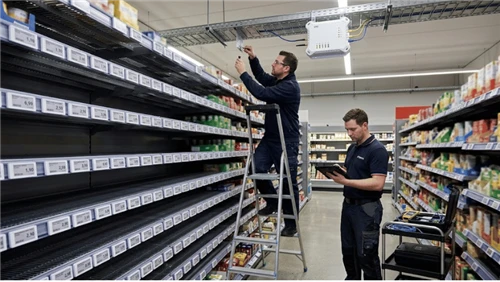
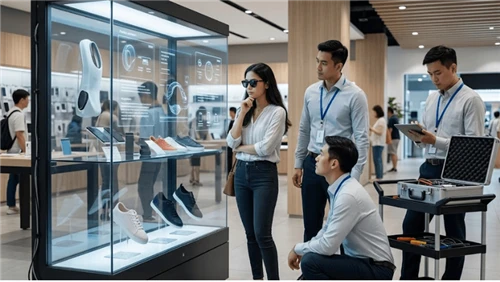
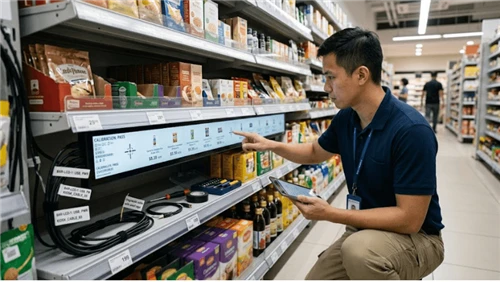
Electronic shelf labels (ESLs) - also called digital shelf labels or digital price tags - are changing that workflow for grocery operators of every size, from single-location independents to national chains. This guide covers how the technology works, what it actually costs, where the ROI comes from, and how to evaluate whether it fits your operation - including the parts most vendor-written overviews skip.
What Are Electronic Shelf Labels and How Do They Work?
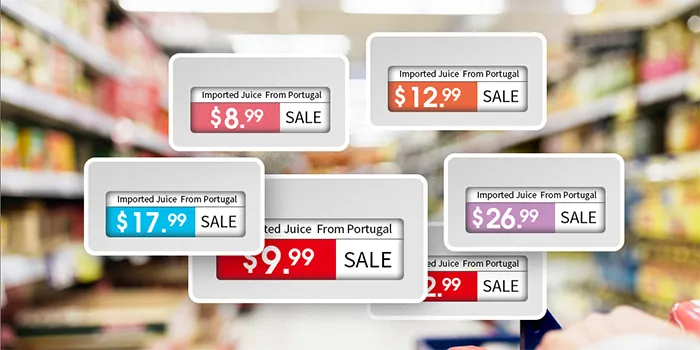
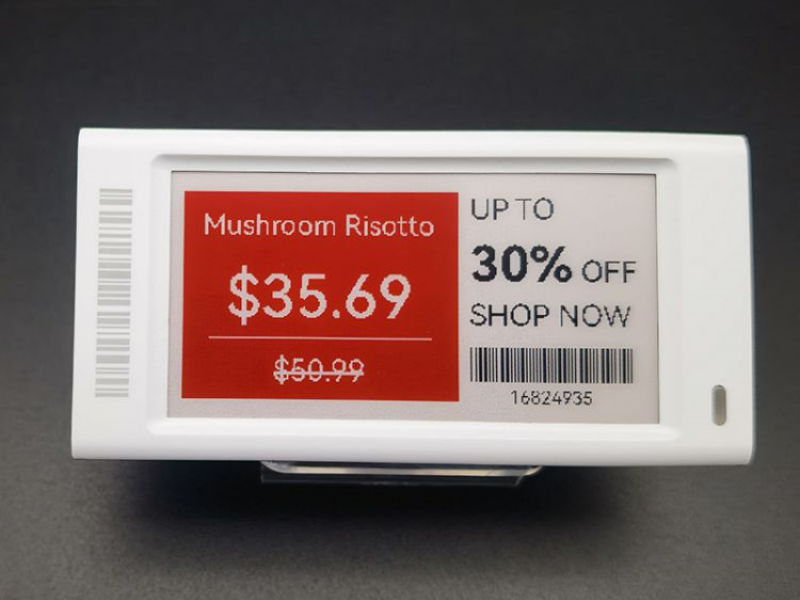
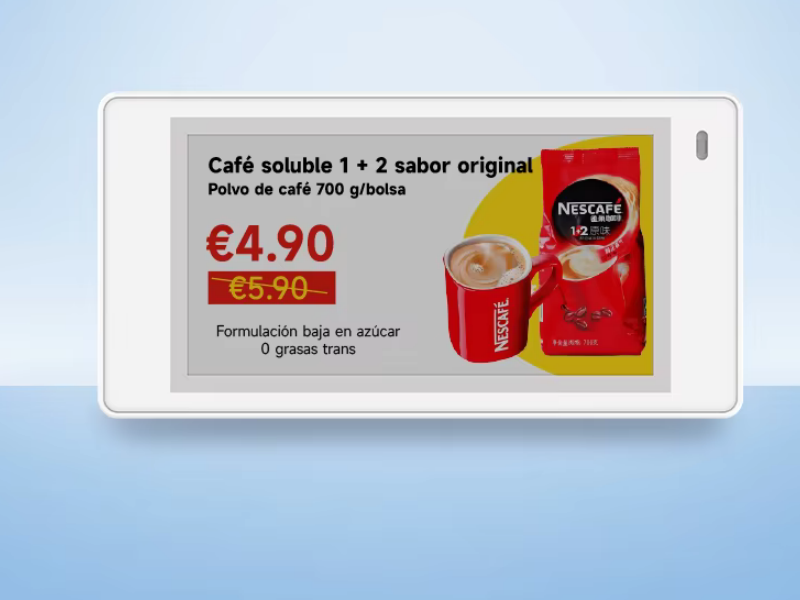
An electronic shelf label is a battery-powered digital display that mounts at the shelf edge, replacing the paper tag strip. Each label shows price, product name, unit cost, and - depending on the system - promotional details, QR codes, or inventory indicators.
Most grocery deployments use e-ink displays (the same low-power screen technology found in e-readers). E-ink holds a static image without drawing power between updates, which means long battery life and excellent readability under bright store lighting. LCD-based labels are brighter and support color and animation, but consume more power and typically cost more per unit. Understanding how e-ink and LCD shelf labels compare matters at the vendor selection stage, particularly for departments with different display needs - produce sections may benefit from color LCD to highlight promotions, while center-store aisles typically run fine on standard e-ink.
Each label connects wirelessly to a central access point - usually via sub-GHz radio frequency (RF), Wi-Fi, or infrared - which ties into your store's pricing database or POS system. When a price changes in the back-end system, the update pushes automatically to every relevant label, usually within seconds to a few minutes depending on network size. For a deeper look at how ESL systems work end-to-end, the communication protocol choice (Bluetooth vs. Wi-Fi vs. sub-GHz RF) affects both update speed and infrastructure cost - worth clarifying with any vendor early.
Integration is where most buyers underestimate the complexity. ESLs function as a display layer, not a standalone system. They deliver their full operational value only when directly connected to your POS, pricing database, and ideally your inventory management system. A price change entered once should propagate everywhere - the register, the shelf, the back-of-house report - without anyone triggering it manually. Without that integration, ESLs become semi-manual displays that still require staff to push updates, which erodes the labor benefit significantly.
5 Operational Benefits Worth Quantifying
1. Labor Recovery: From a Two-Day Task to Two Minutes
Manual price changes require someone to generate the new tag, print it, cut it, and walk the floor department by department. In a store running weekly promotions or managing several thousand SKUs, that process can absorb 30 to 50 staff hours per week. One independent grocer reported to the U.S. Chamber of Commerce saving approximately 50 labor hours weekly after switching - hours that shifted toward restocking, customer service, and floor management.
At larger scale, a Walmart store team lead described a price change that previously took two days now taking minutes. The labor benefit grows proportionally with promotion frequency and SKU count, which is why high-volume grocery formats tend to see the fastest payback.
2. Pricing Accuracy and Compliance Exposure
In most U.S. states, consumer protection law requires that the advertised shelf price be honored at checkout. A mismatch isn't just a customer service problem - it's a compliance exposure that can trigger regulatory fines and, in documented cases at chains like Kroger, class action litigation.
Paper label systems create a natural error window between when a price changes in the system and when the floor is updated. ESLs connected directly to the POS close that window. The downstream consequences of incorrect price displays are more serious than most operators budget for - errors compound across high-traffic days and sale periods, when the risk of overcharging is highest. For more on how compliance risk plays out in practice, see what happens when price displays are wrong.
3. Perishable Markdown Automation
Under a paper label system, managing markdowns on near-expiry items is slow: someone has to identify the item, calculate the discount, print a new tag, and apply it. The time between "this item is about to expire" and "the discount is live on the shelf" is often long enough that the selling window closes before the markdown lands.
ESLs integrated with inventory and expiration tracking allow stores to automate that process. When an item crosses a time threshold before its sell-by date, the price drops automatically. Research from UC San Diego's Rady School of Management found that dynamic pricing of perishables can reduce food waste by up to 21 percent - a meaningful number for any department running significant fresh or prepared food volume.
4. Pick-to-Light for Online Order Fulfillment
ESLs have a fulfillment capability that rarely appears in basic benefits lists: their LEDs can flash on command. This is the foundation of pick-to-light - when a worker is fulfilling an online order or curbside pickup, the relevant ESL is triggered to flash, guiding them directly to the correct item without a printed pick list or aisle memorization.
Instacart's Carrot Tag platform integrates with compatible ESLs to direct in-store pickers using this method. Walmart's deployment supports the same workflow via mobile app. As online grocery fulfillment grows as a share of total store volume, pick-to-light capability is becoming a standard evaluation criterion rather than a nice-to-have. If your store runs any meaningful delivery or curbside volume, confirm pick-to-light compatibility before finalizing a vendor.
5. A Shelf Edge That Signals Operational Discipline
Shelf edges cluttered with misaligned paper tags, faded labels, and overlapping promotional stickers communicate disorder - even in stores that are otherwise well-run. ESLs produce a consistent, legible shelf edge with room to display more information: unit price, nutritional highlights, QR codes, promotional callouts. Shoppers who trust that the shelf price matches the register check out faster and dispute less. That's not a soft benefit - it affects throughput and staff time spent on customer disputes.
What Does It Actually Cost - and When Does It Pay Back?
This is the question most ESL overviews avoid. The honest answer is that upfront costs are real, the range is wide, and the payback period depends heavily on your specific operation.
Hardware is the largest cost component: the labels themselves, the access point infrastructure to create the wireless network, and the software platform that manages everything. A mid-size grocery store deploying approximately 30,000 labels has been estimated at roughly $300,000–$350,000 in hardware and installation, based on figures reported by industry sources including the U.S. Chamber of Commerce. Smaller deployments cost less; the per-label economics also improve at scale as the market matures. For a detailed breakdown, this ESL cost analysis covers what drives the variation.
Ongoing costs include annual software licensing, support contracts, and battery replacement - though e-ink batteries typically last three to seven years depending on update frequency, so that's a deferred cost, not an immediate one.
On payback periods: Published case studies vary considerably. Houchens Food Group, a regional U.S. grocery chain, piloted ESLs across two stores and calculated an ROI period of approximately 3.5 years based on hardware, paper tag elimination, and labor savings. The independent grocer cited above projected under two years. Industry benchmarks from sources like Grand View Research and retail technology analysts generally place the range at 24 to 36 months for standard grocery formats - shorter for stores with high promotion volume, longer for those with infrequent price changes. To model what your specific store might look like, an ESL ROI calculator can help you plug in your own labor costs and promotion frequency.
ESLs deliver faster returns when your store runs frequent price changes, carries significant perishable volume, has high regional labor costs, or is growing its online fulfillment operations. They're harder to justify when pricing rarely changes, your current workflow is already lean, or the POS integration requires expensive custom development.
The Surge Pricing Question: What the Evidence Shows
When Walmart and Kroger announced large-scale ESL deployments in 2024, several prominent U.S. senators raised concerns that digital shelf labels would enable "surge pricing" - automatically raising grocery prices during peak shopping hours or high-demand events, similar to ride-sharing apps. Several states, including Arizona, Rhode Island, and Maine, have introduced or considered legislation to restrict ESL use. The public concern is real and grocers need to be ready to address it.
The research doesn't support it. A 2025 study from UC San Diego's Rady School of Management examined hundreds of millions of product transactions at a major U.S. grocery retailer before and after ESL adoption and found essentially no change in pricing behavior. "If digital labels were causing surge pricing, you'd expect a visible spike in price changes," one of the study's authors noted. "Instead, we saw no meaningful difference before and after installation." The full findings are available on the UC San Diego news site.
In practice, the dominant use case for ESLs is the opposite of surge pricing: faster promotional markdowns, perishable price reductions, and competitive adjustments that lower prices more reliably. Walmart has explicitly stated its system maintains the same price for all customers regardless of time of day or demand. For a clear-eyed look at whether ESLs actually enable dynamic pricing in grocery contexts, the short answer is: the technology allows it, but current operator behavior doesn't reflect it. Shopper transparency - a shelf-edge note explaining that prices update for promotions - is a low-effort way to preempt the concern entirely.
How to Evaluate and Implement a Grocery Store Labeling System
Most failed or slow-payback ESL deployments trace back to two root causes: underestimated integration complexity and a missing pre-deployment baseline. Here's how to avoid both.
Start with a workflow audit, not a vendor conversation. Before talking to anyone selling hardware, document how price changes work in your store today: who does it, how long each cycle takes, how often errors reach the checkout, and what the downstream effects have been - customer complaints, compliance notices, returned markdowns. This baseline is what makes your ROI estimate credible and helps you identify which departments should be in a pilot.
Match hardware to your store environment. Not all ESL hardware performs equally across every department. Refrigerated and frozen sections create condensation and temperature variation that standard e-ink hardware isn't rated for. Ask any vendor for cold-chain-certified hardware specifications before assuming a system covers your whole store. Display size requirements also vary: produce may need larger labels with QR codes and nutritional detail; center-store can typically run on standard formats. The ESL installation process is faster than most expect for the physical hardware - single-store rollouts have been completed in one to four days - but full POS integration and staff training typically extend the timeline.
Vet vendor integration track records specifically. The major ESL vendors in the U.S. grocery market include VusionGroup (formerly SES-imagotag), Pricer, Hanshow, and others. For a side-by-side comparison of what these ESL manufacturers offer, the key evaluation criteria for grocery formats are: battery life guarantees, network coverage in your specific store layout, POS compatibility and middleware requirements, support SLAs, and modularity for expansion. Ask for references from other grocery operators in your size range - not from enterprise deployments if you're running a 20,000 sq ft independent store.
Pilot one department or one location first. A 90-day pilot with defined success metrics - labor hours saved, error rate change, shopper dispute frequency - gives you real operational data before committing to a full rollout. Use that data to refine your vendor selection and integration approach, and to build the business case for leadership if capital approval is needed. For independent grocers affiliated with buying cooperatives like IGA, Affiliated Foods, or Wakefern, group purchasing agreements can reduce per-unit hardware costs meaningfully - worth asking about before going direct to a vendor. IGA's research on ESL adoption by independent grocers outlines how smaller operators are approaching the investment.
Frequently Asked Questions
How much do electronic shelf labels cost for a grocery store?
A mid-size store deploying around 30,000 labels typically runs $300,000–$350,000 in hardware and installation. Smaller stores cost less; per-unit costs also vary by display type and vendor. Ongoing costs include software licensing (usually annual) and battery replacement after three to seven years. For a more detailed cost breakdown by store type, see this analysis of real ESL costs.
Are electronic shelf labels worth it for small grocery stores?
They can be, particularly for stores with active promotions, significant perishable departments, or growing online order fulfillment. The ROI math is store-specific - stores with infrequent price changes will see longer payback periods. Independent operators affiliated with buying co-ops may access group pricing that changes the economics. A single-department pilot is a lower-risk way to evaluate before committing.
Do electronic shelf labels cause surge pricing?
Current evidence says no. A 2025 UC San Diego study analyzing hundreds of millions of grocery transactions found no evidence of surge pricing before or after ESL adoption. In practice, grocers are primarily using ESLs for promotional markdowns and pricing accuracy corrections - not demand-based price increases.
How long does ESL installation take in a grocery store?
Physical label installation in a single store typically takes one to four days. Full implementation - POS integration, staff training, and system testing - takes longer and is planned in phases. Stores that have done multiple rollouts report that installation speed improves with each location.
What's the difference between e-ink and LCD electronic shelf labels?
E-ink displays are low-power, highly readable under store lighting, and have long battery life - typically three to seven years. LCD displays are brighter, support color and animation, and update faster, but consume more power and cost more per unit. Most grocery deployments use e-ink for standard shelf labeling and LCD for high-visibility promotional displays. For a detailed technical comparison, this guide on LCD vs. e-ink shelf labels covers the trade-offs by use case.
How do ESLs integrate with existing grocery POS systems?
Integration varies by vendor and POS platform. The most effective setups connect directly to the POS and pricing database, so a price change entered once updates both the register and the shelf automatically. Confirm compatibility with your existing POS during vendor evaluation, and ask specifically about middleware requirements - integration problems found after installation are significantly more expensive to fix than those caught in planning.
What happens to the display when an ESL battery dies?
E-ink displays retain their last image without power, so a dead battery results in a blank or frozen label rather than an incorrect price. Most vendor platforms include battery monitoring tools that alert staff before labels go dark. Battery replacement logistics are worth covering in vendor SLA conversations upfront.