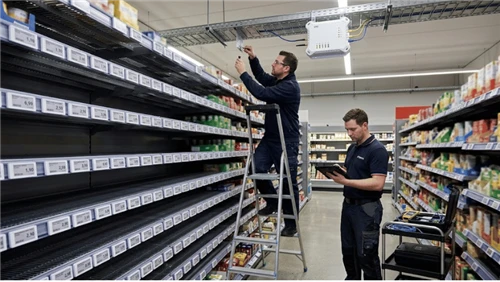
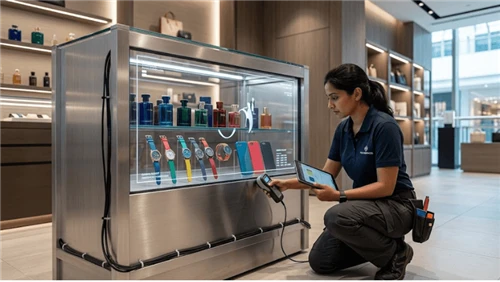
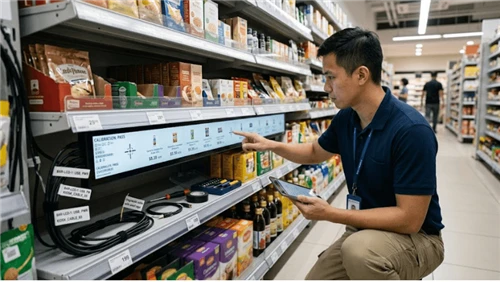
An electronic shelf label pilot should prove that the complete operating system works in a real store. A label that receives one successful price update during a vendor demonstration has not yet validated product data, system integration, wireless coverage, shelf mounting, employee workflows, exception handling, or financial impact.

A useful pilot therefore begins with a business decision: can the proposed electronic shelf label solution deliver accurate shelf information, recover from normal failures, reduce net operating work, and scale without introducing unacceptable risk?
Quick answer: Define the rollout decision before installation, collect a baseline for the current paper-label process, test representative store conditions, measure the 12 KPIs below, run controlled failure scenarios, and apply predetermined go, revise, or stop rules. The thresholds in this guide are illustrative examples, not universal industry standards.
How to Use This Electronic Shelf Label Pilot Checklist
This checklist is designed for retail operations, IT, merchandising, finance, store management, and procurement teams. It covers the full path from the source pricing system to the physical shelf and separates technical performance from operational value.
Replace every illustrative threshold with a value approved by the retailer. The final criteria should reflect applicable pricing rules, internal service-level agreements, historical performance, business risk, store format, promotion frequency, and the supplier's contractual commitments.
Before the pilot begins, agree on four items:
- The decision the pilot must support;
- The evidence required to make that decision;
- The person responsible for each KPI;
- The conditions that automatically prevent rollout.
Electronic Shelf Label Pilot KPI Scorecard
The following scorecard can be copied into a project workbook. Example thresholds are intentionally conservative and should be adjusted rather than adopted automatically.
| KPI | Formula or Reporting Method | Primary Data Source | Illustrative Acceptance Criterion | Example Weight |
|---|---|---|---|---|
| 1. Price Accuracy Rate | Correct audited displays ÷ total audited displays × 100% | POS or ERP price file, ESL audit record, promotion schedule | No unresolved critical price mismatch; quantitative target approved before testing | 20% |
| 2. First-Attempt Update Success Rate | Labels updated correctly on first transmission ÷ attempted updates × 100% | ESL platform event log | Example: at least 99.5%, with no department below its approved floor | 8% |
| 3. End-to-End Update Completion Time | Report median and P95 from source-system release to confirmed shelf display | POS or ERP timestamp, middleware log, ESL confirmation log | P95 meets the agreed single-item and batch-update SLA | 7% |
| 4. Failed-Update Detection Time | Alert timestamp minus actual failure timestamp; report median and P95 | Gateway, network, and ESL monitoring logs | Example: P95 detection within 5 minutes for monitored failures | 7% |
| 5. Exception Resolution Time | Verified closure timestamp minus incident opening timestamp; report by incident type | Help desk, store log, ESL platform | Example: median store-resolvable incident closed within 15 minutes | 6% |
| 6. Net Labor Saved | Baseline paper-label hours minus ESL operating, exception, and maintenance hours | Time study, labor schedule, issue log | Positive net savings and no material unplanned workload | 10% |
| 7. Integration Transaction Success Rate | Valid transactions completed without manual correction ÷ valid transactions submitted × 100% | API, middleware, POS, ERP, and ESL logs | Example: at least 99.9%, with zero silent data loss | 12% |
| 8. Product-to-Label Binding Accuracy | Correct product-location-label bindings ÷ audited bindings × 100% | Binding application, planogram, product master, physical audit | No incorrect binding affecting a displayed price | 10% |
| 9. Display Readability and Template Task Success | Correctly completed reader tasks ÷ tasks attempted × 100% | Observed shopper and employee tasks, scan tests | Example: at least 95% task success and no unreadable mandatory field | 5% |
| 10. Mounting Incident Rate | Mounting-related incidents ÷ installed labels × 100% for the pilot period | Store incident log, physical inspection | Example: below 0.5%, with no recurring fixture-specific failure | 5% |
| 11. Staff Task Completion Rate | Correct tasks completed without assistance ÷ assigned tasks × 100% | Training assessment and observed tasks | Example: at least 90% after normal training | 5% |
| 12. Business Case Variance | Actual validated benefit minus forecast benefit, divided by forecast benefit | Finance model and pilot measurements | Example: result within plus or minus 20% of approved assumptions | 5% |

A weighted score helps teams compare results, but it must not override critical failures. An incorrect shelf price, silent loss of price transactions, uncontrolled access to the management platform, or an inability to detect failed updates may block rollout even when the total score is high.
Step 1: Define the Rollout Decision Before Selecting the Pilot Area
Write one decision statement that explains what the pilot will authorize. For example:
The pilot will determine whether the proposed ESL system can maintain controlled shelf-price accuracy, process scheduled promotions, integrate with the current POS and ERP environment, support normal store exceptions, and produce enough verified operational benefit to justify rollout to the next group of stores.
This statement is stronger than "test whether electronic shelf labels work." It forces the team to define the complete system boundary. Teams that need a technical overview before setting the boundary can first review how electronic shelf labels work, including the relationship between management software, gateways, labels, and backend systems.
The decision statement should identify:
- The store types and departments included;
- The pricing, promotion, inventory, and planogram workflows included;
- The systems and interfaces that must be tested;
- The pilot start date, duration, and promotion cycles;
- The roles that approve technical, operational, and financial results;
- The critical conditions that require a stop or retest.
Step 2: Select a Representative Pilot Scope
The easiest aisle is rarely the most informative pilot. The scope should contain the conditions that may fail during expansion, not only the conditions that make the demonstration look clean.
Include a deliberate mix of:
- High-frequency and low-frequency price changes;
- Regular prices, scheduled promotions, markdowns, and promotion reversals;
- Standard shelf rails, peg hooks, wire baskets, glass shelves, endcaps, and refrigerated fixtures;
- High, low, and obstructed shelf positions;
- Areas close to refrigeration, structural columns, stock rooms, or other wireless systems;
- Different label sizes and display templates;
- Multiple employee shifts and normal replenishment activity.
For a grocery project, the existing guide to supermarket electronic price tag deployment can help identify the departments and workflows that deserve pilot coverage. The physical plan should also follow an electronic shelf label installation guide so that gateway placement, mounting compatibility, and coverage checks are documented rather than improvised.

Illustrative Pilot Design
The following example is a planning model, not a universal recommendation:
- One representative store;
- Three departments with different fixture and pricing patterns;
- Approximately 1,500 labels across at least three sizes;
- Six weeks of operation;
- Two complete promotion start-and-end cycles;
- Coverage tests in refrigeration, endcaps, corners, and low shelves;
- Normal activity across three employee shifts;
- One controlled integration interruption and one gateway interruption;
- Weekly physical audits plus event-log analysis.
A chain with materially different store formats may need more than one pilot archetype. A compact convenience store, a large supermarket, and a warehouse-style store can have different coverage, mounting, workflow, and update-volume risks.
Step 3: Establish the Paper-Label Baseline
A pilot cannot prove savings if the current process has not been measured. Record the complete paper-label workload before installation, including preparation and rework rather than only the time spent attaching labels.
The baseline should capture:
- Price and promotion changes per week;
- Time spent printing, sorting, walking, replacing, verifying, and correcting labels;
- Paper, toner, printer, disposal, and storage costs;
- Missing, delayed, duplicate, or incorrect labels;
- Checkout disputes or audit findings connected to shelf-price differences;
- Promotion launch and reversal delays;
- Time spent on price audits and exception follow-up.
Use the same departments and comparable operating periods for baseline and pilot measurements. The article comparing electronic shelf labels versus paper labels provides useful categories, but the business case should use the retailer's own time studies and cost data.
Step 4: Create a Defensible Audit and Sampling Plan
Do not let the supplier select only the labels that will be audited. Define the population, sample, timing, and failure classification before the first result is collected.
Use Full Validation for Critical Events
Some events should be checked across the complete affected population whenever technically practical:
- Major promotion activation;
- Promotion expiration and price reversion;
- Emergency price correction;
- System recovery after an integration outage;
- Template changes affecting mandatory price fields.
Use Stratified Sampling for Routine Audits
For routine shelf audits, divide the population into meaningful groups before selecting random labels. Useful strata include department, fixture type, label size, wireless zone, update type, promotion status, shelf height, and employee shift.
A quality team that wants a formal attribute-sampling framework can review ISO 2859-1:2026 sampling procedures for inspection by attributes. The standard is not an ESL-specific requirement, and the sampling plan must still be adapted to pricing risk, legal obligations, and the retailer's tolerance for missed errors.
Separate Critical, Major, and Minor Failures
| Severity | Example | Suggested Treatment |
|---|---|---|
| Critical | Wrong selling price, silent transaction loss, unauthorized price change, failed promotion reversal | Immediate containment; may automatically block rollout |
| Major | Repeated coverage failure, incorrect product binding without price impact, unresolved batch delay | Correct root cause and retest affected conditions |
| Minor | Cosmetic alignment issue, noncritical template spacing, isolated mount adjustment | Track trend and correct before expansion where practical |

The 12 Electronic Shelf Label Pilot KPIs
1. Price Accuracy Rate
Price accuracy compares the shelf display with the approved source record. Audit the complete record that matters to the customer and the retailer, not only the largest price number.
Formula: Correct audited displays ÷ total audited displays × 100%.
Check the product identifier, product description, selling price, unit price where applicable, currency, promotion price, promotion start and end time, and required attributes. Stable identifiers should be used throughout the data path; the GS1 Global Trade Item Number guidance is a useful reference when GTIN is part of the retailer's product master.
Classify every mismatch by root cause:
- Incorrect source data;
- Incorrect product-to-label binding;
- Interface mapping error;
- Delayed or failed update;
- Template logic error;
- Promotion scheduling error;
- Unauthorized manual override.
The pilot should not hide severe errors inside a high average. A retailer may require no unresolved critical price mismatch even if the numerical accuracy target has otherwise been reached. The operational and customer consequences are discussed further in what happens when price displays are wrong.
2. First-Attempt Update Success Rate
This metric shows how many labels receive and display the intended content on the first transmission cycle.
Formula: Labels confirmed correct on first attempt ÷ attempted label updates × 100%.
Report the result by department, gateway, fixture, label model, and wireless zone. A store-wide result of 99.5% can still conceal a freezer section operating at 96%.
Potential causes include weak coverage, interference, gateway placement, battery condition, device registration, queue congestion, and label firmware. Review the selected architecture against the site's comparison of Bluetooth, Wi-Fi, and Sub-GHz ESL networks.
3. End-to-End Update Completion Time
Measure the complete business process, not only the time required for the display to refresh.
Start time: The approved price or content change is released by the source system.
End time: The ESL platform confirms that the correct content is displayed on the intended label.
Record separate results for:
- One product update;
- Department-level batch update;
- Store-wide promotion;
- Scheduled future update;
- Promotion rollback;
- Emergency correction.
Report the median and P95 rather than only the average. The median describes the typical update, while P95 shows the time within which 95% of measured updates completed. The maximum and all failures should be reported separately.
When setting an SLA, distinguish backend processing, middleware, rendering, queueing, gateway transmission, display refresh, and confirmation reporting. The guide to ESL refresh rates and display performance can support the display-specific portion of this analysis.

4. Failed-Update Detection Time
A failed update that is visible in an exception queue is manageable. A failed update that remains undetected creates uncontrolled pricing risk.
Formula: Alert timestamp minus the timestamp at which the update or device actually failed.
Test whether the platform:
- Identifies the exact label and location;
- Distinguishes offline devices from rejected content or integration errors;
- Retries automatically according to a documented rule;
- Escalates repeated failure;
- Preserves an audit trail;
- Allows the store to verify the final displayed state.
Use a known failure event so the true start time is available. The troubleshooting guide for electronic shelf labels not updating can help create realistic fault categories for the pilot log.
5. Exception Resolution Time
Measure the time from incident creation to verified closure and report results by incident type and support owner.
Typical store-level exceptions include:
- Incorrect product binding;
- Product moved to a new shelf;
- Damaged or missing label;
- Low battery alert;
- Failed update;
- Incorrect template;
- Promotion that did not end correctly.
Separate incidents that store staff should resolve from incidents requiring central IT or supplier support. Calculate median and P95 resolution time for each class. If routine tasks repeatedly require the supplier, the pilot may work technically but fail as a scalable operating model.
6. Net Labor Saved
Gross labor removal is not the correct measure. ESLs eliminate some paper-label activities but introduce monitoring, rebinding, template, maintenance, and exception work.
Formula: Baseline paper-label labor minus ESL operating labor minus exception-handling labor minus device-maintenance labor.
Include:
- Printing and sorting;
- Walking and shelf location search;
- Removing and replacing labels;
- Verification and rework;
- Reviewing exception reports;
- Rebinding after product moves;
- Replacing batteries or damaged devices;
- Maintaining templates and user permissions;
- Investigating integration errors.
Record work by role and department, because an hour removed from store labor may be replaced by a more expensive hour in central IT. For a broader view of workflow effects, review how ESLs can streamline retail operations.

7. Integration Transaction Success Rate
The pilot should validate every interface that affects the shelf, including POS, ERP, product information management, promotion engine, middleware, inventory platform, store systems, and the ESL management platform.
Formula: Valid transactions completed without manual correction ÷ valid transactions submitted × 100%.
Track accepted, rejected, delayed, duplicate, and missing transactions. A high success percentage is not enough if a small number of records disappear without an alert. The acceptance requirement should therefore include zero silent data loss.
Run one controlled interruption:
- Pause an integration connection;
- Release several approved changes;
- Restore the connection;
- Verify queue preservation, ordering, deduplication, recovery, and final shelf state.
8. Product-to-Label Binding Accuracy
A technically successful update is still wrong if it reaches the wrong shelf position.
Formula: Correct product-location-label bindings ÷ audited bindings × 100%.
Verify:
- The label identifier is associated with the correct product identifier;
- The system location matches the physical location;
- Duplicate and unbound labels are reported;
- Product moves are reflected correctly;
- Removed products can be cleared or reassigned;
- Staff can rebind without creating hidden duplicate relationships.
Include planogram resets and product moves in the pilot. A static shelf validates initial installation, not the ongoing retail workflow.
9. Display Readability and Template Task Success
Readability should be tested as a task, not judged only by the person who designed the template.
Ask shoppers or employees to identify the price, product, unit price, promotion status, previous price, barcode, QR code, or staff indicator from realistic viewing positions. Include upper and lower shelves, bright lighting, glare, and crowded fixtures.
Formula: Correctly completed reader tasks ÷ tasks attempted × 100%.
Where multiple display technologies are being considered, the comparison of LCD versus E-Ink shelf labels can help define which content belongs on battery-powered shelf tags and which content requires a larger full-color display.
10. Mounting Stability and Physical Durability
Track physical incidents throughout normal replenishment, cleaning, customer contact, cart movement, and planogram changes.
Formula: Mounting-related incidents ÷ installed labels × 100% for the pilot period.
Record loose labels, sliding devices, broken clips, adhesive failure, impact damage, moisture exposure, labels removed by customers, and repeated problems on a particular fixture. Do not average different mount types together. The final rollout plan should approve a specific mount for each shelf or fixture family.
11. Staff Task Completion Rate
After normal training, observe whether employees can complete routine tasks correctly without project-team assistance.
Formula: Correct unaided tasks ÷ assigned tasks × 100%.
Test whether staff can:
- Bind and move a label;
- Replace a damaged device;
- Recognize a failed update;
- Read and classify an alert;
- Correct a basic mapping issue;
- Apply an approved template;
- Escalate a problem with the necessary evidence.
Record the time, error type, help requested, and unclear instruction. Training feedback should produce changes to the rollout guide rather than remain as general comments.
12. Operational and Financial Impact
The financial KPI should use measured pilot inputs, not generic savings claims.
Validate:
- Net labor change;
- Printing and material reduction;
- Faster promotion execution;
- Reduction in rework and price-audit effort;
- Costs of gateways, labels, mounts, software, integration, training, support, and spares;
- Exception and maintenance workload;
- Costs that may increase at chain scale.
Use the site's ESL ROI calculator as a framework, then replace default assumptions with the pilot's verified values.
A short pilot cannot prove multi-year battery life, long-term hardware failure rates, or future support costs. These should be supported by warranty terms, reference projects, service commitments, and contractual evidence.
Add a Cybersecurity and Access-Control Gate
An ESL platform can connect pricing systems, cloud services, gateways, mobile binding tools, and store networks. The pilot should therefore test governance and recovery as well as display performance.
Review:
- User roles and least-privilege access;
- Multi-factor authentication where available;
- API credential storage and rotation;
- Approval controls for price and template changes;
- Audit logs for user, system, and device actions;
- Network segmentation and gateway management;
- Backup, recovery, and account removal;
- Supplier access and support-session controls.
The NIST Cybersecurity Framework 2.0 provides a general risk-management structure that can help IT and governance teams organize these checks. It is not an ESL-specific certification.

Stress Tests Every ESL Pilot Should Include

Large Batch Update
Release a department-wide or store-wide batch and record queue behavior, completion time, retries, failed labels, platform responsiveness, and exception reporting.
Promotion Start and Automatic End
Verify both activation and reversal. A promotion that starts correctly but does not return to the approved regular price is a critical failure.
Incorrect Product Binding
Deliberately create a controlled wrong binding and verify how quickly the system and staff detect, contain, correct, and document it.
Gateway or Network Interruption
Disconnect a test gateway or network segment. Confirm that the last valid E-Ink image remains visible where applicable, the outage is reported, queued updates are preserved, service recovers, and no transactions are duplicated or lost.
Invalid Source-System Record
Submit a controlled record with a missing identifier, invalid price field, or incorrect effective time. The system should reject or quarantine it rather than display incomplete information.
Planogram Change
Move products and ask trained employees to update the physical and digital bindings. Measure completion time, binding accuracy, and support requests.
Damaged or Missing Label
Remove one test label and confirm that staff can identify the issue, select a spare, bind it correctly, verify content, and close the incident.
Permission and Account Test
Attempt an action using a role that should not have permission, remove a test user, and verify that access is revoked and logged.
Illustrative Example: Why the Store Average Can Mislead
The following example is hypothetical and is included only to demonstrate analysis.
A six-week pilot covers 1,500 labels across grocery, cosmetics, and frozen foods. The store-wide first-attempt update success rate is 99.1%, which initially appears acceptable. Department-level analysis shows:
| Area | First-Attempt Success | Main Finding |
|---|---|---|
| Grocery | 99.8% | Stable performance |
| Cosmetics | 99.3% | Several binding errors after a planogram move |
| Frozen foods | 95.8% | Coverage weakness and mount movement during replenishment |

The overall average hides a department that is not ready for rollout. The correct decision is not an unconditional go. The team should redesign gateway placement, approve a different freezer mount, repeat the promotion and batch tests in that zone, and verify that the problem does not recur.
The example also shows why error classification matters. A low-risk cosmetic template issue should not be treated the same as a failed price update or an incorrect product binding.
Build a Go, Revise, or Stop Decision
Critical Gates
Consider preventing rollout when any of the following remains unresolved:
- Incorrect shelf prices or failed promotion reversals;
- Silent loss, duplication, or uncontrolled reordering of price transactions;
- Failed updates that are not detected reliably;
- Unauthorized access or inadequate audit logging;
- Store workflows that depend on repeated supplier intervention;
- A technical design that cannot support representative store conditions.
Illustrative Weighted Decision Rule
- Go: Total score of 85 or above, every critical gate passed, and rollout owners and resources approved.
- Revise and retest: Score from 70 to 84, or a correctable weakness limited to a defined department, interface, mount, template, or training process.
- Stop or reconsider: Score below 70, an unresolved critical failure, or a business case that remains dependent on unsupported assumptions.
The score is a decision aid, not a substitute for judgment. A project should not compensate for price-control failure by scoring highly on aesthetics or staff satisfaction.

Evidence Required in the Final Pilot Report
The final report should contain:
- Pilot objective and rollout decision statement;
- Store, department, label, fixture, and gateway scope;
- System architecture and integration map;
- Baseline method and results;
- KPI definitions, formulas, thresholds, weights, and owners;
- Sampling plan and audit evidence;
- Results by department, zone, fixture, label type, update type, and shift;
- Critical, major, and minor failure log;
- Root-cause analysis and retest results;
- Training assessment and employee feedback;
- Security and access-control findings;
- Updated cost and benefit assumptions;
- Open risks, contractual actions, and rollout changes;
- Formal go, revise, or stop approval.
Attach source evidence such as timestamps, system logs, audit sheets, screenshots, installation photographs, support tickets, time studies, and training records.
What to Request From the ESL Supplier
| Question | Evidence to Request | Warning Sign |
|---|---|---|
| How are failed updates detected? | Alert workflow, retry rules, dashboard example, exported event log | Failure can only be discovered through a manual shelf check |
| How does the system recover after an outage? | Queue, ordering, deduplication, and recovery test results | No documented recovery behavior |
| Which tasks can store staff perform? | Role matrix, training guide, observed task demonstration | Routine changes require vendor support |
| How are price changes audited? | User log, source record, transmission status, display confirmation | No end-to-end timestamp or user trail |
| How will the pilot architecture scale? | Store archetype, gateway, software, licensing, support, and rollout plan | Scaling requires an undefined redesign |
| Which assumptions are contractual? | SLA, warranty, support response, spare supply, security, and integration terms | Performance claims remain informal |
When comparing suppliers, use consistent evidence requests rather than relying on feature lists alone. The site's overview of electronic shelf label manufacturers compared can support the early market-screening stage, while the pilot should validate the selected system in the retailer's own environment.
Common Pilot Mistakes
- Choosing an easy area: A clean demonstration aisle may exclude the conditions most likely to fail.
- Skipping the baseline: Without current labor and error data, savings cannot be verified.
- Measuring averages only: Store-wide averages conceal tail delays and weak zones.
- Changing thresholds after seeing results: Acceptance criteria must be approved before testing.
- Testing only hardware: The project includes data, integration, workflow, access, mounting, support, and recovery.
- Ignoring workarounds: Unofficial spreadsheets and repeated manual checks are part of the real operating cost.
- Ending too early: A short test may miss promotion reversal, planogram change, cleaning, replenishment, outages, and shift differences.
- Treating a high score as permission to ignore critical failures: Some failures require containment regardless of total points.
FAQ
Q: Should ESL pilot results use averages or percentile measurements?
A: Use both. The median shows typical performance, while P95 indicates the time within which 95% of measured updates or incidents were completed. Averages alone can hide a small number of severe delays. The pilot report should also list maximum values, failed transactions, and unresolved exceptions separately.
Q: How should price accuracy be audited during an ESL pilot?
A: Compare the physical shelf display with the approved source record and verify the product identifier, selling price, unit price where required, promotion price, effective dates, currency, and product description. Use full validation for critical promotion events where practical and stratified random sampling for routine audits. Results should be separated by department, fixture type, label size, update type, promotion status, and wireless zone.
Q: What should automatically block an electronic shelf label rollout?
A: Unresolved critical failures should block rollout even when the total KPI score is high. Examples include incorrect shelf prices, failed promotion reversals, silent loss or duplication of price transactions, unauthorized price changes, failures that are not detected reliably, and routine workflows that cannot be completed without repeated supplier intervention.
Q: Can one ESL pilot represent every store in a retail chain?
A: Not always. One pilot may be sufficient when stores have similar layouts, fixtures, systems, update volumes, and operating processes. Chains with materially different store formats may need separate pilot archetypes. A compact convenience store, large supermarket, pharmacy, and warehouse-style location can have different wireless coverage, mounting, workflow, and integration risks.
Q: Who should own the ESL pilot KPIs?
A: Ownership should be divided according to the source of evidence. Retail operations may own labor and workflow measures, IT may own integration and monitoring results, merchandising may approve templates and promotion behavior, finance may validate cost assumptions, and store management may assess employee task completion. Each KPI should have one named owner responsible for data quality, threshold approval, and final sign-off.
Q: How should failed ESL updates be tested?
A: Create controlled failures with known start times. Examples include disconnecting a gateway, pausing an integration connection, submitting an invalid source record, removing a label, or creating a controlled incorrect binding. Verify alert timing, automatic retries, exception classification, escalation, recovery, audit logs, and the final shelf state. A failure that is corrected but never detected by the platform should not be considered a successful test.
Q: What evidence should an ESL supplier provide after the pilot?
A: Request exported event logs, update confirmation records, retry rules, integration recovery results, gateway coverage findings, role and permission documentation, training materials, support response commitments, warranty terms, spare-device recommendations, and a rollout architecture for larger store volumes. Informal statements should not replace measurable evidence or contractual commitments.
Q: How can a retailer determine whether labor savings are real?
A: Measure net labor change rather than only the work removed from the paper-label process. Subtract ESL monitoring, exception handling, rebinding, template maintenance, device replacement, and IT support time from the baseline paper-label workload. Record hours by role and department because store labor savings may be offset by additional work for central IT or support teams.
Q: What should happen when one department fails but the overall pilot score passes?
A: Do not approve an unconditional rollout based only on the store-wide average. Identify the failed department, classify the root cause, correct the network, mounting, template, workflow, or integration issue, and repeat the affected tests. Rollout may proceed in validated areas only when the deployment plan clearly separates them from conditions that still require remediation.
Final Takeaway
An electronic shelf label pilot should produce a defensible rollout decision, not a collection of successful screen refreshes.
The strongest pilots define success before installation, compare results with a measured baseline, use explicit formulas and data sources, report tail performance as well as averages, test abnormal conditions, document critical failures, and require evidence for every claimed benefit.
When the retailer completes this process, the rollout decision no longer depends on a supplier presentation or a generic savings estimate. It is supported by the retailer's own price audits, system logs, time studies, store workflows, risk controls, and financial measurements.