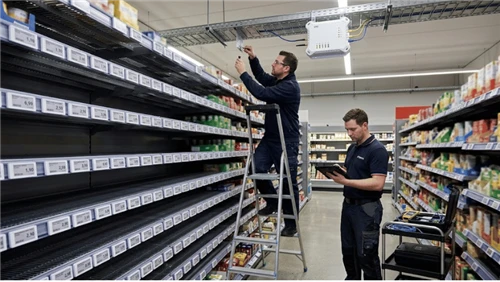
Next time you're in a Walmart or Whole Foods, look closely at the shelf tags. Many of them are no longer paper. They're small digital screens - and they can update a price in seconds.
Electronic shelf labels (ESLs), also called digital price tags or digital shelf labels, are becoming standard equipment in American grocery stores. Walmart plans to have them in 2,300 locations by 2026. Kroger, Whole Foods, Amazon Fresh, and a growing number of regional chains already use them.
You may have read headlines about "surge pricing" and wondered whether stores will start charging more for ice cream when it's hot outside. Senators have written letters. Social media has amplified the fear. What does the evidence actually show? This article answers that - and covers the technology, consumer impact, labor effects, and who's watching.
What Are Electronic Shelf Labels?
The basics
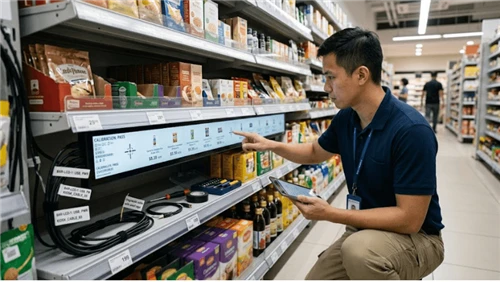
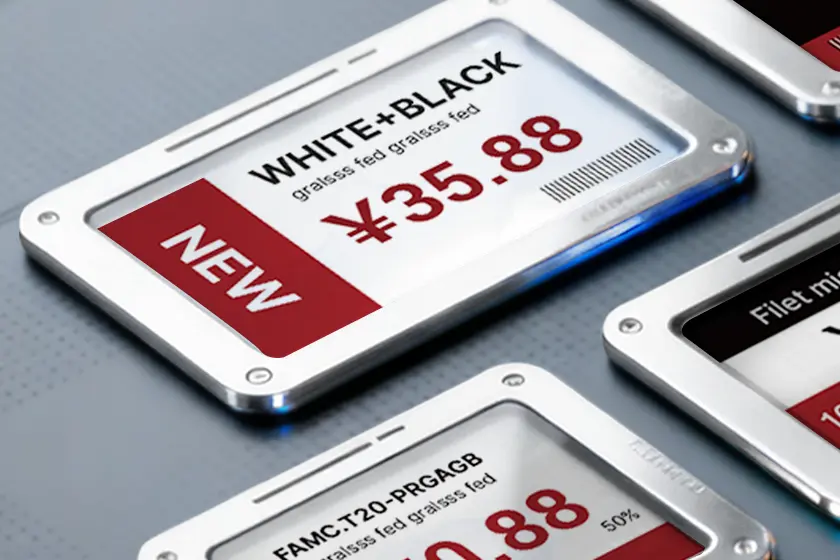
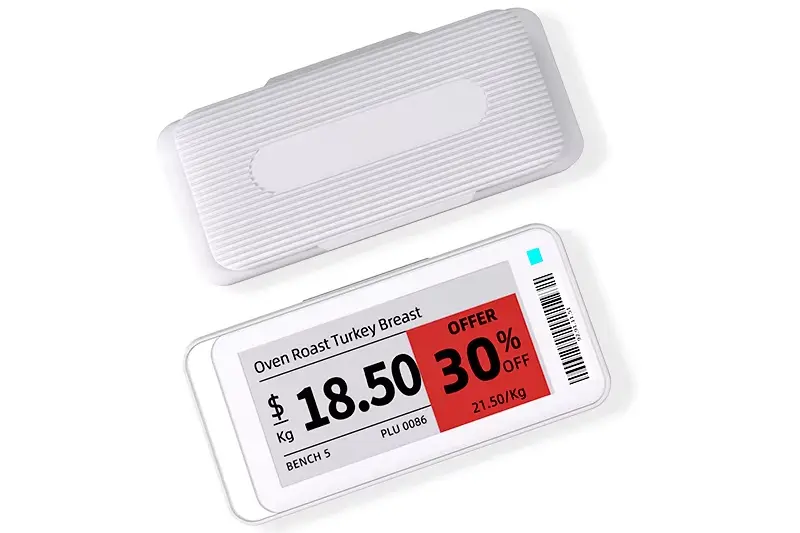
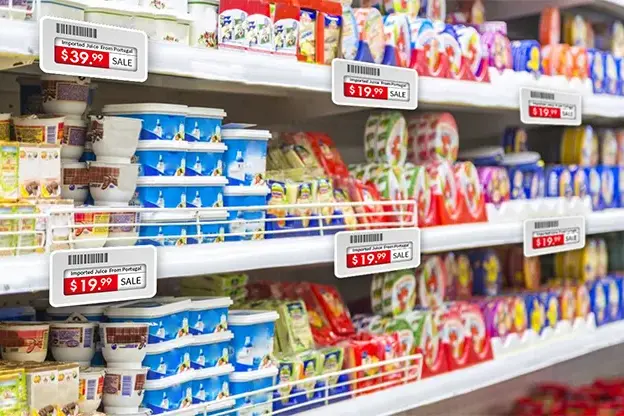
An electronic shelf label is a battery-powered digital display that attaches to the shelf edge where a traditional paper price tag would sit. Instead of a printed sticker, you see a small screen showing the price, product name, and sometimes additional information like promotions, unit pricing, or a QR code.
The most common type uses e-ink (electronic ink) technology - the same display found in Kindle e-readers. E-ink screens consume power only when the image changes, which is why a single battery can run an ESL for five to ten years. For a deeper look at e-ink display costs and lifespan, including how that equation plays out for retailers at scale, the numbers are more nuanced than most coverage suggests.
How do electronic shelf labels work?
The process from price change to shelf display is simpler than it sounds. For a full technical breakdown, see how electronic shelf labels work - but here's the short version:
- A manager or pricing system initiates a price update in the store's central point-of-sale (POS) software.
- The update transmits wirelessly - via radio frequency (RF), Bluetooth, or a proprietary sub-GHz network - to an in-store access point.
- The access point pushes the new price to the specific ESL on the shelf.
- The e-ink display refreshes. This takes a few seconds.
- Because the ESL links directly to the POS system, the shelf price and register price are always synchronized.
That synchronization matters more than it sounds. Paper tags fall off, get misfiled, or sit unchanged after a sale ends. ESLs eliminate that mismatch - what you see is what you pay.
Which stores are using them?
ESLs have been common in European grocery chains since the 1990s - France's Carrefour and Germany's Rewe adopted them decades ago, with no documented surge pricing incidents over that period. US adoption accelerated sharply in 2023–2024. For a current overview of electronic shelf labels in grocery stores, the landscape spans far beyond the headline names:
- Walmart began piloting ESLs in Grapevine, Texas in 2024 and has committed to 2,300 stores by 2026. See a detailed breakdown of Walmart's digital shelf label rollout.
- Kroger, Whole Foods, and Amazon Fresh already use them in several markets.
- Schnucks, a Midwestern regional chain, was among the earlier US adopters.
- Independent grocers have also installed them - some reporting labor savings of around 50 hours per week on price management tasks alone.
The global ESL market was estimated at $1.85 billion in 2024 and is projected to reach $7.54 billion by 2033, according to Grand View Research - roughly 15% annual growth.
The Surge Pricing Debate: What Does the Evidence Say?
Before reading further, note that this is the question most people came here to answer. The full analysis is in do electronic shelf labels enable dynamic pricing - but the short answer is: no, not in practice. Here's why.
Why shoppers and lawmakers are worried
The concern is understandable. Apps like Uber have normalized surge pricing - higher demand, higher price. When news spread that Walmart and Kroger were installing digital tags that can update "up to six times per minute," the obvious worry was: will grocery stores do the same?
In August 2024, Senators Elizabeth Warren and Bob Casey wrote to Kroger's CEO, warning that ESLs could enable stores to "calibrate price increases to extract maximum profits" based on time of day, weather, or other conditions. The concern landed. Social media ran with it.
Digital infrastructure does, in theory, make demand-based pricing easier to implement. That's a legitimate thing to scrutinize.
What the research actually found
Here's where the data diverges sharply from the fear.
Researchers Robert Sanders (UC San Diego's Rady School of Management) and Ioannis Stamatopoulos (University of Texas at Austin) examined five years of pricing data - 2019 to 2024 - across more than 100 stores at a major US grocery chain that adopted ESLs during that period. They were specifically looking for short-lived, unexplained price spikes correlated with demand conditions.
Their conclusion, published in 2025: "We find virtually no surge pricing either before or after ESL adoption."
Before ESL installation, roughly 1 in 20,000 products showed any behavior resembling a surge-pricing pattern. After installation, that number did not meaningfully increase. If anything, discount activity became slightly more common - consistent with stores using the technology to move perishables faster.
"If digital labels were causing surge pricing, you'd expect a visible spike in price changes," said Robert Sanders. "Instead, we saw no meaningful difference before and after installation."
Why surge pricing doesn't serve grocers
The same research offers a structural explanation for why this was always unlikely.
Grocery stores operate on margins of roughly 1–3% net profit. They make money on volume and repeat customers - not on squeezing individual transactions. One bad pricing experience can send a family permanently to the competitor across the street.
"Unlike Uber or hotels, grocery stores don't make money on a single item - they make money on your entire basket and your long-term loyalty," said Ioannis Stamatopoulos. Unpredictable pricing is self-defeating in that model.
That doesn't mean misuse is impossible. But across thousands of stores and millions of price points, it isn't happening.
ESL vs. Traditional Paper Tags
Here's how electronic shelf labels compare to paper tags across the dimensions that matter most - for both shoppers and retailers. For a more detailed analysis, see electronic shelf labels vs paper labels.
| Paper price tags | Electronic shelf labels | |
|---|---|---|
| Price update time | Hours to days (manual) | Seconds (automated) |
| Accuracy | Prone to POS mismatches | Synchronized with POS in real time |
| Labor required | High (physical replacement) | Minimal after setup |
| Information displayed | Price only | Promotions, unit price, QR codes |
| Upfront cost | Very low | $100K–$200K+ per store |
| Environmental impact | Ongoing paper waste | E-waste at end of life, paper savings ongoing |
| Surge pricing risk | Not applicable | Theoretically possible; not observed in practice |
What Electronic Shelf Labels Mean for Shoppers
The genuine benefits
Pricing accuracy is the clearest win. Paper tags get displaced, fade, or aren't updated when a sale ends. ESLs eliminate that category of error - the shelf price and register price match, reliably.
Many systems also display more than just the price. Unit pricing (cost per ounce or pound), promotional end dates, and QR codes linking to product details or loyalty discounts are increasingly common features of electronic shelf labelling systems in modern retail environments.
For online order pickers, ESLs offer a different kind of benefit entirely. Instacart's Carrot Tags system uses retail electronic shelf labels that flash or blink when triggered, guiding pickers directly to the right product on a shelf - cutting fulfillment time significantly.
The legitimate concerns
When weighing the electronic shelf labels pros and cons from a consumer perspective, three concerns come up consistently - and all are worth taking seriously:
- Personalized pricing: No evidence it's happening today, but the technology could theoretically allow different prices for different customers if linked to loyalty card profiles. Worth monitoring as systems become more sophisticated.
- Digital divide: Features like QR codes require a smartphone to access. Shoppers without one - or those less comfortable with technology - get a reduced experience. The basic price display is fine; the extended features create an access gap.
- Data collection: ESLs are part of a broader move toward real-time retail analytics. How that data is retained and used is a reasonable question to ask, particularly as personalization capabilities grow.
What shoppers actually say
Reactions are genuinely mixed. Many shoppers report appreciating the clarity and readability of ESL displays - particularly in cooler and freezer sections, where paper tags frequently curl or become illegible. The synchronization with the register is also appreciated by anyone who has ever been overcharged due to a stale promotion label.
Others express a more instinctive distrust. "It's corporations vs. the humans," one Canadian shopper told an AP reporter after his local Loblaws switched to digital labels. That reaction isn't based on a specific pricing incident - it's a response to a perceived shift in power toward the retailer. That's a real and reasonable feeling, even when current data shows the outcomes have been benign.
What shoppers can actually do
Understanding the technology is useful. Acting on that understanding is more useful:
- Check your receipt. ESLs are designed to match the register, but software errors happen. Spot-check a few items against the shelf price until you trust the system at your store.
- Know your state's scanner law. Most US states require retailers to honor the lower of the shelf price or register price if a discrepancy exists - and some mandate a free item or a penalty payment to the customer. The National Conference of State Legislatures maintains a current summary of scanner accuracy laws by state.
- Report persistent problems. If you notice repeated pricing errors at a specific store, report them to your state's consumer protection office or the CFPB. These reports inform enforcement priorities.
What ESLs Mean for Stores and Workers
Labor savings and ROI
For retailers, price management at scale is a genuine operational burden. A large grocery store carries between 20,000 and 50,000 SKUs, according to the Food Industry Association (FMI). When prices change - for promotions, supplier cost adjustments, or competitive responses - staff have historically had to walk every aisle and replace each affected paper tag.
With ESLs, a manager can update prices store-wide in minutes from a mobile app. Walmart has stated that a task previously taking associates two days can now be completed in minutes. Independent retailers have reported saving approximately 50 labor hours per week. For those evaluating the investment case, an ESL ROI calculator can help model the payback timeline against upfront costs, which typically run $100,000 to $200,000 or more per store.
Smarter markdowns and less food waste
ESLs make it significantly easier to reduce prices on perishables as they approach expiration. With paper tags, marking down a few dozen yogurts requires someone to print and physically replace each label. With ESLs, a category-wide price drop takes seconds.
Sanders and Stamatopoulos found in their 2025 research that discount frequency actually increased slightly after ESL adoption - consistent with stores using the technology to move perishables more efficiently rather than to raise prices. For a broader view of how electronic shelf labels streamline retail operations, the perishables use case is one of the most commercially compelling.
The jobs question
Workers have a legitimate question here. ESLs reduce the need for one specific task: manually replacing paper price tags. Retailers generally describe this as redeployment rather than elimination - staff previously spending hours on label replacement can be moved to customer service, stocking, or order fulfillment.
Whether that redeployment actually happens, and at what scale across the industry, is something that will take years to observe. For a fuller picture of electronic shelf labels' real costs - including who bears the operational and workforce transition burden - the honest answer is that the long-term labor impact remains uncertain.
Regulation: Who's Watching?
What lawmakers have proposed
The political response has been active. In 2024, Senators Warren and Casey called on Kroger to halt ESL expansion pending clear pricing policies. Several state legislators have explored bills that would prohibit demand-based pricing on essential goods. As of mid-2026, no federal legislation specifically targeting ESLs has been enacted - but the issue remains on congressional radar.
The regulatory question isn't whether ESLs are legal. They clearly are. The question is whether specific uses of real-time pricing capabilities would constitute price gouging under existing consumer protection law. That line is still being worked out. For current analysis of how ESL dynamic pricing intersects with regulatory frameworks, the picture is evolving.
What retailers have committed to
Both Walmart and Kroger have publicly stated that their ESL systems do not use surge pricing and that prices are consistent for all customers in a given store, regardless of time of day or who is shopping.
"These labels are just a modern tool to help our associates do their jobs better," Walmart stated. "The price you see is the same for everyone in any given store."
Kroger has similarly denied engaging in dynamic demand pricing, describing their ESL use as focused on inventory management and enabling faster markdowns on perishables.
These are corporate commitments, not regulatory requirements. The absence of legislation means consumers are currently relying on retailer self-reporting and academic monitoring - which is exactly why the Sanders/Stamatopoulos research matters, and why continued oversight is valuable.
Should Shoppers Be Worried About Electronic Shelf Labels?
The evidence says: not about the specific things most of the headlines warned about.
The surge pricing fear was real and understandable - but five years of data across more than 100 stores, examined specifically for that behavior, found it wasn't happening. The business logic of grocery retail makes it unlikely: thin margins, price-sensitive customers, and fierce local competition don't leave much room for the kind of pricing experiments that work in ride-sharing or hospitality.
What ESLs do introduce - and what's worth monitoring - are more subtle shifts: the potential for personalized pricing as loyalty systems grow more sophisticated, questions about data retention, and whether the labor redeployment story retailers are telling actually plays out at scale.
Informed attention is the right posture. Check your receipts, know your state's scanner laws, and watch how the regulatory conversation develops. For those who want to understand the full range of electronic shelf label solutions and how they're being deployed across different retail formats, the technology is more varied - and more capable - than most consumer coverage suggests.
Frequently Asked Questions
Can stores charge different people different prices using electronic shelf labels?
Not currently. Walmart and Kroger have both confirmed that prices shown are consistent for all customers in a given store, regardless of loyalty card status, time of day, or other factors. Academic research examining five years of pricing data across more than 100 stores found no evidence of personalized or demand-based pricing following ESL adoption.
Which grocery stores currently use electronic shelf labels in the US?
Walmart (2,300+ stores and expanding), Kroger, Whole Foods, Amazon Fresh, and Schnucks are among the most prominent US adopters. Many regional and independent grocers have also installed them. European chains including Carrefour, Rewe, and Albert Heijn have used them for decades.
Will prices be more accurate with electronic shelf labels?
Generally, yes. ESLs link directly to the store's POS system, so the shelf price and register price are always synchronized. This eliminates the mismatch that occurs when paper tags aren't updated after a promotion ends - a common source of checkout frustration. If a discrepancy does occur, most state scanner accuracy laws entitle you to the lower of the two prices. See our article on what happens if price displays are wrong for the specific consumer rights involved.
Are electronic shelf labels better for the environment?
On balance, probably yes - though with caveats. ESLs eliminate ongoing paper tag consumption across millions of shelf positions, and e-ink displays use minimal power over their lifespan. The main counterpoint is e-waste when devices eventually need replacement. With a typical lifespan of 5–10 years, the per-year environmental impact is substantially lower than single-use paper alternatives, but responsible end-of-life disposal remains important.
Will electronic shelf labels cost workers their jobs?
The technology reduces one specific task: manually replacing paper price tags. Retailers generally describe this as redeployment - moving staff to customer service, stocking, or fulfillment - rather than outright elimination. The long-term employment impact across the industry is genuinely uncertain. It depends on how individual retailers choose to redeploy the hours they recover, which will vary significantly by chain and market.
How long do electronic shelf labels last?
Most ESLs use e-ink displays that consume power only when the image refreshes. A standard battery typically lasts 5–10 years. The displays themselves are designed for the same period under normal retail conditions, making them a long-term infrastructure investment rather than a consumable.
Sources: UC San Diego / UT Austin pricing study (Sanders & Stamatopoulos, 2025); Grand View Research ESL market data (2024); Warren–Casey letter to Kroger (August 2024); FMI – The Food Industry Association; Walmart and Kroger corporate communications.