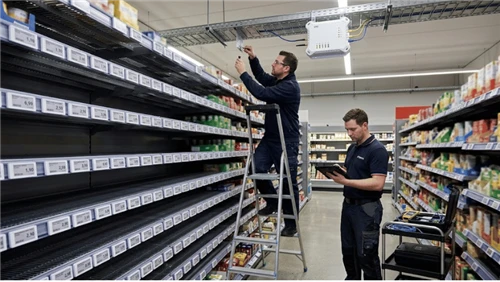
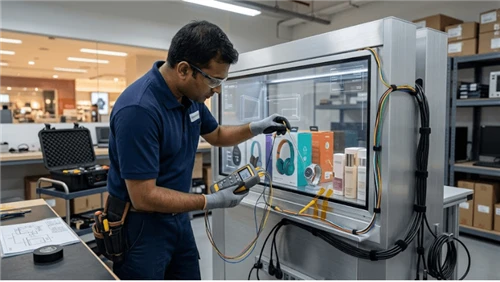
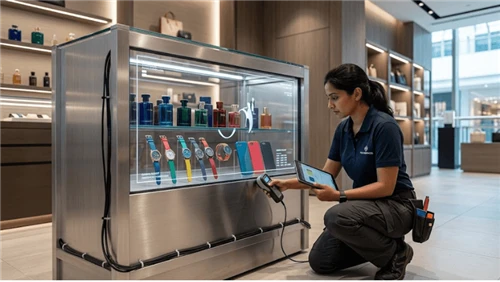
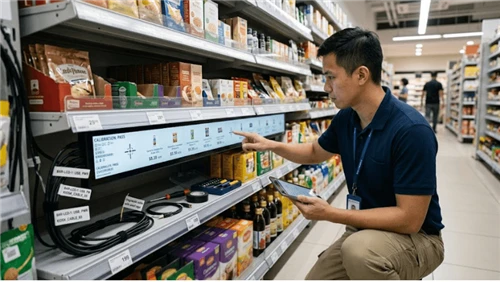
Electronic shelf label gateway placement should not be based on a brochure range or a floor-plan circle alone. Metal shelving, refrigerated cases, stock density, walls, mounting height, other wireless equipment, and the volume of price updates can all change how an ESL network performs in a real store.
Quick answer: Create a preliminary gateway plan from the current store layout, then validate it with the actual gateways and representative labels. Test difficult shelf positions, normal and bulk updates, gateway failure, exception visibility, and final device confirmation. Approve only the configuration that has been corrected, retested, and documented.

An electronic shelf label solution normally combines labels, gateways or access points, a management platform, and connections to pricing or product systems. Reliable coverage is therefore not only an RF question. It is the ability to deliver the correct update, identify failures, and prove that the intended label reached an approved final state.
What ESL Gateway Placement Must Prove
A gateway carries update traffic between the management platform and labels on the sales floor. Depending on the system, the same network component may be called a gateway, base station, access point, or communication controller. A broader explanation of the system workflow is available in this guide to how electronic shelf labels work.
Bluetooth-based systems may implement the Bluetooth Electronic Shelf Label Profile, which specifies how a Bluetooth client controls and updates ESL devices. Other systems may use proprietary 2.4 GHz, Sub-GHz, Wi-Fi, or another architecture. The selected protocol affects survey tools, available signal indicators, gateway association, confirmation behavior, and channel planning. It is useful to review the differences between Bluetooth, Wi-Fi, and Sub-GHz ESL communication before defining a test method.
Nominal Range Is Not Usable Coverage
A vendor range describes performance under defined conditions. Usable coverage is the result required by the retailer in the installed store.
A zone should not be considered usable merely because one label receives one command. The project should establish whether:
- Representative labels receive the correct update consistently.
- Normal and bulk updates complete inside the approved business window.
- Unconfirmed labels remain visible in an exception process.
- Older or delayed events cannot overwrite newer content.
- Critical areas remain manageable when a gateway or backhaul connection fails.
- The correct physical label is bound to the correct product and shelf position.
Update speed also depends on the display technology, image size, waveform, platform scheduling, and network load. Separate guidance on ESL refresh rates and display performance can help teams avoid blaming every slow update on RF coverage.
Use a Three-Stage ESL RF Site Survey
A defensible survey separates planning from validation. The three stages below prevent a predictive design from being mistaken for a completed installation.

Stage 1: Preliminary Predictive Planning
Use the current floor plan, fixture schedule, ceiling information, network availability, candidate mounting points, and the supplier's documented assumptions to create an initial gateway layout.
This stage should identify likely coverage zones and obvious risks, but it should not approve the final gateway count. A planning radius cannot reproduce stocked shelves, freezer construction, radio reflections, label orientation, or the store's live wireless environment.
Stage 2: Active On-Site Survey
Install temporary or final-position gateways and use the approved label models to send real updates from representative locations. Record both any vendor-supported RF measurements and the actual operational result.
General wireless deployment guidance from NIST on industrial wireless systems emphasizes understanding existing wireless devices, operating bands, interference sources, and the installed environment. For ESL projects, those principles must be combined with real label-update testing.
Stage 3: Final Post-Installation Validation
Repeat critical tests after gateways are fixed in their approved positions, shelves are stocked, cold equipment is operating, and normal store systems are active. Save the final gateway map and test evidence as the deployment baseline.
This final validation is different from the general hardware work covered in an electronic shelf label installation guide. Installation confirms that components are mounted and connected; RF validation confirms that the installed system performs in the real environment.
What to Collect Before Entering the Store
A site survey becomes slower and less reliable when the team discovers basic layout or infrastructure information only after testing begins. Before the visit, collect:
| Information | Why It Matters |
|---|---|
| Current floor plan | Defines aisles, checkouts, service areas, receiving, back rooms, walls, columns, and mezzanines. |
| Fixture and equipment plan | Identifies steel gondolas, refrigerated cases, freezers, stock cages, large displays, and other potential obstructions. |
| Ceiling and mounting data | Shows height, approved mounting points, cable routes, lift requirements, and future maintenance access. |
| Power and network locations | Prevents a radio-friendly position from being selected where secure backhaul or power cannot be provided. |
| Label models and density | Ensures that the survey uses the devices, orientations, and zone densities intended for rollout. |
| Update workload | Defines routine updates, largest promotions, operational alerts, and any storewide update event that the network must support. |
| Business-critical zones | Identifies areas where an incorrect or stale price creates the greatest customer or operational risk. |
Supplier selection also affects what can be measured and confirmed. Before the survey, verify these technical capabilities as part of choosing a retail electronic shelf label solution.
Map the Store's Highest-Risk RF Zones
The floor plan should become a risk map before candidate gateways are installed. Start with the areas most likely to expose a weak design.
Metal Shelving and Dense Displays
Metal may reflect, block, or redirect radio signals. Test labels at the bottom of a shelf, behind metal edges, inside narrow aisles, beside dense fixtures, and near heavily stocked products. One eye-level label cannot represent an entire aisle.
Refrigerators and Freezers
Cold equipment combines metal, insulation, glass, machinery, and unusual mounting positions. Treat refrigerator doors, open chillers, frozen end sections, lower rails, and labels between adjacent cases as separate test points.
For a grocery deployment, the physical and operational demands of these departments should also be considered alongside the broader use cases described in this guide to supermarket electronic price tags.
Walls, Columns, Back Rooms, and Receiving Areas
Solid walls and structural columns may separate a sales-floor gateway from a stock room, pharmacy, service counter, receiving dock, or mezzanine. Include those areas when labels support picking, replenishment, inventory, or customer-facing pricing.
Checkouts and Wireless-Dense Areas
Checkout zones may contain Wi-Fi access points, POS terminals, payment devices, handheld scanners, security equipment, customer devices, and digital displays. Their presence does not automatically create a failure, but it makes testing under normal operating conditions more important.
Choose Preliminary Gateway Locations
Candidate gateways should be positioned where radio performance, power, secure network access, safe maintenance, and future store changes can all be managed.
- Prefer elevated, open positions where the approved antenna design is not blocked by large metal fixtures.
- Avoid enclosed cabinets unless the supplier has approved the enclosure and installation method.
- Keep gateways identifiable and accessible for inspection, replacement, and network troubleshooting.
- Record gateway ID, exact location, mounting height, power source, network address, intended zones, and installation date.
- Do not place a gateway where future signs, seasonal displays, or store remodeling are likely to obstruct it.
Coverage overlap may improve boundary performance or resilience, but only if the platform supports the expected association or failover behavior. Actual gateway association, queuing, and failover vary by supplier. When comparing vendors, review both hardware and network evidence rather than relying on a single coverage claim; this electronic shelf label manufacturer comparison outlines broader evaluation factors.
What to Measure During the RF Site Survey
No single number proves that an ESL zone is ready. The survey should combine RF or platform measurements with operational outcomes.
| Measurement | What It Helps Explain | Important Limitation |
|---|---|---|
| Vendor-supported signal or link-quality indicator | Shows relative radio conditions at a test point. | Names, scales, thresholds, and availability vary by protocol and platform. |
| Channel or spectrum observation | Identifies active bands, competing wireless systems, and possible interference patterns. | It does not prove that the ESL application will succeed under load. |
| Update completion time | Shows whether an individual or bulk event completes inside the business window. | A fast software response may not prove final device rendering. |
| Retry count | Highlights unstable zones that may eventually succeed but consume time and capacity. | Retry behavior differs by platform and should not be compared without context. |
| Final confirmation state | Shows the strongest evidence the platform can provide for the endpoint. | Device confirmation may still not prove correct product-to-label binding or shelf placement. |
| Visible content verification | Confirms that the intended template and price appear on a sampled physical label. | Manual sampling cannot prove every future update will succeed. |
| Exception visibility | Shows whether an unconfirmed or failed label creates an actionable record. | An exception is useful only when ownership and closure evidence are defined. |
Radio equipment and permitted operating conditions vary by market. For US deployments, relevant devices are subject to the applicable FCC equipment authorization and RF device requirements. Other markets have their own spectrum, power, and conformity rules. The selected system's certified configuration should not be changed solely to improve one store's survey result.
How to Run the Active ESL Site Survey
- Number the store zones. Use consistent codes such as A01 for an aisle, F01 for a freezer zone, C01 for checkout, and B01 for the back room. Use the same codes on the floor plan, test sheet, gateway configuration, and exception log.
- Install candidate gateways. Place the approved hardware at positions that reflect the intended final height, orientation, backhaul, and power conditions.
- Select representative test labels. Include upper, middle, and lower shelves, end caps, freezer positions, checkouts, back rooms, structural obstructions, and the predicted edge of coverage.
- Run controlled individual updates. Use a known test event and record the test point, label ID, gateway, status, completion time, retries, visible result, and evidence.
- Run realistic bulk updates. Test an aisle, department, promotion set, or other load that represents the largest planned operational event.
- Test normal store conditions. Where practical, repeat critical tests with shelves stocked, cold equipment running, Wi-Fi active, staff devices in use, and checkouts operating.
- Test resilience and failure visibility. Disable or disconnect one gateway only through an approved test procedure. Confirm what happens to affected events, whether alternate coverage is used where supported, and whether unresolved labels remain visible.
- Correct and retest. Move or add a gateway, change the approved mounting arrangement, remove an unintended obstruction, repair the backhaul, replace a faulty label, or correct the binding. Do not close the problem until the final configuration passes the same test that exposed it.
Use a Site Survey Record, Not Informal Notes
A survey record makes the result repeatable and auditable. The following fields can be used as a starting point:
| Field | Example Entry |
|---|---|
| Test point | F02-Lower-07 |
| Zone | Frozen food, west wall |
| Label model | Approved 2.66-inch test label |
| Gateway | G02 |
| Shelf position | Lower rail beside freezer end section |
| Test type | Bulk promotion update |
| Platform status | Transmitted, not device-confirmed |
| Completion time | Record the measured project result |
| Retry count | Record the platform result |
| Observed issue | Repeated unconfirmed state during bulk event |
| Corrective action | Move candidate gateway and repeat test |
| Retest result | Pass or fail against the approved criterion |
| Evidence | Floor-plan mark, screenshot, log, and photo reference |
The example deliberately avoids universal signal or time thresholds. Those values must come from the selected system, the retailer's risk requirements, and verified project testing.
Illustrative Supermarket Survey Example
The following scenario is hypothetical and demonstrates the decision process rather than claiming a real deployment result.
A grocery store has six main aisles, two refrigerated walls, a frozen-food section, eight checkouts, and a back room behind a solid wall. The preliminary plan assigns G01 to aisles 1–3, G02 to aisles 4–6 and refrigerated displays, and G03 to checkouts and the back room.
Individual updates work in most locations, but three problems appear:
- Lower-shelf labels beside the frozen section remain unconfirmed.
- Two back-room labels update only after repeated retries.
- End-cap labels between G01 and G02 become inconsistent during a bulk promotion test.
The team should not simply increase retries and approve the store. It should first determine whether the failures share an RF cause.
- Confirm that each event reached the correct store, product, and label binding.
- Check label health and repeat the event with a known-good test label.
- Verify that G01, G02, G03, and their backhaul connections are online.
- Review queue status and event ordering.
- Compare vendor-supported link measurements and operational outcomes at the failed test points.
- Move or add approved coverage where the evidence indicates an RF weakness.
- Repeat the same individual, bulk, and failure tests.
- Save the final gateway map and closed-defect evidence as the approved baseline.
This process also prevents unnecessary hardware purchases. A failed update caused by binding, a damaged label, or a network queue should not automatically result in another gateway. The financial effect of gateways, installation, labels, maintenance, and software should be evaluated within the retailer's real electronic shelf label costs.
Diagnose a Failed Label Before Blaming RF Coverage
When an ESL does not update, use a fixed troubleshooting order:
- Validate the source event. Confirm product, store, template, version, effective time, and intended content.
- Check product-to-label binding. A healthy label can display the wrong product when the association is incorrect.
- Check label health. Review battery, registration, hardware state, and whether a known-good test event succeeds.
- Check gateway availability. Confirm that the intended gateway is powered, connected, registered, and processing events.
- Check backhaul and platform queues. A LAN, server, integration, or queue problem may look like an RF failure.
- Compare nearby test points. A cluster of failures at similar shelf positions is stronger RF evidence than one isolated device.
- Review available link and retry data. Use platform-specific measurements, not invented universal thresholds.
- Correct the suspected cause and repeat the original test. A different test cannot prove that the original failure is closed.
For broader fault isolation, use the dedicated guide to electronic shelf labels not updating rather than expanding this article into a complete troubleshooting manual.

Understand Confirmation Levels
The terms below are generic examples. Actual status names and the evidence behind them vary by platform.
| Status | What It May Prove | What It Does Not Automatically Prove |
|---|---|---|
| Accepted | The platform received the request. | The gateway transmitted it. |
| Queued or Published | The event entered a delivery process. | The label received it. |
| Transmitted | A gateway sent the event. | The correct label rendered the content. |
| Device Confirmed | The device responded where supported. | Product binding and physical shelf placement are correct. |
| Visually Verified | A sampled label shows the intended content. | Every other label or future event will succeed. |
| Reconciled | The final recorded state matches the approved event. | The store layout will remain unchanged after approval. |
For customer-facing price updates, transmission alone is normally weak acceptance evidence. The project should use the strongest confirmation the platform genuinely supports and define when physical sampling is required.
Build a Coverage and Acceptance Test Matrix
| Test | Purpose | Required Evidence | Release Decision |
|---|---|---|---|
| Single-label risk-position update | Validate each difficult shelf location. | Final status, visible result, test-point record. | Unexplained failure requires investigation. |
| Aisle or department bulk update | Test local load and completion behavior. | Completion report and unresolved-label list. | Critical unconfirmed labels block approval. |
| Promotion activation and reversal | Test content, timing, and return to the next valid price. | Before, active, and post-promotion evidence. | Incorrect customer price blocks promotion use. |
| Gateway outage | Test resilience and exception visibility. | Failover or queued-event evidence where supported, plus an exception record. | Silent failure is unacceptable. |
| Backhaul interruption | Distinguish LAN or platform recovery from RF coverage. | Queue order, recovery log, stale-event protection. | Older data must not overwrite the approved state. |
| Freezer and metal-fixture zones | Validate known physical risks. | Representative upper, middle, lower, and edge test points. | Move or add approved coverage when the criteria are not met. |
| Normal operating condition | Test the installed environment under realistic activity. | Repeatable result with stocked shelves and active store systems. | Retest after material network or layout changes. |
Define Acceptance Criteria Before Testing
There is no universal pass threshold for every store, protocol, or platform. The retailer and supplier should agree on the evidence before the survey begins.
Must-Have Criteria
- Every critical zone is represented by documented test points.
- Customer-facing prices cannot remain silently unconfirmed.
- Failed events create a visible exception with an owner.
- Bulk updates and promotion reversals are tested.
- The final configuration is retested after every material correction.
- The final gateway map, network details, open issues, and closure evidence are stored.
Recommended Criteria
- Zone-level retry and unconfirmed-label monitoring.
- Defined completion windows for routine updates, promotions, and urgent corrections.
- Approved physical sampling rules for high-risk price events.
- A recovery procedure for gateway or backhaul failure.
Advanced Criteria for Larger Deployments
- Automated reconciliation between the approved event and device-level status.
- Standardized defect severity and escalation across stores.
- Trend analysis by gateway, zone, label model, and fixture type.
- Controlled comparison of store templates without assuming identical RF results.
How Many ESL Gateways Does a Store Need?
There is no reliable universal formula based only on floor area or label count.
The final number depends on the protocol, gateway hardware, antenna design, store geometry, ceiling, fixtures, label density, update load, business-critical zones, available power and network locations, and required resilience.
Use the supplier's estimate to create candidate positions, then let the active survey determine the final count. A smaller store with dense steel fixtures and refrigerated cases may require more careful planning than a larger open-format store.
When comparing solutions, confirm what the quoted coverage and capacity figures actually assume. A general explanation of what an electronic shelf label solution includes can help procurement teams separate label, gateway, software, and integration responsibilities.
When to Retest After Go-Live
The approved gateway map is a baseline, not a permanent guarantee. Repeat targeted tests when:
- Aisles, end caps, or shelving are rearranged.
- New refrigerators, freezers, stock cages, or large displays are installed.
- The store is remodeled or a new wall is added.
- Label density or update workload increases materially.
- Gateways, firmware, protocol settings, or network infrastructure change.
- New wireless equipment is installed nearby.
- One zone develops repeated retries or unconfirmed labels.
Monitor by zone rather than relying only on one storewide success percentage. A high overall result can hide a persistent dead zone affecting a small but important group of labels.
Common Gateway Placement Mistakes
- Relying on a coverage radius: a floor-plan circle does not model shelves, stock, orientation, traffic, or update load.
- Testing only eye-level labels: lower rails, freezer edges, corners, end caps, and back rooms may behave differently.
- Testing one label at a time: this does not demonstrate the largest promotion or operational workload.
- Calling transmission a success: the intended physical label and final content still need appropriate confirmation.
- Adding gateways before diagnosing the cause: binding, label health, backhaul, queue, or template failures may not be RF problems.
- Copying one store design everywhere: common standards are useful, but each location needs validation against its installed environment.
- Ignoring maintenance access: a gateway that cannot be safely reached is not a practical final position.
FAQ
Q: Should an ESL RF site survey be completed before or after shelves are stocked?
A: Use early planning before stocking to identify candidate locations and infrastructure needs. Complete final validation after the important fixtures and representative stock are present, because the installed environment can change wireless behavior.
Q: Should an ESL site survey record RSSI?
A: Record a vendor-supported signal or link-quality measure when it is available and meaningful for the selected system. Do not use one universal RSSI threshold across unrelated protocols or devices. Combine the RF measurement with real update completion, retries, confirmation, and exception visibility.
Q: How can a team distinguish an RF problem from a label problem?
A: Validate the event and binding, test a known-good label in the same position, check gateway and backhaul status, review queues, and compare nearby test points. A repeatable cluster of failures at similar positions is stronger RF evidence than one isolated device.
Q: Can the same gateway layout be reused in similar stores?
A: It can be used as a preliminary template when the layouts and systems are genuinely similar. Each store should still be validated because fixture materials, cold equipment, ceiling conditions, network locations, stock, and local radio activity can differ.
Q: Does coverage overlap guarantee gateway failover?
A: No. Gateway association, redundancy, and failover behavior vary by platform. Test the approved failure scenario and verify that affected events either use a supported alternate path or create a visible exception.
Q: When is a professional RF engineer needed?
A: Specialist support may be appropriate when the store has complex RF conditions, multiple overlapping wireless systems, difficult regulatory requirements, unexplained performance, or a deployment risk that the ESL supplier's normal tools and process cannot resolve.
Final Takeaway
Reliable electronic shelf label gateway placement connects four forms of evidence: an accurate store layout, a documented preliminary design, real RF and label-update testing, and clear acceptance rules.
Before approving a store, the project team should be able to show where every gateway is installed, which risk zones were tested, what each status proves, how RF and non-RF failures were separated, what was corrected, and how the final configuration was retested.
Review the available electronic shelf labels and discuss label models, gateway architecture, store conditions, testing evidence, and rollout requirements with the LEGOYO team before finalizing a deployment plan.