This guide works through both sides without a stake in the outcome. No product recommendations, no projected payback periods borrowed from a sales deck.

What Are Electronic Shelf Labels?
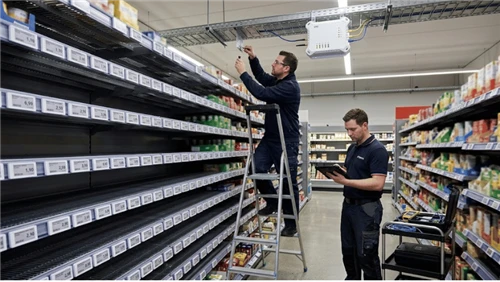
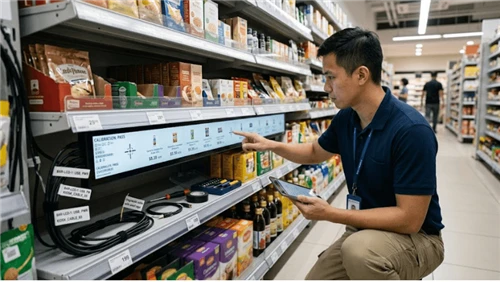
Electronic shelf labels are battery-powered digital displays mounted at the shelf edge to replace paper price tags. When a price changes in your POS or inventory system, it pushes wirelessly to each label - typically via 2.4GHz radio frequency, Bluetooth Low Energy, or sub-GHz protocols. If you want to understand how the update cycle actually works at the infrastructure level, that matters more than most vendor overviews suggest - update speed, gateway density, and batch processing limits all vary significantly.
Most modern ESLs use e-paper displays, which consume power only when the image changes, not to maintain it. This is why batteries typically last five to ten years. LCD-based alternatives require continuous power and need replacement far more frequently. Choosing between them involves trade-offs in cost, readability, and maintenance that are worth understanding before you evaluate vendors - the comparison between e-paper and LCD shelf label technology has direct implications for total cost of ownership.
Where Electronic Shelf Labels Genuinely Deliver
Labor savings - proportional to how often your prices change
The strongest financial argument for ESLs rests on a single variable: price change frequency. In a typical grocery environment, staff may spend ten or more hours per week printing, cutting, and physically replacing paper labels - substantially more during weekly promotional resets or supplier price changes. ESLs eliminate that cycle. A price approved in the central system propagates to every label in one store or fifty simultaneously.
Walmart's rollout is the most visible current evidence of this logic. An electronics team leader at a Walmart store told CNBC the digital labels freed up roughly three-quarters of the hours she previously spent on price updates - which aligns with what retailers in high-frequency pricing environments consistently report.
The constraint is proportionality. A specialty store changing prices twice a month will see a fraction of that return. Labor savings scale with how much labeling labor you currently have to save.
Pricing accuracy with legal stakes
Pricing discrepancies between the shelf and the register are a recurring compliance problem. Approximately twenty US states have retail pricing statutes that require stores to honor the shelf price when it is lower than what scans at checkout - and some impose per-item fines for scanner errors. Understanding what happens when price displays are wrong is not just an operational question; it is a legal one in many markets.
ESLs connected to the same database as your POS system keep shelf and register prices synchronized in real time. The FTC has explicitly cited electronic shelf tags connected to the checkout database as a practical tool for improving pricing compliance. That legal dimension is rarely the headline benefit in vendor presentations, but for pharmacies and food retailers in particular, it is one of the most concrete arguments for the investment.
Dynamic pricing becomes operationally feasible
Paper labels make real-time price responsiveness nearly impossible at scale. Marking down bakery items at 6 PM to reduce waste, reflecting a supplier cost change the same day it arrives, or matching a competitor's weekend promotion within hours - none of these are practical with manual processes at volume. ESLs make them all operationally feasible.
That said, capability and customer acceptance are different things. We address the consumer trust dimension in the cons section. Before deciding how aggressively to use dynamic pricing, understanding how dynamic pricing interacts with ESL systems - technically and strategically - is worth doing before deployment, not after.
Genuine sustainability gains
A mid-sized supermarket may print and discard tens of thousands of paper price tags annually. ESLs eliminate that waste stream. E-paper technology also consumes minimal ongoing power - the display reflects ambient light rather than generating it, drawing energy only during updates. Unlike some ESL selling points, this benefit holds regardless of store size or price change volume. It is one of the straightforwardly true ones.

What Vendors Tend to Underemphasize
The full cost picture looks different from the per-label quote
A per-label price quoted in isolation significantly understates the actual investment. A realistic picture for a mid-sized store deploying approximately 1,000 labels:
- Labels at $7–$15 each: $7,000 to $15,000
- Gateway access points (3–5 units at $300–$500 each): $900 to $2,500
- Management software: $500 to $5,000+ annually or one-time, depending on vendor model
- IT integration and installation: $1,000 to $8,000+, depending on system compatibility
- Staff training: $500 to $2,000
The total lands between $10,000 and $32,500 before any return. A detailed breakdown of ESL deployment costs across store sizes is more useful than a unit price. Real-world cost reports from deployed retailers also reveal ongoing expenses - software subscriptions, battery replacement cycles, hardware attrition - that initial proposals routinely exclude.
Integration is where most difficult rollouts begin
The distance between "ESL working in a vendor demo" and "ESL working correctly with your existing systems" is where most painful implementations originate. Common failure patterns include promotional pricing rules that don't translate cleanly from your POS to the label management software, update queues that back up during large batch changes, and inventory stock status that doesn't propagate reliably.
Retailers with older or heavily customized POS systems face the highest risk. "Plug-and-play" is frequently an optimistic characterization once a vendor's API documentation encounters your actual infrastructure. Before signing a contract, ask for a documented integration record against your specific POS version - not a general compatibility claim. If your labels stop updating after deployment, these are the most common causes. The choice of wireless protocol - Bluetooth, Wi-Fi, or sub-GHz - also affects update reliability and infrastructure requirements in ways that are not always transparent in presales conversations.
One server failure is not one bad label
Paper labels have an underappreciated advantage: they fail individually. If a single paper tag is wrong, one product has a problem. If an ESL management server crashes or a software update corrupts the update queue, every label in the store can show incorrect or frozen information simultaneously. For retailers operating in states with scanner accuracy laws, that scenario is both a customer experience failure and a potential compliance event. Mitigation requires a clearly defined vendor support SLA, documented recovery protocols, and staff procedures for manual price verification - established before go-live, not during an incident.
Dynamic pricing carries a consumer trust problem
In February 2024, Wendy's CEO mentioned on an earnings call that the chain was investing in digital menu boards to enable dynamic pricing. Within days, a boycott hashtag was trending, Burger King had launched a competitive promotion in response, and Wendy's was issuing clarifications that the remarks had been misunderstood. The episode became a documented case study in how consumer perception of dynamic pricing diverges from the underlying business logic - even when the intent is more modest than the coverage suggested.
ESLs in grocery retail face the same gap. The technology enables real-time price changes; consumer acceptance of visible price changes on physical shelf labels in everyday retail is a separate and more fraught question. Legislative scrutiny is also real: a bill introduced in the US House would prohibit digital shelf labels over concerns that the technology creates infrastructure for practices that could develop over time, regardless of current intent. Using ESLs for dynamic pricing without a transparent consumer communication strategy is a reputational risk that does not appear in the labor savings calculation.
Does the Investment Make Financial Sense for Your Store?
Rather than accepting a vendor's projected payback period, calculate your own. Estimate how many hours per week your team spends on manual price changes, multiply by the fully loaded hourly cost, then multiply by 52. That is your annual labeling labor cost - the primary savings opportunity. Divide your total upfront investment by that number (adjusted for a realistic 50–75% reduction in labeling labor, depending on price change volume) and you have an approximate payback period.
A grocery store executing 200 price changes weekly might spend $12,000–$18,000 per year on labeling labor. An ESL system costing $22,000 upfront could realistically recover that within two years. A specialty retailer with 400 SKUs changing prices monthly might spend $900 on labeling labor annually - the same $22,000 investment could take twenty years to recover, if it ever does. Working through this with your store's actual numbers before requesting a vendor quote separates the genuine business case from the optimistic one.
Which Retailers Benefit Most?
For retail ESL deployment, the business case varies considerably by format:
- Large grocery and supermarket: Strong case. High SKU count, frequent price changes, and meaningful labeling labor costs create the right conditions.
- Pharmacy and drug store: Strong case. Regulatory pricing accuracy requirements add a compliance dimension that strengthens the argument beyond pure labor savings.
- Home improvement and DIY: Reasonable case. Large SKU counts and seasonal pricing cycles support the investment at sufficient scale.
- Fashion and apparel: Moderate case. Seasonal markdown management is the primary benefit; otherwise price change frequency is limited.
- Electronics retail: Moderate case. High-value items help justify per-label cost; change frequency is middling.
- Small convenience stores and specialty boutiques: Weak case. Infrastructure costs are largely fixed regardless of store size, while the labor savings that drive ROI do not scale down proportionally.
The Verdict
Electronic shelf labels are a well-supported investment for retailers with large SKU counts, high price change frequency, and systems capable of clean integration. The labor savings are real, the pricing accuracy benefit has regulatory backing, and the sustainability gains are genuine.
For smaller stores, infrequent price changers, or operations where POS integration would require significant custom development, the case is genuinely difficult - and the retailers who regret ESL purchases typically bought on the strength of a vendor's generic ROI projection rather than their own labeling labor math.
The most productive first step is not a demo. It is calculating your current annual labeling labor cost. If that number justifies serious interest, the next conversation is a frank integration assessment with your actual systems on the table.
Frequently Asked Questions
What are the main disadvantages of electronic shelf labels?
The three most significant are high upfront capital cost (typically $10,000–$32,000+ for a mid-sized store), integration complexity with existing POS and inventory systems, and the risk of system-wide pricing failures when management software encounters errors. For smaller stores with infrequent price changes, the ROI math is also genuinely difficult to make work.
How long do electronic shelf label batteries last?
E-paper ESL batteries typically last five to ten years, with the range determined primarily by how often the display updates. Stores with multiple daily price changes will see batteries deplete faster than stores updating weekly. LCD-based ESLs require continuous power and need replacement every one to two years - a significant difference in total cost of ownership that is worth examining before choosing a system.
Are electronic shelf labels worth it for small businesses?
For most small specialty retailers with fewer than 500 SKUs and infrequent price changes, the financial case is hard to make. Gateway hardware, software, and installation costs are largely fixed regardless of store size, while the labor savings that drive ROI scale directly with SKU count and price change frequency. Small businesses that adopt ESLs typically do so for reasons beyond labor savings - competitive positioning, sustainability goals, or future-proofing - which can be valid reasons, but should be evaluated honestly rather than framed as cost recovery arguments they may not support.
What should I ask an ESL vendor before signing a contract?
Ask for documented integration experience with your specific POS system and version - not a general API compatibility claim. Ask what happens operationally when the management server is unavailable, what the SLA response time is for critical failures, and what the five-year total cost of ownership looks like including software fees, battery replacement, and expected hardware attrition. The answers to those four questions tell you more than any reference case study.