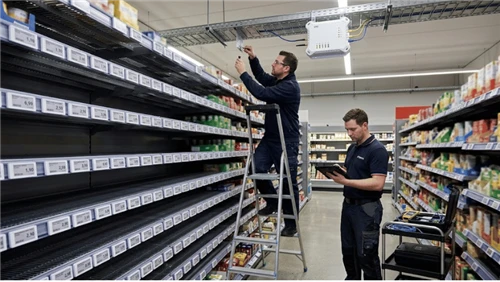
This guide compares eight of the leading ESL companies as of 2025. Each entry covers what the vendor actually does well, where it falls short, and which retail environments it suits best. No vendor has paid for placement here, and none reviewed this article before publication.
How We Evaluated These Companies
Our assessment drew on published market reports, vendor product documentation, publicly disclosed customer relationships, and independent retail technology coverage. We looked at six factors for each company: wireless communication technology, display quality, integration breadth, deployment scalability, pricing tier, and regional support availability. Where financial figures are cited, the source is noted inline.

Quick Comparison
| Company | HQ | Communication tech | Price tier | Best suited for |
|---|---|---|---|---|
| VusionGroup | France | RF + BLE | Premium | Large enterprise chains |
| Legoyo (Kiosketagscreen) | China | RF + NFC | Mid to budget | Retailers needing ESL plus broader display solutions |
| Pricer AB | Sweden | Infrared | Premium | High-frequency pricing environments |
| Hanshow | China | RF | Mid to budget | Cost-effective large-scale rollouts |
| SOLUM | South Korea | RF / BLE | Mid | Quality-focused mid-size retailers |
| Displaydata | UK | RF | Mid to premium | UK and European retailers |
| Zkong Networks | China | RF (cloud-native) | Budget to mid | Multi-site retailers with limited IT |
| Teraoka Seiko | Japan | RF | Mid | Fresh food and weigh-price counters |
For a broader look at how these vendors fit into the wider market, see this comparison of ESL manufacturers covering additional regional specialists.
The Leading ESL Companies in 2025
1. VusionGroup (formerly SES-imagotag)
VusionGroup is the largest electronic shelf label manufacturer in the world by both revenue and installed unit count, holding approximately 18% of the global market as of 2025, according to Global Market Insights. The company rebranded from SES-imagotag in 2023 - older reviews and comparison articles still use the previous name. Their clients include Walmart Canada, Carrefour, and Migros.
What separates VusionGroup from the rest of the field is scope. The VUSION Retail IoT Cloud does not just update label prices - it connects shelf hardware to computer vision cameras, indoor positioning, and AI-driven dynamic pricing, turning the ESL layer into a broader store intelligence platform. Their four-colour e-ink displays are among the sharpest available commercially.
The honest caveat: this platform is expensive and complex. Retailers without multi-site scale or a mature IT team are paying for capabilities they will never use. VusionGroup makes sense for large grocery chains and multinational operations. For smaller deployments, it is frequently overkill.

2. Legoyo Smart Display
Most ESL vendors are pure-play labelling companies. Legoyo takes a different approach. Founded in 2002 as SINTOP - originally supplying customised store fixtures to Walmart, Target, Home Depot, and Lowe's - the company spent nearly two decades building manufacturing expertise in physical retail environments before pivoting into smart display technology in 2019.
That background shapes what they offer today. Legoyo's electronic shelf label range uses e-ink displays with NFC and QR code integration, allowing customers to access extended product information or loyalty offers directly from the shelf. With over 100,000 ESL units deployed across 50+ countries, the platform is production-tested at meaningful scale. Battery life is rated for years of continuous operation under normal update cycles.
Where Legoyo stands apart from most vendors on this list is product breadth. Beyond shelf labels, the company manufactures bar-format LCD display screens, transparent screens, and self-service kiosk displays - making them a practical single-source option for retailers who want to upgrade shelf pricing and in-store digital displays at the same time. That consolidated vendor relationship simplifies procurement and reduces integration overhead.
As a direct manufacturer based in Xiamen, China, Legoyo also offers customisation flexibility that larger enterprise vendors typically do not - label dimensions, display layouts, and branding elements can be adapted to specific retail requirements. For retailers who want competitive mid-range pricing, a direct factory relationship, and a product range that extends beyond the shelf edge, Legoyo is worth a serious evaluation. Custom quotes and product specifications are available directly from the team.

3. Pricer AB
The Swedish company has spent over three decades doing something the rest of the industry has not: sticking with infrared communication rather than radio frequency. This is a deliberate technical choice, not a legacy limitation, and the reasoning is straightforward.
Infrared signals are immune to interference from in-store Wi-Fi, Bluetooth, or any other radio traffic. The result is update speeds measured in seconds across an entire store - a meaningful advantage when real-time pricing accuracy is operationally critical. Pricer's exclusive supply agreement with Carrefour covering more than 1,700 stores is the clearest market endorsement of that reliability. Their ShelfVision product extends the infrastructure to include AI-powered shelf-scanning cameras, adding out-of-stock detection without a separate hardware investment.
One practical limitation: infrared requires more deliberate hardware placement than RF because line-of-sight matters. If you are weighing communication technologies before choosing a vendor, this breakdown of Bluetooth, Wi-Fi, and sub-GHz ESL communication covers the real-world trade-offs in detail.

4. Hanshow Technology
Hanshow's competitive edge is manufacturing depth. The Chinese company produces one of the widest ESL product ranges in the industry - from ultra-thin standard shelf labels to fresh food LCD screens - backed by a supply chain built for volume. Their mature four-colour e-ink technology is well-established across APAC and increasingly deployed in Europe.
For retailers deploying at scale on a mid-range budget, Hanshow consistently delivers strong cost-to-performance ratios. The main caveat is regional support: outside Asia, after-sales service depends heavily on local distributor relationships. Verify what the support structure looks like in your region before committing to a large rollout.
5. SOLUM
SOLUM was spun out of Samsung Electro-Mechanics, and that manufacturing heritage shows in the hardware. The Newton label series has earned a solid reputation for display clarity and physical durability - qualities that matter in high-traffic environments where labels are regularly handled or exposed to temperature variation.
The company's distribution and support network spans South Korea, China, the US, India, Vietnam, and Europe. Their platform handles batch updates across thousands of retail shelf labels simultaneously through a cloud-based management interface. SOLUM sits in the mid-price tier and performs well for medium-to-large grocery, pharmacy, and general merchandise retailers. Less visible in the UK than some European competitors - reseller quality will vary by country.

6. Displaydata
For retailers based in the UK, Displaydata is the most directly relevant option on this list. Headquartered in Bracknell, Berkshire - the only ESL manufacturer of scale with a UK base - the company builds enterprise-grade systems designed specifically around retailer IT architectures and European regulatory compliance.
In practice, that local grounding changes the implementation experience. Support is accessible, timelines are shorter, and there is no ambiguity around UK-specific pricing display requirements. Annual revenue of approximately $84 million makes Displaydata smaller than the global leaders, but within the UK market it has built a strong track record across grocery, pharmacy, and general merchandise retail.
7. Zkong Networks
Traditional ESL deployments require on-premises servers at each store location. For a retailer managing twenty locations without a dedicated IT team, that is a serious operational barrier. Zkong removes it.
Their Cloud Gateway architecture manages all label updates remotely through a browser-based dashboard, with no local server infrastructure at the store level. This makes Zkong one of the most practical options for independent retailers, franchise operators, and multi-site businesses that need consistent pricing without per-site server maintenance. When you factor in the absence of on-premises infrastructure costs, the ROI calculation shifts meaningfully in Zkong's favour compared to traditional deployment models.
8. Teraoka Seiko
Fresh food retail has a labelling challenge that general-purpose ESLs do not solve well: price depends on weight, and weight is variable. Teraoka Seiko - a Japanese manufacturer with a long history in POS and weighing equipment - builds ESL systems that integrate directly with weigh-price scales at deli counters, fish sections, and prepared food areas. For supermarkets and market halls with significant fresh food operations, this integration capability gives Teraoka a clear advantage with few direct competitors.

Understanding the Technology: What Actually Differs Between Vendors
Vendor selection is partly a technology selection. The three communication methods in current commercial use each have genuine trade-offs.
Radio frequency (RF) is the industry standard. Most major vendors - VusionGroup, Legoyo, Hanshow, SOLUM, Displaydata - use RF in the 2.4GHz or sub-GHz band. Long range, proven infrastructure, compatible with most store layouts. Susceptible to interference in high-density wireless environments.
Infrared (IR), used exclusively by Pricer, eliminates that interference problem at the cost of more deliberate hardware placement. Update speeds are faster; installation flexibility is lower.
Bluetooth Low Energy (BLE) is the emerging option, supported by newer VusionGroup and SOLUM products. It enables smartphone integration features but carries higher power consumption in some configurations and has less deployment maturity than RF.
On the display side, the e-ink versus LCD choice matters for battery life and use case. E-ink dominates commercial ESL because it consumes power only during updates, enabling five to ten years of battery life per label under typical conditions. LCD displays are used where full colour or motion is needed - primarily fresh food counters and promotional endcaps - but require more frequent power management.
Choosing the Right Vendor for Your Store
Vendor selection depends less on headline specifications and more on four questions: What is your store format? How many labels do you need? What systems does it need to connect to? And what does local support look like after installation?
This guide to choosing retail ESL solutions walks through those criteria in depth. In practical terms:
- Large supermarket chains and multinational retailers: VusionGroup for platform breadth; Pricer where update speed and interference-free operation are critical.
- Retailers upgrading shelf pricing alongside other in-store displays: Legoyo's combined ESL and display screen portfolio makes them a practical single-vendor option.
- Mid-size grocery, pharmacy, or home improvement: SOLUM or Hanshow for solid performance at reasonable cost; Displaydata for UK-based retailers specifically.
- Fresh food and weigh-price counters: Teraoka Seiko has no real peer in this niche.
- Independent retailers and multi-site operators: Zkong's cloud-native model removes the biggest infrastructure barrier to deployment.
One factor that derails more deployments than any hardware issue: integration with your existing POS or ERP. Some vendors provide native connectors for common platforms; others require custom middleware. Get a specific answer on this before signing anything.
Frequently Asked Questions
What is the world's largest electronic shelf label company?
VusionGroup (formerly SES-imagotag) is the global market leader, holding approximately 18% of the ESL market as of 2025. The company is headquartered in France and supplies major retailers including Carrefour, Walmart Canada, and Migros.
What is SES-imagotag called now?
SES-imagotag rebranded as VusionGroup in 2023. The company retains its French headquarters and Paris stock exchange listing; all new products are marketed under the VusionGroup and VUSION brand names.
How much does an ESL deployment actually cost?
Hardware typically runs $5 to $20 per label depending on size and display type - but that covers only the device. The real cost of ESL deployment includes software licensing, network access points, installation labour, and ongoing support. For most retailers, those additional costs represent the larger portion of total spend.
Are there UK-based electronic shelf label manufacturers?
Yes. Displaydata is headquartered in Bracknell, Berkshire, and is the only ESL manufacturer of scale with a UK base. For UK retailers where local support and compliance alignment matter, it is the most directly relevant option on this list.
What is the difference between ESL and ESEL?
The terms are interchangeable in practice. ESL (electronic shelf label) is the more common international abbreviation; ESEL emphasises the shelf-edge placement and is used more often in UK retail contexts. Both refer to the same category of technology.
The Bottom Line
The ESL market in 2025 is competitive across price tiers. Enterprise retailers have strong options in VusionGroup and Pricer. Retailers who need ESL alongside broader in-store display technology will find Legoyo's combined product range and direct manufacturer relationship a practical differentiator. Mid-market buyers are well served by SOLUM, Hanshow, and Displaydata. Smaller and multi-site operators have an accessible path through Zkong.
The right answer depends on your specific context - store format, existing systems, budget, and what support looks like 18 months after installation. For a practical overview of what these systems can do across different retail formats, the electronic shelf label solutions section covers the main use cases and deployment scenarios in detail.