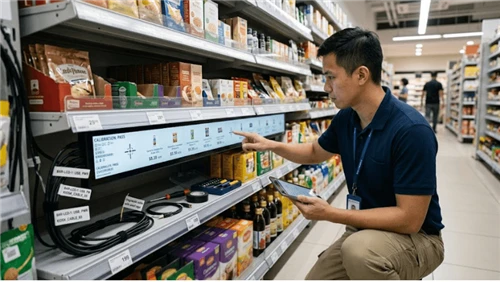
This is a narrow engineering topic with an outsized effect on field reliability because several teams own different pieces of the same result. Define what the display, product lighting, fans, player, and service workflow should do when a showcase door opens-and how the system returns to a known state afterward. This guide is written for Showcase designers, retail integrators, facilities teams, and transparent-display buyers. Its practical question is straightforward: How should a transparent LCD showcase respond to door-open events during customer use, restocking, and service? The answer is not a universal number or a one-line product claim. It is a controlled method that defines the operating condition, the configuration being approved, the evidence required for acceptance, and the conditions that force a retest.
A transparent LCD showcase is an optical and mechanical system: the physical product, interior lighting, transparent panel, glass, enclosure, player, content, and customer viewing zone all affect the result. A change behind the screen can be as important as a change to the screen itself. For that reason, this article treats transparent LCD door interlock as a system decision. Exact limits-such as electrical ratings, optical tolerances, mechanical loads, environmental severities, safety limits, communication timing, or maintenance intervals-must come from the exact production model, applicable standards, and the buyer's approved project requirements. Where those sources do not establish a universal value, this guide deliberately does not invent one.

Before freezing the specification, keep the topic connected to the wider LEGOYO content architecture. Useful starting points are Transparent LCD Screen, Transparent LCD Touch Integration, Transparent LCD Content Design. Those pages establish the product and adjacent-system boundary; this article owns the narrower problem described above rather than repeating their broader material.
For content-gap research, the planning review compared how Crystal Display Systems Transparent LCD, Japan Display Inc. Transparent Display, Pro Display Transparent LCD present the broader product category. Those commercial sources informed topic differentiation only; the final article does not use competitor marketing claims as project facts or link readers to competing commercial pages.
Failure modes to design for before rollout
The following failures are intentionally more specific than "device not working." They represent plausible ways a transparent LCD door interlock project can be technically connected but operationally wrong. Use them as FMEA inputs, pilot scenarios, and support-ticket categories; do not treat the table as a claim that every product will experience every condition.
| Failure mode | Detection principle | Required response |
|---|---|---|
| The door sensor bounces and repeatedly pauses/resumes playback | Make the condition observable and preserve context. | Assign correction, owner, and targeted retest. |
| Content resumes at an arbitrary point and loses the intended product narrative after restocking | Make the condition observable and preserve context. | Assign correction, owner, and targeted retest. |
| Lighting stays in a service state after the door is closed | Make the condition observable and preserve context. | Assign correction, owner, and targeted retest. |
| A misaligned door magnet/switch reports closed even when the door is not fully seated | Make the condition observable and preserve context. | Assign correction, owner, and targeted retest. |
| An open-door condition masks a separate thermal or player fault | Make the condition observable and preserve context. | Assign correction, owner, and targeted retest. |
| Staff bypass the sensor because the normal workflow is inconvenient, eliminating the intended control | Make the condition observable and preserve context. | Assign correction, owner, and targeted retest. |
A useful failure response protects the next transaction or store task, exposes the condition to the correct owner, and preserves enough evidence to diagnose it. "Reboot until it works" may temporarily restore service but destroys information about cause and can hide systematic faults. Where reboot or reset is an approved recovery action, log why it was used and whether the fault returned.
Separate symptom, cause, and consequence
For transparent LCD door interlock, a visible symptom can have causes in hardware, installation, software, data, content, environment, or service. The incident record should therefore capture the symptom seen by the user, the system state at that moment, recent changes, the diagnostic finding, and the final corrective action. This makes recurring "random" failures comparable across sites instead of producing isolated anecdotes.
Define the decision boundary before choosing a fix
The first deliverable should be a one-page decision boundary for transparent LCD door interlock. It should identify the exact site/use case, the production hardware and software revision, who operates the feature, what failure looks like to that user, and what evidence is required before the design can be accepted. This avoids a common B2B procurement failure: comparing attractive component features before agreeing what the installed transparent showcase must actually do.
For this topic, explicitly include door sensor and mechanical actuation, normal customer-facing closed state, restock/service open state, content pause/blank/continue decision. Then add interior lighting response, fan or other enclosure-system dependencies, open-too-long alert policy, close-event debounce and state restoration. These are not independent checklist items. A change to one can invalidate the others. The project record should therefore tie each condition to an owner and a retest trigger.
Minimum scope record
- Exact production model, revision, accessory/fixture configuration, and software/firmware versions relevant to transparent LCD door interlock
- Defined users and normal workflow, including who handles exceptions and service
- Site/environment assumptions that can change the result
- Interfaces to adjacent systems, devices, content, power, network, fixtures, or data sources
- Acceptance method and evidence owner for every critical requirement
- Change triggers that require comparison with the approved baseline or a formal retest
The scope should also say what this article does not own. The site has power-off and service-access content, but door-state orchestration is a separate operational event with repeated daily transitions. Keeping that boundary explicit reduces cannibalization in the content strategy and, more importantly, prevents engineering teams from using one test as evidence for a different risk.
Map the installed system and its interfaces
Draw the path from trigger or source through the hardware/software stack to the result a user can observe. For transparent LCD door interlock, the drawing should be specific enough that a technician can point to where a fault could be introduced and where it can be measured. Avoid a marketing architecture with only cloud, device, and user icons; the useful drawing includes the interfaces that can create ambiguous ownership.
A practical interface map for this project includes the following control points. The evidence column is deliberately generic because the exact tool depends on the production design; the important requirement is that the team chooses a repeatable method before acceptance.
| Control point | What must be defined | Useful evidence |
|---|---|---|
| Door sensor and mechanical actuation | Define the production condition and its owner. | Record observable state, configuration, and exception evidence. |
| Normal customer-facing closed state | Define the production condition and its owner. | Record observable state, configuration, and exception evidence. |
| Restock/service open state | Define the production condition and its owner. | Record observable state, configuration, and exception evidence. |
| Content pause/blank/continue decision | Define the production condition and its owner. | Record observable state, configuration, and exception evidence. |
| Interior lighting response | Define the production condition and its owner. | Record observable state, configuration, and exception evidence. |
| Fan or other enclosure-system dependencies | Define the production condition and its owner. | Record observable state, configuration, and exception evidence. |
| Open-too-long alert policy | Define the production condition and its owner. | Record observable state, configuration, and exception evidence. |
| Close-event debounce and state restoration | Define the production condition and its owner. | Record observable state, configuration, and exception evidence. |
Once the map exists, assign a named owner to every boundary: OEM hardware, fixture/mechanical design, electrical integration, platform/software, store operations, service, and procurement acceptance as applicable. Many costly field faults persist because each team can prove its own component is working while nobody owns the end-to-end outcome.
Configuration identity matters
Always record the configuration that produced a pass. At minimum, capture the hardware revision, connected accessories, relevant cable/fixture version, firmware and software, settings that affect the behavior, and site condition. If a supplier substitutes a part or the field team changes a route, bracket, controller, player, driver, template, or setting, the project should be able to tell whether the original evidence still applies.
Design controls worth specifying explicitly
A strong specification for transparent LCD door interlock should convert the following topics from assumptions into controlled requirements. Each control needs a normal state, an exception state, evidence, and a change trigger.
Door sensor and mechanical actuation
Treat door sensor and mechanical actuation as an interface, not a label in a drawing. State what establishes the approved condition, what downstream behavior depends on it, and how a technician can verify it on production-equivalent equipment. Then test its interaction with normal customer-facing closed state because that neighboring condition can change the result without producing an obvious hardware alarm.
For procurement, ask for the model-specific boundary and supporting documentation. For commissioning, add local evidence. A supplier document can establish what a product was designed to support; it cannot prove that the buyer's exact fixture, data, software, environment, content, and operating workflow have been integrated correctly.
Normal customer-facing closed state
Treat normal customer-facing closed state as an interface, not a label in a drawing. State what establishes the approved condition, what downstream behavior depends on it, and how a technician can verify it on production-equivalent equipment. Then test its interaction with restock/service open state because that neighboring condition can change the result without producing an obvious hardware alarm.
For operations, make abnormal state visible. A resilient design should not require store staff to infer whether a system is healthy from customer complaints. Provide a diagnostic state or record that distinguishes configuration error, unavailable dependency, service condition, and a genuine component fault wherever the technology allows it.
Restock/service open state
Treat restock/service open state as an interface, not a label in a drawing. State what establishes the approved condition, what downstream behavior depends on it, and how a technician can verify it on production-equivalent equipment. Then test its interaction with content pause/blank/continue decision because that neighboring condition can change the result without producing an obvious hardware alarm.
For procurement, ask for the model-specific boundary and supporting documentation. For commissioning, add local evidence. A supplier document can establish what a product was designed to support; it cannot prove that the buyer's exact fixture, data, software, environment, content, and operating workflow have been integrated correctly.
Content pause/blank/continue decision
Treat content pause/blank/continue decision as an interface, not a label in a drawing. State what establishes the approved condition, what downstream behavior depends on it, and how a technician can verify it on production-equivalent equipment. Then test its interaction with interior lighting response because that neighboring condition can change the result without producing an obvious hardware alarm.
For operations, make abnormal state visible. A resilient design should not require store staff to infer whether a system is healthy from customer complaints. Provide a diagnostic state or record that distinguishes configuration error, unavailable dependency, service condition, and a genuine component fault wherever the technology allows it.
Interior lighting response
Treat interior lighting response as an interface, not a label in a drawing. State what establishes the approved condition, what downstream behavior depends on it, and how a technician can verify it on production-equivalent equipment. Then test its interaction with fan or other enclosure-system dependencies because that neighboring condition can change the result without producing an obvious hardware alarm.
For procurement, ask for the model-specific boundary and supporting documentation. For commissioning, add local evidence. A supplier document can establish what a product was designed to support; it cannot prove that the buyer's exact fixture, data, software, environment, content, and operating workflow have been integrated correctly.

Fan or other enclosure-system dependencies
Treat fan or other enclosure-system dependencies as an interface, not a label in a drawing. State what establishes the approved condition, what downstream behavior depends on it, and how a technician can verify it on production-equivalent equipment. Then test its interaction with open-too-long alert policy because that neighboring condition can change the result without producing an obvious hardware alarm.
For operations, make abnormal state visible. A resilient design should not require store staff to infer whether a system is healthy from customer complaints. Provide a diagnostic state or record that distinguishes configuration error, unavailable dependency, service condition, and a genuine component fault wherever the technology allows it.
Open-too-long alert policy
Treat open-too-long alert policy as an interface, not a label in a drawing. State what establishes the approved condition, what downstream behavior depends on it, and how a technician can verify it on production-equivalent equipment. Then test its interaction with close-event debounce and state restoration because that neighboring condition can change the result without producing an obvious hardware alarm.
For procurement, ask for the model-specific boundary and supporting documentation. For commissioning, add local evidence. A supplier document can establish what a product was designed to support; it cannot prove that the buyer's exact fixture, data, software, environment, content, and operating workflow have been integrated correctly.
Close-event debounce and state restoration
Treat close-event debounce and state restoration as an interface, not a label in a drawing. State what establishes the approved condition, what downstream behavior depends on it, and how a technician can verify it on production-equivalent equipment. Then test its interaction with door sensor and mechanical actuation because that neighboring condition can change the result without producing an obvious hardware alarm.
For operations, make abnormal state visible. A resilient design should not require store staff to infer whether a system is healthy from customer complaints. Provide a diagnostic state or record that distinguishes configuration error, unavailable dependency, service condition, and a genuine component fault wherever the technology allows it.
Build an acceptance test that represents the field
Acceptance testing should prove the workflow described by How should a transparent LCD showcase respond to door-open events during customer use, restocking, and service? Start with a known-good production configuration, capture the baseline, then introduce one controlled variation or failure at a time. Do not approve the project solely because the normal demo path works once.
| Step | Test activity | Evidence to retain |
|---|---|---|
| 1 | Cycle the production door slowly, quickly, and to partial-latch positions while logging sensor and application state | Configuration, expected result, actual result, evidence, owner, disposition |
| 2 | Define and verify the exact media behavior for short customer/service openings and extended maintenance openings | Configuration, expected result, actual result, evidence, owner, disposition |
| 3 | Test power interruption while the door is open and confirm the restart state is deterministic | Configuration, expected result, actual result, evidence, owner, disposition |
| 4 | Introduce sensor disconnect/stuck-open/stuck-closed faults where safe and verify they are observable | Configuration, expected result, actual result, evidence, owner, disposition |
| 5 | Repeat after hinge, latch, gasket, or sensor service that can change actuation geometry | Configuration, expected result, actual result, evidence, owner, disposition |
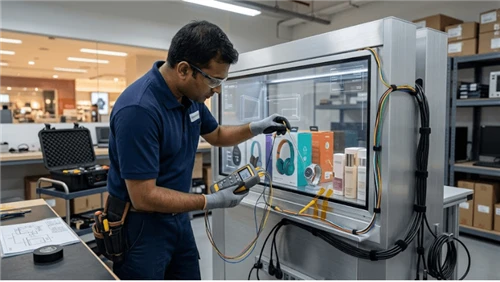
| 6 | Run a realistic restocking task to confirm the interlock supports operations rather than forcing workarounds | Configuration, expected result, actual result, evidence, owner, disposition |
Factory, site, and pilot tests do different jobs
Factory acceptance is useful for repeatable configuration checks, controlled fault injection, assembly review, and supplier evidence. Site acceptance exposes real mounting, power, lighting, RF, network, store fixtures, access, cleaning, and operator conditions. A pilot adds time: shift changes, replenishment, maintenance, content or data changes, peak periods, replacement parts, and real exception ownership. Reuse the same requirement IDs across all three stages so evidence remains traceable.
Do not average away a serious failure
A high overall pass percentage can hide an unacceptable edge case. Classify requirements by consequence before testing. A rare defect that can misidentify a product, interrupt a transaction, strand a customer document, create an electrical/EMC problem, or silently desynchronize operations may justify a stronger control than a more frequent cosmetic defect. The project should decide that priority before test results are known.
Retest the neighbors after a fix
When a defect is corrected, rerun the failed case and the neighboring cases the change could affect. A new bracket can change RF; a new seal can change temperature; a new driver can change enumeration; a new template can change scan layout; a new timing rule can change recovery. Closing only the original symptom is not sufficient when the fix crosses an interface.
Operations and change control after handover
A passing installation can drift. For transparent LCD door interlock, the handover package should include the approved configuration, relevant drawings, test records, known failure symptoms, recovery actions, service access instructions, and a clear list of changes that require renewed verification. Store layout changes, replacement parts, firmware/software updates, cleaning processes, cabling changes, and local configuration edits are common sources of drift.
Metrics worth trending
- door-sensor faults
- extended-open events
- interlock bypass findings
- service actions followed by state errors
- content/lighting recovery failures after door close
Trend exceptions by site, hardware/software revision, fixture family, service action, and time. The purpose is not to create a dashboard for its own sake; it is to detect patterns that a single help-desk ticket cannot show. If a particular replacement part, store fixture, or software release appears repeatedly, the issue can be moved from reactive support into change control.
Adjacent LEGOYO guidance that can help maintain the wider system boundary includes Clear LCD vs Traditional Display, Products, Solutions, Supermarket Solutions. Use those pages for neighboring decisions rather than expanding this article until it competes with them.
Retest triggers to place in the handover
- Hardware or accessory revision changes the approved assembly
- Firmware, operating system, driver, CMS, application, API, or template change can affect the tested behavior
- Fixture, mounting, lighting, power, network, RF, cleaning, airflow, or service condition changes
- A substitute component is introduced because the original reaches end of life
- A recurring field failure challenges an assumption used during initial acceptance
Procurement questions that expose hidden scope
For transparent LCD door interlock, a useful RFQ asks the supplier to state the exact configuration and evidence boundary. Avoid yes/no questions such as "supported?" when the real issue is how the function behaves in the buyer's installed system.
- What door-sensing hardware and mounting tolerance are included in the showcase design?
- Which outputs are controlled by door state: player, backlight/lighting, fans, alarms, or only application logic?
- Can open duration and sensor state be logged or monitored remotely?
- What is the expected system state if the sensor is missing or contradictory?
- How is sensor alignment checked after door or hinge service?
- Can the buyer define different behavior for staff service mode and normal operation?
Ask the supplier to mark each response as standard, optional, integrator-supplied, buyer-supplied, or project-specific engineering. Request drawings and documentation that match the quoted revision. If the answer depends on site conditions, the dependency should be written into the quote or technical schedule instead of left as a sales-call assumption.

Normalize quotations before comparing price
Two quotations are not comparable when one includes fixtures, cables, licensed software, commissioning, diagnostic access, spares, and training while another assumes the buyer will provide them. Build a compliance matrix with requirement ID, supplier response, evidence, deviation, owner, and commercial impact. This is especially important for integrated retail hardware because the missing item often appears later as site labor or custom engineering rather than as a visible line in the hardware price.
Decision framework: approve, revise, or stop
| Decision layer | Required artifact | Approval question |
|---|---|---|
| Scope | Use case, site, users, exact configuration | Is the boundary explicit enough to reproduce? |
| Design | Interface map and controlled requirements | Does every critical assumption have an owner? |
| Evidence | Production-equivalent test records | Can another reviewer understand why it passed? |
| Recovery | Detection, degraded state, service action | Can operators recognize and recover from abnormal states? |
| Lifecycle | Baseline, revisions, spares, retest triggers | Can the approved state be maintained after handover? |
For transparent LCD door interlock, the final status should be approve, revise, or stop-not "looks fine." Record residual risks and their owner. If an item cannot be proven before rollout, state the temporary control and the date/event when evidence will be collected. This prevents an unresolved pilot assumption from silently becoming the production standard.
The strongest next step is to give the supplier the site conditions, interface map, intended workflow, and acceptance evidence you expect. If you are evaluating a LEGOYO project, use Request a Quote after those inputs are ready; a more complete requirement set makes configuration review and quotation comparison more useful.
FAQ
Q: Can a supplier data sheet alone prove transparent LCD door interlock is acceptable?
A: No. A data sheet can establish model-specific boundaries, but the project must still verify the installed interactions that matter to the intended workflow. Use supplier documentation as an input to the acceptance plan, not as a substitute for it.
Q: How large should the pilot be?
A: There is no universal device count. Choose a pilot large and varied enough to include the difficult conditions that could change the result: representative fixtures, edge locations, user behaviors, operating states, service actions, and failure recovery. A smaller pilot with deliberately selected risk cases can be more useful than a larger convenience sample.
Q: What should trigger a retest of door sensor and mechanical actuation?
A: Retest when a change can affect the approved condition, including a model or revision substitution, changes to normal customer-facing closed state, restock/service open state, software/firmware, mounting, site environment, or a recurring field failure. The handover record should name these triggers before the project closes.
Q: How should acceptance evidence be stored?
A: Keep the requirement ID, exact configuration, method, expected result, actual result, evidence location, reviewer, defect disposition, and date together. Screenshots or photographs without configuration context are weak evidence; logs without a physical/site reference can be equally ambiguous.
Q: Should every store use the same threshold?
A: Use common definitions and methods where possible, but do not copy a threshold into a different risk or environment without justification. Exact numerical limits should come from applicable standards, model-specific documentation, validated project requirements, or approved pilot evidence-not from an unrelated example.
Final recommendation
Treat transparent LCD door interlock as a controlled project boundary rather than a feature claim. Define the exact production configuration, make failure observable, test the hard conditions deliberately, and carry the approved state into service and change control. That approach is slower than a showroom checkbox at the beginning, but it is far faster than diagnosing an ambiguous fleet problem after rollout.
For product context, return to LEGOYO products or the technical blog. For a project-specific review, prepare your site conditions, interfaces, workflow, and acceptance criteria before using Request a Quote.